
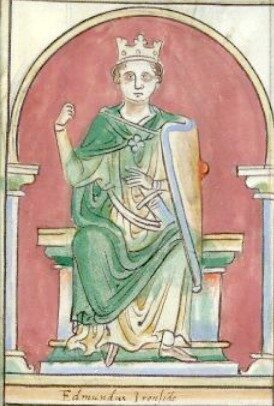
Edmund II of England
Edmund II of England was a King of the English, Wessex dynasty. Born 980, in Kingdom of Wessex. Died November 30, 1016, in Oxford. Positions held include Monarch of England (1016).
Facts
21 facts · 1 confirmed by two sources · 7 cited · 12 from one source · 1 where the sources disagree
What’s different
- Born: we show 980 (Sources disagree). Wikidata also lists 988
Where this comes from
Papalocal keeps its own record. It started from these sources; what each one said is kept here as it was copied, so a change on their side never changes this page by itself. Tap one to read its version.
What Wikidata says · copied November 16, 2026 · revision 2568064411
- Described as
- King of the English, Wessex dynasty
- Other names
- Edmund Ironside, Edmund II
- Born
- 988; 980 · 1 reference
- Died
- November 30, 1016 · 3 references
- Born in
- Kingdom of Wessex
- Died in
- Oxford
- Buried in
- Glastonbury Abbey
- Occupation
- monarch
- Positions held
- Monarch of England (1016)
- Spouse
- Ealdgyth (1015–1016) · 2 references
- Children
- Edward the Exile · 1 reference; Edmund Ætheling · 1 reference
- Father
- Æthelred the Unready · 1 reference
- Mother
- Ælfgifu of York · 1 reference
- Siblings
- Goda of England; Æthelstan Ætheling · 1 reference; Edward the Confessor; Eadwig Ætheling; Alfred Aetheling; Eadred Ætheling; Eadgyth · 1 reference; Wulfhild · 1 reference
- Religion
- Chalcedonian Christianity
- Wikipedias with a page
- 59
Wikidata item Q188684 (wikidata.org/wiki/Q188684), public domain (CC0). Copied November 16, 2026.
What Wikipedia says · copied November 16, 2026 · revision 1375601409
Edmund Ironside (c. 991 – 30 November 1016; Old English: Ēadmund, Old Norse: Játmundr, Latin: Edmundus; sometimes also known as Edmund II) was King of the English from 23 April to 30 November 1016. Edmund's reign was spent fighting against a Danish invasion led by Cnut.
Edmund was born sometime between 990 and 993 to King Æthelred the Unready. Little is known about Edmund's life before 1015; the first concrete evidence of his agency was from the late 1000s and he seems to have been close with his brother Æthelstan. Although Edmund possibly fought alongside his father in the campaigns of 1009 to 1011 and the campaign of 1013, when the royal family was forced to flee to Normandy due to Sweyn Forkbeard's invasion that year, Edmund stayed in England with Æthelstan. Æthelstan died in June 1014 and in his will Edmund was the main beneficiary, receiving the sword of Offa and estates in the Danelaw. Edmund inherited Æthelstan's connections in the Five Boroughs. When his close allies Sigeferth and Morcar were executed with the permission of King Æthelred, he revolted, illegally marrying Sigeferth's widow and occupying the Five Boroughs. Edmund issued two charters, on one of which he called himself king.
Edmund's revolt was suddenly ended by the invasion of Sweyn's son Cnut in the summer of 1015. To contest Cnut's occupation in Wessex, he attempted to raise armies alongside his father and Eadric Streona, Ealdorman of Mercia, but they all collapsed due to mistrust. A third force raised with Uhtred of Bamburgh unravelled as Uhtred submitted to Cnut when the latter threatened Bamburgh. Æthelred died on 23 April 1016 and Edmund soon claimed the throne. He fought in four battles with Cnut at Penselwood, Sherston, Brentford, and possibly Otford, and gained military success. By the time he faced Cnut at the Battle of Assandun, he was backed by the "whole English nation" but Eadric Streona fled, causing a decisive English defeat. After a possible sixth battle, Edmund was forced to partition the kingdom at Alney, with Cnut receiving everything except for Wessex, held by Edmund.
Edmund died on 30 November after ruling for 222 days, allowing Cnut to consolidate the rest of England. Afterwards, Cnut exiled or executed Edmund's family and supporters. The Danish line founded by Cnut would end in 1042 and the House of Wessex was restored temporarily under Edmund's much younger half-brother, Edward the Confessor. Edgar the Ætheling, Edmund's grandson, was a claimant to the English throne for some time. Edmund's reputation was praised in medieval sources, and he is generally seen as a brave and capable king who fought Cnut to a standstill, forcing compromise.
- Born, in its opening lines
- c. 991
- Died, in its opening lines
- November 30, 1016
From the Wikipedia article “Edmund Ironside” (en.wikipedia.org/wiki/Edmund_Ironside), by its contributors, under CC BY-SA 4.0 (creativecommons.org/licenses/by-sa/4.0/). Copied November 16, 2026; not changed.
Confirmed Two sources agree. Cited One source, and it names where it got it. One source One source, without a reference of its own. Sources disagree The sources disagree. We show the best-supported value and keep theirs below.
