
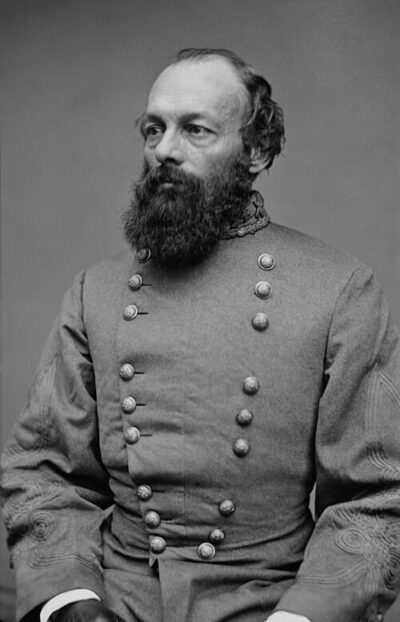
Edmund Kirby Smith
Edmund Kirby Smith was a Confederate States Army general. Born May 16, 1824, in St. Augustine. Died March 28, 1893, in Sewanee. Educated at United States Military Academy and Sewanee: The University of the South.
Facts
25 facts · 2 confirmed by two sources · 7 cited · 16 from one source
Where this comes from
Papalocal keeps its own record. It started from these sources; what each one said is kept here as it was copied, so a change on their side never changes this page by itself. Tap one to read its version.
What Wikidata says · copied November 15, 2026 · revision 2567332765
- Described as
- Confederate States Army general (1824-1893)
- Other names
- E. Kirby Smith, Kirby Smith
- Born
- May 16, 1824 · 3 references
- Died
- March 28, 1893 · 3 references
- Born in
- St. Augustine · 1 reference
- Died in
- Sewanee · 1 reference
- Buried in
- University of the South Cemetery · 1 reference
- Cause of death
- pneumonia
- Citizen of
- United States; Confederate States of America
- Occupation
- army officer; botanist · 1 reference; botanical collector · 3 references; scientific collector · 1 reference
- Worked for
- Atlantic and Pacific Telegraph Company (1866–1868); University of Nashville (1870–1875); Sewanee: The University of the South (1875–1893); United States Military Academy · 1 reference
- Education
- United States Military Academy; Sewanee: The University of the South
- Children
- Joseph Lee Kirby-Smith · 1 reference; Ephraim Kirby-Smith · 1 reference
- Father
- Joseph Lee Smith
- Mother
- Frances Kirby Smith
- Military branch
- United States Army · 1 reference; Provisional Army of the Confederate States (1861–1865) · 1 reference
- Military rank
- general · 2 references
- Wikipedias with a page
- 24
Wikidata item Q551560 (wikidata.org/wiki/Q551560), public domain (CC0). Copied November 15, 2026.
What Wikipedia says · copied November 15, 2026 · revision 1381740611
Edmund Kirby Smith (May 16, 1824 – March 28, 1893) was a Confederate States Army general, who oversaw the Trans-Mississippi Department (comprising Arkansas, Missouri, Texas, western Louisiana, Arizona Territory and the Indian Territory) from 1863 to 1865. Before the American Civil War, Smith served as an officer of the United States Army.
Smith was wounded at the First Battle of Bull Run and distinguished himself during the Heartland Offensive, the Confederacy's unsuccessful attempt to capture Kentucky in 1862. He was appointed as commander of the Trans-Mississippi Department in January 1863. The area included most actions east of the Rocky Mountains and west of the Mississippi River. In 1863, Smith dispatched troops in an unsuccessful attempt to relieve the Siege of Vicksburg. After the United States took control of Vicksburg in July, the Trans-Mississippi Department was cut off from the rest of the Confederacy and became virtually an independent nation, nicknamed "Kirby Smithdom".
In the Red River Campaign of Spring 1864, he commanded victorious Confederate troops under Major-General Richard Taylor, who defeated a combined Union Army and Navy assault under U.S. Major-General Nathaniel P. Banks. On June 2, 1865, Smith surrendered his army at Galveston, Texas, the last general with a major field force.
He quickly fled to Mexico and then to Cuba to avoid arrest for treason. His wife negotiated his return during the period when the U.S. government offered amnesty to those who would take an oath of loyalty to the United States. After the war, Smith worked in the telegraph and railway industries. He also served as a professor of mathematics at the University of the South in Tennessee. He botanized plant specimens and bequeathed his collection to the University of Florida.
- Born, in its opening lines
- May 16, 1824
- Died, in its opening lines
- March 28, 1893
From the Wikipedia article “Edmund Kirby Smith” (en.wikipedia.org/wiki/Edmund_Kirby_Smith), by its contributors, under CC BY-SA 4.0 (creativecommons.org/licenses/by-sa/4.0/). Copied November 15, 2026; not changed.
Confirmed Two sources agree. Cited One source, and it names where it got it. One source One source, without a reference of its own. Sources disagree The sources disagree. We show the best-supported value and keep theirs below.
