
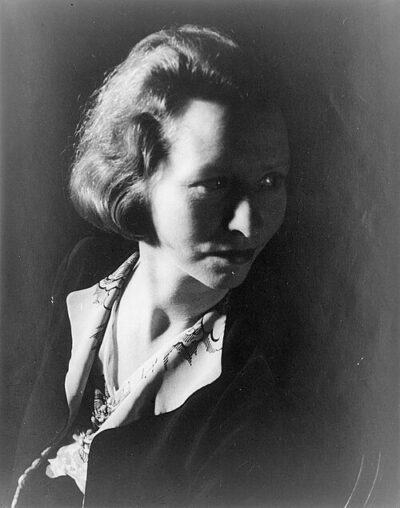
Edna St. Vincent Millay
Edna St. Vincent Millay was an American poet. Born February 22, 1892, in Rockland. Died October 19, 1950, in Austerlitz. Known for Renascence. Educated at Vassar College and Camden Hills Regional High School. Awards include Pulitzer Prize for Poetry, Fellowship of the Academy of American Poets and Robert Frost Medal.
Facts
26 facts · 2 confirmed by two sources · 10 cited · 14 from one source
Where this comes from
Papalocal keeps its own record. It started from these sources; what each one said is kept here as it was copied, so a change on their side never changes this page by itself. Tap one to read its version.
What Wikipedia says · copied November 13, 2026 · revision 1383234653
Edna St. Vincent Millay (February 22, 1892 – October 19, 1950) was an American lyrical poet and playwright. Millay was a renowned social figure and noted feminist in New York City during the Roaring Twenties and beyond. She also wrote prose under the pseudonym Nancy Boyd.
Millay won the 1923 Pulitzer Prize for Poetry for her poem "Ballad of the Harp-Weaver"; she was the first woman and second person to win the award. In 1943, Millay was the sixth person and the second woman to be awarded the Frost Medal for her lifetime contribution to American poetry.
Millay was highly regarded during much of her lifetime, with the prominent literary critic Edmund Wilson calling her "one of the only poets writing in English in our time who have attained to anything like the stature of great literary figures.'' By the 1930s, her critical reputation began to decline, as modernist critics dismissed her work for its use of traditional poetic forms and subject matter, in contrast to modernism's exhortation to "make it new." However, the rise of feminist literary criticism in the 1960s and 1970s revived an interest in Millay's works.
- Born, in its opening lines
- February 22, 1892
- Died, in its opening lines
- October 19, 1950
From the Wikipedia article “Edna St. Vincent Millay” (en.wikipedia.org/wiki/Edna_St._Vincent_Millay), by its contributors, under CC BY-SA 4.0 (creativecommons.org/licenses/by-sa/4.0/). Copied November 13, 2026; not changed.
What Wikidata says · copied November 14, 2026 · revision 2569148007
- Described as
- American poet (1892–1950)
- Other names
- Nancy Boyd
- Born
- February 22, 1892 · 13 references
- Died
- October 19, 1950 · 9 references
- Born in
- Rockland · 1 reference
- Died in
- Austerlitz · 1 reference
- Buried in
- Steepletop Cemetery · 1 reference
- Cause of death
- falling from height
- Citizen of
- United States
- Occupation
- playwright; poet · 1 reference; translator; librettist; writer · 2 references
- Education
- Vassar College; Camden Hills Regional High School
- Member of
- American Academy of Arts and Letters
- Known for
- Renascence
- Awards
- Pulitzer Prize for Poetry (1923) · 1 reference; Fellowship of the Academy of American Poets (1949) · 1 reference; Robert Frost Medal (1943) · 1 reference
- Field
- poetry
- Spouse
- Eugen Boissevain (1923–) · 1 reference
- Father
- Henry Tolman Millay · 1 reference
- Mother
- Cora Buzzell · 1 reference
- Siblings
- Kathleen Millay; Norma Millay
- Lived in
- Maine
- Wikipedias with a page
- 61
Wikidata item Q62134 (wikidata.org/wiki/Q62134), public domain (CC0). Copied November 14, 2026.
Confirmed Two sources agree. Cited One source, and it names where it got it. One source One source, without a reference of its own. Sources disagree The sources disagree. We show the best-supported value and keep theirs below.
