
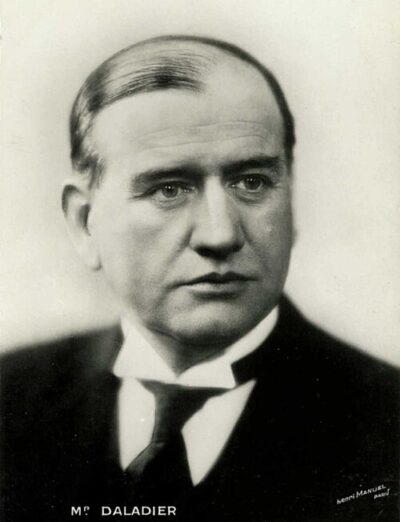
Édouard Daladier
Édouard Daladier was a French politician. Born June 18, 1884, in Carpentras. Died October 10, 1970, in 16th arrondissement of Paris. Positions held include Deputy of the French Third Republic (1919–1942), Mayor of Avignon (1953–1958) and President of the Council (2 times) (1933–1940). Awards include Knight of the Legion of Honour, Croix de guerre 1914–1918 and Grand Cross of the Order of Saint-Charles.
Facts
18 facts · 2 confirmed by two sources · 7 cited · 9 from one source
Where this comes from
Papalocal keeps its own record. It started from these sources; what each one said is kept here as it was copied, so a change on their side never changes this page by itself. Tap one to read its version.
What Wikidata says · copied November 16, 2026 · revision 2560313540
- Described as
- French politician (1884-1970)
- Other names
- Edouard Daladier
- Born
- June 18, 1884 · 15 references
- Died
- October 10, 1970 · 16 references
- Born in
- Carpentras · 3 references
- Died in
- 16th arrondissement of Paris · 2 references
- Buried in
- Grave of Édouard Daladier
- Citizen of
- France
- Occupation
- politician · 2 references
- Positions held
- Deputy of the French Third Republic (1919–1942) · 1 reference; Mayor of Avignon (1953–1958); President of the Council (2 times) (1933–1940); Representative of the Parliamentary Assembly of the Council of Europe (1951–1955) · 1 reference
- Political party
- Radical Party; Radical-Socialist and Radical Republican Party
- Member of
- Parliamentary Assembly of the Council of Europe
- Awards
- Knight of the Legion of Honour (1928) · 1 reference; Croix de guerre 1914–1918; Grand Cross of the Order of Saint-Charles (1939) · 1 reference
- Spouse
- Madeleine Laffont · 1 reference
- Wikipedias with a page
- 66
Wikidata item Q213526 (wikidata.org/wiki/Q213526), public domain (CC0). Copied November 16, 2026.
What Wikipedia says · copied November 16, 2026 · revision 1368332914
Édouard Daladier (French: [edwaʁ daladje]; 18 June 1884 – 10 October 1970) was a French Radical-Socialist (centre-left) politician, who was the Prime Minister of France in 1933, 1934 and again from 1938 to 1940.
Daladier was born in Carpentras and began his political career before World War I. During the war, he fought on the Western Front and was decorated for his service. After the war, he became a leading figure in the Radical Party and Prime Minister in 1933 and 1934. Daladier was Minister of Defence from 1936 to 1940 and Prime Minister again in 1938. As head of government, he expanded the French welfare state in 1939.
Along with Neville Chamberlain, Benito Mussolini and Adolf Hitler, Daladier signed the Munich Agreement in 1938, which gave Nazi Germany control over the Sudetenland. After Hitler's invasion of Poland in 1939, Britain and France declared war on Germany. During the Phoney War, France's failure to aid Finland against the Soviet Union's invasion during the Winter War led to Daladier's resignation on 21 March 1940 and his replacement by Paul Reynaud. Daladier remained Minister of Defence until 19 May, when Reynaud took over the portfolio personally after the French defeat at Sedan.
After the Fall of France, Daladier was tried for treason by the Vichy government during the Riom Trial and imprisoned first in Fort du Portalet, then in Buchenwald concentration camp, and finally in Itter Castle. After the Battle of Castle Itter, Daladier resumed his political career as a member of the French Chamber of Deputies from 1946 to 1958. He died in Paris in 1970.
- Born, in its opening lines
- June 18, 1884
- Died, in its opening lines
- October 10, 1970
From the Wikipedia article “Édouard Daladier” (en.wikipedia.org/wiki/Édouard_Daladier), by its contributors, under CC BY-SA 4.0 (creativecommons.org/licenses/by-sa/4.0/). Copied November 16, 2026; not changed.
Confirmed Two sources agree. Cited One source, and it names where it got it. One source One source, without a reference of its own. Sources disagree The sources disagree. We show the best-supported value and keep theirs below.
