
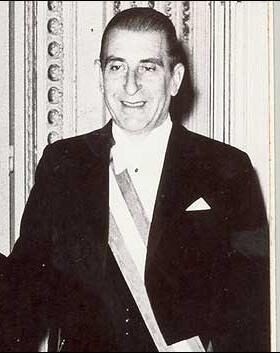
Eduardo Frei Montalva
Eduardo Frei Montalva was a President of Chile. Born January 16, 1911, in Santiago. Died January 22, 1982, in Santiago. Positions held include President of Chile (1964–1970), president of the Senate of Chile (1973) and senator of Chile. Educated at Pontifical Catholic University of Chile and Instituto de Humanidades Luis Campino. Awards include Grand Cross of the Order Bernardo O'Higgins, Grand Cross of the Order of Merit and Santiago Municipal Literature Award.
Facts
39 facts · 2 confirmed by two sources · 9 cited · 28 from one source
Where this comes from
Papalocal keeps its own record. It started from these sources; what each one said is kept here as it was copied, so a change on their side never changes this page by itself. Tap one to read its version.
What Wikidata says · copied November 16, 2026 · revision 2570479478
- Described as
- President of Chile (1911-1982)
- Other names
- Eduardo Nicanor Frei Montalva
- Born
- January 16, 1911 · 8 references
- Died
- January 22, 1982 · 9 references
- Born in
- Santiago · 1 reference
- Died in
- Santiago · 1 reference
- Buried in
- Santiago General Cemetery · 1 reference
- Citizen of
- Chile
- Occupation
- lawyer · 1 reference; politician · 2 references; jurist · 1 reference
- Positions held
- President of Chile (1964–1970); president of the Senate of Chile (1973); senator of Chile; public works minister
- Political party
- Christian Democratic Party; Conservative Party (–1938); Falange Nacional · 1 reference
- Education
- Pontifical Catholic University of Chile · 1 reference; Instituto de Humanidades Luis Campino
- Awards
- Grand Cross of the Order Bernardo O'Higgins; Grand Cross of the Order of Merit; Santiago Municipal Literature Award (1956); Grand Cross of the Order of the Liberator General San Martín; Order of Vasco Núñez de Balboa; Order of the Liberator; Grand Cross Special Class of the Order of Merit of the Federal Republic of Germany; Grand Cross of the Legion of Honour; Knight Grand Cross with Collar of the Order of Merit of the Italian Republic; Knight Grand Cross of the Order of the Bath; Grand Cross of the Order of the Sun of Peru; Knight Grand Cross of the Order of St. Olav; Collar of the Order of Pope Pius IX; Grand Collar of the Order of the Southern Cross; Grand Cross of the Order of Boyacá
- Field
- politics · 1 reference
- Spouse
- María Ruiz-Tagle
- Children
- Eduardo Frei Ruiz-Tagle · 1 reference; Carmen Frei
- Siblings
- Irene Frei
- Religion
- Catholicism
- Wikipedias with a page
- 45
Wikidata item Q475 (wikidata.org/wiki/Q475), public domain (CC0). Copied November 16, 2026.
What Wikipedia says · copied November 16, 2026 · revision 1380311657
Eduardo Nicanor Frei Montalva (Spanish pronunciation: [eˈðwaɾðo fɾej monˈtalβa]; 16 January 1911 – 22 January 1982) was a Chilean political leader. In his long political career, he was Minister of Public Works, president of his Christian Democratic Party, senator, President of the Senate, and the 28th president of Chile from 1964 to 1970. His eldest son, Eduardo Frei Ruiz-Tagle, also became president of Chile (1994–2000).
Said political party supported the Armed Forces intervention to remove his successor Salvador Allende from office in 1973, after the Chamber of Deputies, on 22 August 1973, accused Allende of violating the Constitution. He was later a vocal opponent of the Augusto Pinochet regime. On 22 January 1982, Frei died in Santiago, Chile, following surgery. Assassination was suspected by some but has never been proven.
On 18 August 2023, the Supreme Court ruled out the assassination charges and declared innocent all those accused.
- Born, in its opening lines
- January 16, 1911
- Died, in its opening lines
- January 22, 1982
From the Wikipedia article “Eduardo Frei Montalva” (en.wikipedia.org/wiki/Eduardo_Frei_Montalva), by its contributors, under CC BY-SA 4.0 (creativecommons.org/licenses/by-sa/4.0/). Copied November 16, 2026; not changed.
Confirmed Two sources agree. Cited One source, and it names where it got it. One source One source, without a reference of its own. Sources disagree The sources disagree. We show the best-supported value and keep theirs below.
