
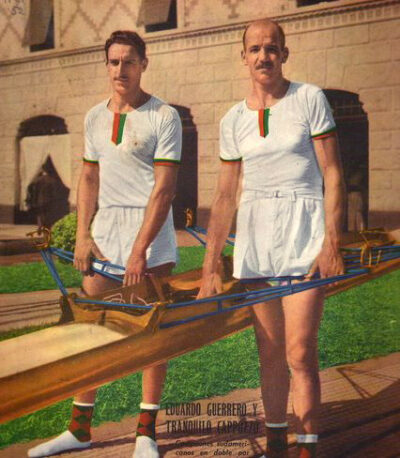
Eduardo Guerrero
Eduardo Guerrero was an Argentine rower. Born March 4, 1928, in Salto. Died August 17, 2015, in Buenos Aires.
Facts
9 facts · 2 confirmed by two sources · 2 cited · 5 from one source
Where this comes from
Papalocal keeps its own record. It started from these sources; what each one said is kept here as it was copied, so a change on their side never changes this page by itself. Tap one to read its version.
What Wikidata says · copied November 18, 2026 · revision 2524965606
- Described as
- Argentine rower (1928-2015)
- Born
- March 4, 1928 · 2 references
- Died
- August 17, 2015 · 2 references
- Born in
- Salto
- Died in
- Buenos Aires
- Cause of death
- pneumonia
- Citizen of
- Argentina · 1 reference
- Occupation
- rower · 1 reference; rugby union player · 1 reference
- Sport
- rowing
- Wikipedias with a page
- 22
Wikidata item Q1290991 (wikidata.org/wiki/Q1290991), public domain (CC0). Copied November 18, 2026.
What Wikipedia says · copied November 18, 2026 · revision 1379557252
Eduardo Guerrero (4 March 1928 – 17 August 2015) was an Argentine rower and Olympic champion, who competed in the 1952 Summer Olympics.
He was born in Salto, Buenos Aires Province.
Guerrero participated in the 1952 Summer Olympics in Helsinki where he won gold medal in double sculls competition together with Tranquilo Cappozzo. That was for 52 years the last gold medal at Olympics for Argentina until the victories of Soccer and Basketball men teams in 2004 games.
He also competed in Rugby for the French Sports Club, and was the founder and director of the Museo Olímpico Rodante. In 2002, Guerrero paddled along the Parana River from Puerto Iguazu to Buenos Aires.
Guerrero died on 17 August 2015 at the age of 87.
- Born, in its opening lines
- March 4, 1928
- Died, in its opening lines
- August 17, 2015
From the Wikipedia article “Eduardo Guerrero (rower)” (en.wikipedia.org/wiki/Eduardo_Guerrero_(rower)), by its contributors, under CC BY-SA 4.0 (creativecommons.org/licenses/by-sa/4.0/). Copied November 18, 2026; not changed.
Confirmed Two sources agree. Cited One source, and it names where it got it. One source One source, without a reference of its own. Sources disagree The sources disagree. We show the best-supported value and keep theirs below.
