
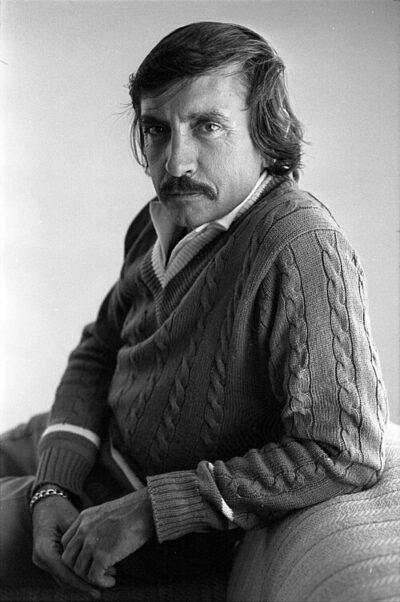
Edward Albee
Edward Albee was an American playwright. Born March 12, 1928, in Washington, D.C.. Died September 16, 2016, in Montauk. Known for Who's Afraid of Virginia Woolf? and The Goat, or Who Is Sylvia?. Educated at Choate Rosemary Hall and Trinity College. Awards include National Medal of Arts, Nestroy Theatre Prize and America Award in Literature.
Facts
40 facts · 2 confirmed by two sources · 10 cited · 28 from one source
Where this comes from
Papalocal keeps its own record. It started from these sources; what each one said is kept here as it was copied, so a change on their side never changes this page by itself. Tap one to read its version.
What Wikidata says · copied November 13, 2026 · revision 2568730287
- Described as
- American playwright (1928–2016)
- Other names
- Edward Franklin Albee III
- Born
- March 12, 1928 · 5 references
- Died
- September 16, 2016 · 4 references
- Born in
- Washington, D.C. · 3 references
- Died in
- Montauk · 2 references
- Cause of death
- diabetes · 1 reference
- Name at birth
- Edward Franklin Albee
- Citizen of
- United States · 4 references
- Occupation
- playwright · 2 references; writer · 2 references; screenwriter · 3 references; university teacher; theatre director
- Worked for
- University of Houston
- Education
- Choate Rosemary Hall; Trinity College; Lawrenceville School; Rye Country Day School; Valley Forge Military Academy and College
- Member of
- American Academy of Arts and Letters; American Academy of Arts and Sciences; Bavarian Academy of Fine Arts; PEN America
- Known for
- Who's Afraid of Virginia Woolf?; The Goat, or Who Is Sylvia?
- Awards
- National Medal of Arts; Nestroy Theatre Prize; America Award in Literature (2015); Tony Award for Best Play (2 times) (1963, 2002) · 1 reference; Grammy Award for Best Audio Book, Narration & Storytelling Recording (1963); Pulitzer Prize for Drama (3 times) (1967, 1975, 1994) · 1 reference; St. Louis Literary Award (1995); Kennedy Center Honors (1996); Drama Desk Award for Outstanding Play (2002); Drama Desk Special Award (2008); Fellow of the American Academy of Arts and Sciences; honorary doctor of the University of Miami (1996) · 1 reference; Hull-Warriner Award; PEN/Laura Pels International Foundation for Theater Award; Evelyn F. Burkey Award
- Lived in
- Washington, D.C.
- Wikipedias with a page
- 63
Wikidata item Q219420 (wikidata.org/wiki/Q219420), public domain (CC0). Copied November 13, 2026.
What Wikipedia says · copied November 13, 2026 · revision 1373062515
Edward Franklin Albee III ( AWL-bee; March 12, 1928 – September 16, 2016) was an American playwright known for works such as The Zoo Story (1958), The Sandbox (1959), Who's Afraid of Virginia Woolf? (1962), A Delicate Balance (1966), and Three Tall Women (1994). Some critics have argued that some of his work constitutes an American variant of what Martin Esslin identified as and named the Theater of the Absurd. Three of his plays won the Pulitzer Prize for Drama and two of his other works won the Tony Award for Best Play.
His works are often considered frank examinations of the modern condition. His early works reflect a mastery and Americanization of the Theatre of the Absurd that found its peak in works by European playwrights such as Samuel Beckett, Eugène Ionesco, and Jean Genet.
His middle period comprised plays that explored the psychology of maturing, marriage and sexual relationships. Younger American playwrights, such as Paula Vogel, credit Albee's mix of theatricality and biting dialogue with helping to reinvent postwar American theatre in the early 1960s. Later in life, Albee continued to experiment in works such as The Goat, or Who Is Sylvia? (2002).
- Born, in its opening lines
- March 12, 1928
- Died, in its opening lines
- September 16, 2016
From the Wikipedia article “Edward Albee” (en.wikipedia.org/wiki/Edward_Albee), by its contributors, under CC BY-SA 4.0 (creativecommons.org/licenses/by-sa/4.0/). Copied November 13, 2026; not changed.
Confirmed Two sources agree. Cited One source, and it names where it got it. One source One source, without a reference of its own. Sources disagree The sources disagree. We show the best-supported value and keep theirs below.
