
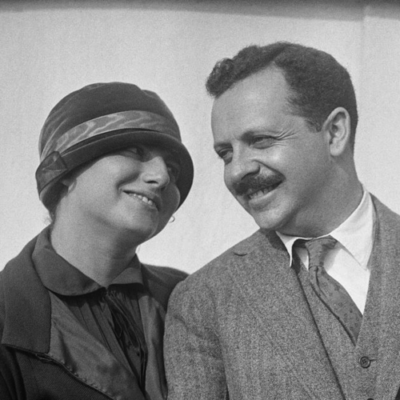
Edward Bernays
Edward Bernays was an American propaganda and marketing pioneer. Born November 22, 1891, in Vienna. Died March 9, 1995, in Cambridge. Known for Propaganda. Educated at Cornell University and DeWitt Clinton High School.
Facts
29 facts · 2 confirmed by two sources · 14 cited · 13 from one source
Where this comes from
Papalocal keeps its own record. It started from these sources; what each one said is kept here as it was copied, so a change on their side never changes this page by itself. Tap one to read its version.
What Wikidata says · copied November 13, 2026 · revision 2567490885
- Described as
- American propaganda and marketing pioneer (1891-1995)
- Other names
- Edward L. Bernays, Edward Louis Bernays
- Born
- November 22, 1891 · 4 references
- Died
- March 9, 1995 · 4 references
- Born in
- Vienna · 1 reference
- Died in
- Cambridge
- Name at birth
- Edward Louis Bernays
- Citizen of
- United States (1892–); Cisleithania
- Occupation
- psychologist · 1 reference; journalist · 1 reference; non-fiction writer; public relations scholar; advertising person · 1 reference; public relations consultant · 1 reference; business consultant · 1 reference; author · 1 reference
- Education
- Cornell University; DeWitt Clinton High School; Cornell University College of Agriculture and Life Sciences · 1 reference
- Known for
- Propaganda
- Field
- public relations research
- Spouse
- Doris Fleischman (1922–) · 1 reference
- Children
- Anne Bernays; Doris Bernays
- Father
- Eli Bernays · 1 reference
- Mother
- Anna Freud Bernays · 1 reference
- Siblings
- Judith Bernays · 1 reference; Lucia Bernays · 1 reference; Hella Freud Bernays · 1 reference; Martha Bernays · 1 reference
- Wikipedias with a page
- 47
Wikidata item Q434839 (wikidata.org/wiki/Q434839), public domain (CC0). Copied November 13, 2026.
What Wikipedia says · copied November 13, 2026 · revision 1384327695
Edward Louis Bernays ( bur-NAYZ; Austrian German: [bɛrˈnaɪs]; November 22, 1891 − March 9, 1995) was an Austrian-American pioneer in the field of public relations and propaganda, referred to in his obituary as "the father of public relations". While credited with advancing the profession of public relations, his techniques have been criticized for manipulating public opinion, often in ways that undermined individual autonomy and democratic values.
His best-known campaigns include a 1929 effort to promote female smoking by branding cigarettes as feminist "Torches of Freedom", and his work for the United Fruit Company in the 1950s, connected with the CIA-orchestrated overthrow of the democratically elected Guatemalan government in 1954. Bernays's involvement in Guatemala facilitated US imperialism and contributed to decades of civil unrest and repression, raising ethical concerns about his role in undermining democratic governance.
He worked for dozens of major American corporations, including Procter & Gamble and General Electric, and for government agencies, politicians, and non-profit organizations.
Of his many books, Crystallizing Public Opinion (1923) and Propaganda (1928) gained special attention as early efforts to define and theorize the field of public relations. Citing works of writers such as Gustave Le Bon, Wilfred Trotter, Walter Lippmann, and Sigmund Freud (his own double uncle), he described the masses as irrational and subject to herd instinct—and he outlined how skilled practitioners could use crowd psychology and psychoanalysis to control them in desired ways. Bernays later synthesized many of these ideas in his post-war book, Public Relations (1945), which outlines the science of managing information released to the public by an organization, in a manner most advantageous to the organization. He does this by first providing an overview of the history of public relations, and then provides insight into its application.
Bernays was named one of the 100 most influential Americans of the twentieth century by Life. His work has been linked to the rise of modern propaganda techniques that some argue have eroded democratic engagement and suppressed dissent. He was the subject of a full-length biography by Larry Tye entitled The Father of Spin (1999) and later an award-winning 2002 documentary for the BBC by Adam Curtis entitled The Century of the Self.
- Born, in its opening lines
- November 22, 1891
- Died, in its opening lines
- March 9, 1995
From the Wikipedia article “Edward Bernays” (en.wikipedia.org/wiki/Edward_Bernays), by its contributors, under CC BY-SA 4.0 (creativecommons.org/licenses/by-sa/4.0/). Copied November 13, 2026; not changed.
Confirmed Two sources agree. Cited One source, and it names where it got it. One source One source, without a reference of its own. Sources disagree The sources disagree. We show the best-supported value and keep theirs below.
