
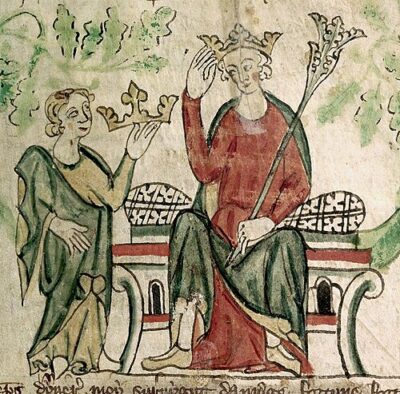
Edward II of England
Edward II of England was a King of England from 1307 to 1327. Born April 25, 1284, in Caernarfon Castle. Died September 21, 1327, in Berkeley Castle. Positions held include Monarch of England (1307–1327) and Lord of Ireland (1307–1327).
Facts
31 facts · 2 confirmed by two sources · 14 cited · 15 from one source
Where this comes from
Papalocal keeps its own record. It started from these sources; what each one said is kept here as it was copied, so a change on their side never changes this page by itself. Tap one to read its version.
What Wikidata says · copied November 16, 2026 · revision 2568844674
- Described as
- King of England from 1307 to 1327
- Other names
- Edward of Caernarvon, Edward II, Edward of Caernarfon
- Born
- April 25, 1284 · 5 references
- Died
- September 21, 1327 · 2 references
- Born in
- Caernarfon Castle · 2 references
- Died in
- Berkeley Castle · 1 reference
- Buried in
- Gloucester Cathedral
- Cause of death
- asphyxia
- Citizen of
- Kingdom of England; Wales
- Occupation
- aristocrat; monarch
- Positions held
- Monarch of England (1307–1327) · 1 reference; Lord of Ireland (1307–1327)
- Spouse
- Isabella of France (1308–1327) · 2 references
- Children
- Edward III of England · 1 reference; John of Eltham, Earl of Cornwall; Eleanor of Woodstock; Joan of The Tower · 1 reference; Adam FitzRoy · 1 reference
- Father
- Edward I of England · 1 reference
- Mother
- Eleanor of Castile · 1 reference
- Siblings
- Elizabeth of Rhuddlan · 1 reference; Mary of Woodstock; Margaret of England · 1 reference; Henry of England; Thomas of Brotherton, 1st Earl of Norfolk; Alphonso, Earl of Chester; Edmund of Woodstock, 1st Earl of Kent; Joan of Acre · 1 reference; Eleanor of England, Countess of Bar · 1 reference
- Religion
- Christianity
- Nickname
- Edward of Caernarvon · 1 reference
- Wikipedias with a page
- 77
Wikidata item Q5236 (wikidata.org/wiki/Q5236), public domain (CC0). Copied November 16, 2026.
What Wikipedia says · copied November 16, 2026 · revision 1384675881
Edward II (25 April 1284 – 21 September 1327), also known as Edward of Caernarfon or Caernarvon, was King of England from 1307 until he was deposed in January 1327. The fourth son of Edward I, Edward became the heir to the throne following the death of his older brother Alphonso. Beginning in 1300, Edward accompanied his father on campaigns in Scotland, and in 1306 he was knighted in a grand ceremony at Westminster Abbey. Edward succeeded to the throne the next year, following his father's death. In 1308, he married Isabella, daughter of the powerful King Philip IV of France, as part of a long-running effort to resolve the tensions between the English and French crowns.
Edward had a close and controversial relationship with Piers Gaveston, who had joined his household in 1300. The precise nature of Edward and Gaveston's relationship is uncertain; they may have been friends, lovers, or sworn brothers. Gaveston's arrogance and power as Edward's favourite provoked discontent both among the barons and the French royal family, and Edward was forced to exile him. On Gaveston's return, the barons pressured the King into agreeing to wide-ranging reforms called the Ordinances of 1311. The newly empowered barons banished Gaveston, to which Edward responded by revoking the reforms and recalling his favourite. Led by Edward's cousin Thomas, 2nd Earl of Lancaster, a group of the barons seized and executed Gaveston in 1312, beginning several years of armed confrontation. English forces were pushed back in Scotland, where Edward was decisively defeated by Robert the Bruce at the Battle of Bannockburn in 1314. Widespread famine followed, and criticism of the King's reign mounted.
The Despenser family, in particular Hugh Despenser the Younger, became close friends and advisers to Edward, but in 1321 Lancaster and many of the barons seized the Despensers' lands and forced the King to exile them. In response, Edward led a short military campaign, capturing and executing Lancaster. Edward and the Despensers strengthened their grip on power, revoking the 1311 reforms, executing their enemies and confiscating estates. Unable to make progress in Scotland, Edward finally signed a truce with Robert. Opposition to the regime grew, and when Isabella was sent to France to negotiate a peace treaty in 1325, she turned against Edward and refused to return. Isabella allied herself with the exiled Roger Mortimer, and invaded England with a small army in 1326. Edward's regime collapsed and he fled into Wales, where he was captured in November. Edward was forced to relinquish his crown in January 1327 in favour of his son, Edward III of England, and he died in Berkeley Castle on 21 September, probably murdered on the orders of the new regime.
Edward's relationship with Gaveston inspired Christopher Marlowe's 1592 play Edward II, along with other plays, films, novels and media. Many of these have focused on the possible sexual relationship between the two men. Edward's contemporaries criticised his performance as a king, noting his failures in Scotland and the oppressive regime of his later years, although 19th-century academics have argued that the growth of parliamentary institutions during his reign was a positive development for England over the longer term. Debate has continued into the 21st century as to whether Edward was a lazy and incompetent king, or simply a reluctant and ultimately unsuccessful ruler.
- Born, in its opening lines
- April 25, 1284
- Died, in its opening lines
- September 21, 1327
From the Wikipedia article “Edward II” (en.wikipedia.org/wiki/Edward_II), by its contributors, under CC BY-SA 4.0 (creativecommons.org/licenses/by-sa/4.0/). Copied November 16, 2026; not changed.
Confirmed Two sources agree. Cited One source, and it names where it got it. One source One source, without a reference of its own. Sources disagree The sources disagree. We show the best-supported value and keep theirs below.
