
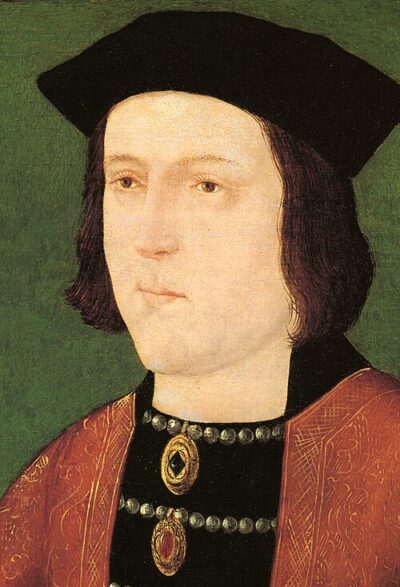
Edward IV of England
Edward IV of England was a King of England from 1461 to 1470 and 1471 to 1483. Born April 28, 1442, in Rouen. Died April 9, 1483, in Palace of Westminster. Positions held include Duke of York (1460–1461), Monarch of England (1461–1483) and Lord of Ireland (1461–1483). Awards include Knight of the Order of the Golden Fleece.
Facts
36 facts · 2 confirmed by two sources · 17 cited · 17 from one source
Where this comes from
Papalocal keeps its own record. It started from these sources; what each one said is kept here as it was copied, so a change on their side never changes this page by itself. Tap one to read its version.
What Wikidata says · copied November 16, 2026 · revision 2569839627
- Described as
- King of England from 1461 to 1470 and 1471 to 1483
- Other names
- Edward Plantagenet, Edward IV, King Edward IV, King Edward IV of England, Edward IV, King of England
- Born
- April 28, 1442 · 1 reference
- Died
- April 9, 1483 · 1 reference
- Born in
- Rouen
- Died in
- Palace of Westminster · 1 reference
- Buried in
- St George's Chapel, Windsor
- Citizen of
- Kingdom of England
- Occupation
- monarch
- Positions held
- Duke of York (1460–1461); Monarch of England (1461–1483); Lord of Ireland (1461–1483); constable (1460–) · 1 reference
- Awards
- Knight of the Order of the Golden Fleece
- Spouse
- Elizabeth Woodville (1464–1483) · 2 references; Eleanor Talbot (1461–) · 1 reference
- Children
- Elizabeth of York · 1 reference; Mary of York; Cecily of York; Edward V of England · 1 reference; Margaret of York; Richard of Shrewsbury, 1st Duke of York · 1 reference; Anne of York · 1 reference; George Plantagenet, 1st Duke of Bedford; Catherine of York; Bridget of York; Arthur Plantagenet, 1st Viscount Lisle · 1 reference; Elizabeth Plantagenet · 1 reference
- Father
- Richard of York, 3rd Duke of York · 1 reference
- Mother
- Cecily Neville, Duchess of York · 1 reference
- Siblings
- Margaret of York · 1 reference; Elizabeth of York, Duchess of Suffolk · 1 reference; Anne of York, Duchess of Exeter · 1 reference; Richard III of England · 1 reference; George Plantagenet, 1st Duke of Clarence · 1 reference; Edmund, Earl of Rutland; Thomas Plantagenet of York · 1 reference
- Religion
- Catholicism · 1 reference
- Wikipedias with a page
- 77
Wikidata item Q160341 (wikidata.org/wiki/Q160341), public domain (CC0). Copied November 16, 2026.
What Wikipedia says · copied November 16, 2026 · revision 1385659212
Edward IV (28 April 1442 – 9 April 1483) was King of England from 4 March 1461 to 3 October 1470, then again from 11 April 1471 until he died in 1483. A member of the House of York, he was a central figure in the Wars of the Roses, a series of civil wars in England fought between the Yorkist and Lancastrian factions between 1455 and 1487.
Edward inherited the Yorkist claim to the throne at the age of eighteen when his father, Richard, Duke of York, was killed at the Battle of Wakefield in December 1460. After defeating Lancastrian armies at Mortimer's Cross and Towton in early 1461, he deposed King Henry VI and took the throne. His marriage to Elizabeth Woodville in 1464 led to conflict with his chief advisor, Richard Neville, Earl of Warwick, known as the "Kingmaker". In 1470, a revolt led by Warwick and Edward's brother George, Duke of Clarence, briefly re-instated Henry VI. Edward fled to Flanders, where he gathered support and invaded England in March 1471; after victories at the battles of Barnet (where the Earl of Warwick was killed) and Tewkesbury (where Henry VI's son, Edward of Westminster, Prince of Wales, was killed), he resumed the throne. Shortly afterwards, Henry VI was found dead in the Tower of London, possibly killed on Edward's orders.
Despite facing an overseas threat from Henry Tudor, the last remaining Lancastrian claimant, Edward reigned in relative peace for the next twelve years. However, he nearly restarted the Hundred Years' War, following his invasion of France in 1475, but was assuaged by Louis XI in the Treaty of Picquigny. This diplomatic agreement formally ended the Hundred Years' War, which had been in abeyance since 1453. Following his sudden death in April 1483, Edward was briefly succeeded by his son Edward V. He had appointed his younger brother, Richard, Duke of Gloucester, Lord Protector of England for the duration of the new king's minority. However, Edward V and his younger brother Richard, Duke of York, disappeared shortly after and their uncle seized the throne as Richard III.
- Born, in its opening lines
- April 28, 1442
- Died, in its opening lines
- April 9, 1483
From the Wikipedia article “Edward IV” (en.wikipedia.org/wiki/Edward_IV), by its contributors, under CC BY-SA 4.0 (creativecommons.org/licenses/by-sa/4.0/). Copied November 16, 2026; not changed.
Confirmed Two sources agree. Cited One source, and it names where it got it. One source One source, without a reference of its own. Sources disagree The sources disagree. We show the best-supported value and keep theirs below.
