
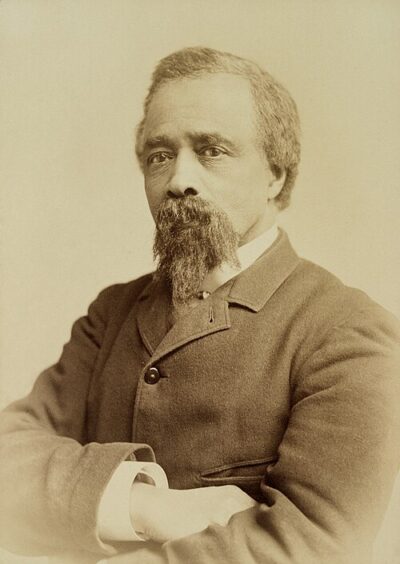
Edward Mitchell Bannister
Edward Mitchell Bannister was a Black Canadian-American visual artist. Born November 2, 1828, in St. Andrews. Died January 9, 1901, in Providence. Educated at Lowell Institute.
Facts
18 facts · 2 confirmed by two sources · 2 cited · 14 from one source
Where this comes from
Papalocal keeps its own record. It started from these sources; what each one said is kept here as it was copied, so a change on their side never changes this page by itself. Tap one to read its version.
What Wikidata says · copied November 16, 2026 · revision 2525584536
- Described as
- Black Canadian-American visual artist (1828-1901)
- Other names
- Edward M. Bannister, E. M. Bannister, Edward Bannister
- Born
- November 2, 1828 · 1 reference
- Died
- January 9, 1901 · 4 references
- Born in
- St. Andrews
- Died in
- Providence · 1 reference
- Buried in
- North Burial Ground
- Cause of death
- myocardial infarction
- Citizen of
- United States
- Occupation
- painter · 1 reference; visual artist; photographer · 1 reference
- Education
- Lowell Institute
- Genre
- landscape painting
- Field
- painting · 1 reference
- Spouse
- Christiana Carteaux Bannister (1857–) · 1 reference
- Lived in
- Boston; Providence; St. Andrews
- Website
- http://www.edwardmbannister.com/biographies/ebbio.html
- Wikipedias with a page
- 20
Wikidata item Q1293032 (wikidata.org/wiki/Q1293032), public domain (CC0). Copied November 16, 2026.
What Wikipedia says · copied November 16, 2026 · revision 1371935505
Edward Mitchell Bannister (November 2, 1828 – January 9, 1901) was a Canadian–American oil painter of the American Barbizon School. Born in colonial New Brunswick, he spent his adult life in New England in the United States. There, along with his wife Christiana Carteaux, he was a prominent member of African-American cultural and political communities, such as the Boston abolition movement. Bannister received national recognition after he won a first prize in painting at the 1876 Philadelphia Centennial Exhibition. He was also a founding member of the Providence Art Club and the Rhode Island School of Design.
Bannister's style and predominantly pastoral subject matter reflected his admiration for the French artist Jean-François Millet and the French Barbizon School. A lifelong sailor, he also looked to the Rhode Island seaside for inspiration. Bannister continually experimented, and his artwork displays his Idealist philosophy and his control of color and atmosphere. He began his professional practice as a photographer and portraitist before developing his better-known landscape style.
Later in his life, Bannister's style of landscape painting fell out of favor. With decreasing painting sales, he and Christiana Carteaux moved out of College Hill in Providence to Boston and then a smaller house on Wilson Street in Providence. Bannister was overlooked in American art historical studies and exhibitions after his death in 1901, until institutions like the National Museum of African Art returned him to national attention in the 1960s and 1970s.
- Born, in its opening lines
- November 2, 1828
- Died, in its opening lines
- January 9, 1901
From the Wikipedia article “Edward Mitchell Bannister” (en.wikipedia.org/wiki/Edward_Mitchell_Bannister), by its contributors, under CC BY-SA 4.0 (creativecommons.org/licenses/by-sa/4.0/). Copied November 16, 2026; not changed.
Confirmed Two sources agree. Cited One source, and it names where it got it. One source One source, without a reference of its own. Sources disagree The sources disagree. We show the best-supported value and keep theirs below.
