
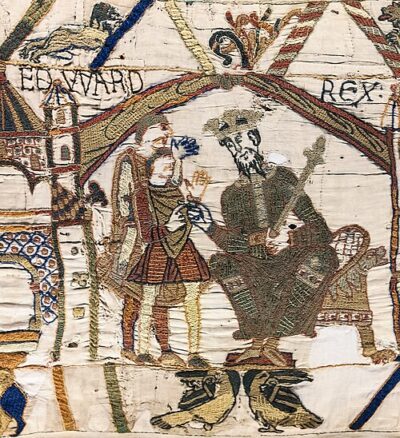
Edward the Confessor
Edward the Confessor was an Anglo-Saxon King of England from 1042 to 1066. Died January 5, 1066, in London. Positions held include Monarch of England (1042–1066). Educated at The King's School Ely.
Facts
24 facts · 0 confirmed by two sources · 10 cited · 13 from one source · 1 where the sources disagree
What’s different
- Died in: we show London (Sources disagree). Wikidata also lists Westminster
Where this comes from
Papalocal keeps its own record. It started from these sources; what each one said is kept here as it was copied, so a change on their side never changes this page by itself. Tap one to read its version.
What Wikidata says · copied November 16, 2026 · revision 2569087456
- Described as
- Anglo-Saxon King of England from 1042 to 1066
- Other names
- Ēadƿeard se Andettere, Saint Edward the Confessor, Saint Edward 'the Confessor', King of England, St Edward the Confessor, Eduard der Bekenner
- Died
- January 5, 1066 · 1 reference
- Born in
- Islip
- Died in
- Westminster; London · 1 reference
- Buried in
- Westminster Abbey
- Citizen of
- Kingdom of England
- Occupation
- monarch; politician · 1 reference
- Positions held
- Monarch of England (1042–1066)
- Education
- The King's School Ely
- Field
- politics · 1 reference; Christianity · 1 reference; state governance · 1 reference
- Spouse
- Edith of Wessex (1045–1066) · 2 references
- Father
- Æthelred the Unready · 2 references
- Mother
- Emma of Normandy · 2 references
- Siblings
- Gunhilda of Denmark; Goda of England · 1 reference; Æthelstan Ætheling; Edmund II of England; Harthacanute; Eadwig Ætheling; Alfred Aetheling · 1 reference; Eadred Ætheling
- Religion
- Catholicism
- Wikipedias with a page
- 70
Wikidata item Q130005 (wikidata.org/wiki/Q130005), public domain (CC0). Copied November 16, 2026.
What Wikipedia says · copied November 16, 2026 · revision 1384852900
Edward the Confessor (1003/1005 – 5 January 1066) was King of the English from 1042 until his death in 1066. He was the last reigning monarch of the House of Wessex.
Edward was the son of Æthelred the Unready and Emma of Normandy. He succeeded Cnut the Great's son – and his own half-brother – Harthacnut. He restored the rule of the House of Wessex after the period of Danish rule since Cnut conquered England in 1016. When Edward died in 1066, he was succeeded by his brother-in-law Harold Godwinson, who was defeated and killed in the same year at the Battle of Hastings by the Normans under William the Conqueror. Edward's young great-nephew Edgar Ætheling of the House of Wessex was proclaimed king after the Battle of Hastings, but was never crowned and surrendered to William less than eight weeks after the battle.
Historians disagree about Edward's fairly long 24-year reign. His nickname reflects the traditional image of him as unworldly and pious. The epithet "Confessor" reflects his reputation as a saint who did not suffer martyrdom as opposed to his uncle, King Edward the Martyr. Some portray Edward the Confessor's reign as leading to the disintegration of royal power in England and the advance in power of the House of Godwin, because of the infighting that began after his death with no heirs to the throne. Biographers Frank Barlow and Peter Rex, on the other hand, portray Edward as a successful king, one who was energetic, resourceful and sometimes ruthless; they argue that the Norman Conquest shortly after his death tarnished his image. However, Richard Mortimer argues that the return of the Godwins from exile in 1052 "meant the effective end of his exercise of power", citing Edward's reduced activity as implying "a withdrawal from affairs".
About a century after his death, in 1161, Pope Alexander III canonised the king. Edward was one of England's national saints until King Edward III adopted Saint George as the national patron saint in about 1350. Edward's feast day is 13 October and is celebrated by both the Church of England and the Catholic Church.
From the Wikipedia article “Edward the Confessor” (en.wikipedia.org/wiki/Edward_the_Confessor), by its contributors, under CC BY-SA 4.0 (creativecommons.org/licenses/by-sa/4.0/). Copied November 16, 2026; not changed.
Confirmed Two sources agree. Cited One source, and it names where it got it. One source One source, without a reference of its own. Sources disagree The sources disagree. We show the best-supported value and keep theirs below.
