
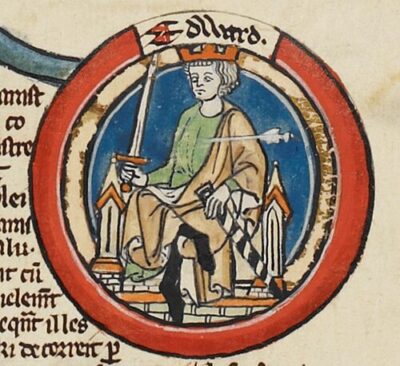
Edward the Martyr
Edward the Martyr was a King of the English. Born 963. Died March 18, 978, in Purbeck Hills. Positions held include Monarch of England (975–978).
Facts
14 facts · 1 confirmed by two sources · 3 cited · 8 from one source · 2 where the sources disagree
What’s different
- Born: we show 963 (Sources disagree). Wikipedia says c. 962
- Buried in: we show Wareham (Sources disagree). Wikidata also lists Shaftesbury Abbey and Woking
Where this comes from
Papalocal keeps its own record. It started from these sources; what each one said is kept here as it was copied, so a change on their side never changes this page by itself. Tap one to read its version.
What Wikidata says · copied November 16, 2026 · revision 2553828034
- Described as
- King of the English (975-978)
- Other names
- Saint Edward the Martyr, Eadweard the Martyr, King Edward the Martyr, Edward the Martyr, king of the English, Eadueard Martyr, King Edward II, St. Eadweard the Martyr, Saint Edward, king of the English, St. Edward, Eaduueard Martyr, Edward the Martyr, king of England, Saint Edward
- Born
- 963 · 1 reference
- Died
- March 18, 978
- Died in
- Purbeck Hills
- Buried in
- Wareham; Shaftesbury Abbey (979–); Woking (1931–1984)
- Cause of death
- deliberate murder · 1 reference
- Citizen of
- Kingdom of England
- Occupation
- monarch
- Positions held
- Monarch of England (975–978)
- Field
- politics · 1 reference
- Father
- Edgar of England · 2 references
- Mother
- Æthelflæd · 2 references
- Siblings
- Edith of Wilton; Æthelred the Unready
- Religion
- Catholicism
- Wikipedias with a page
- 54
Wikidata item Q192920 (wikidata.org/wiki/Q192920), public domain (CC0). Copied November 16, 2026.
What Wikipedia says · copied November 16, 2026 · revision 1380953587
Edward the Martyr (c. 962 – 18 March 978) was King of the English from 8 July 975 until he was killed in 978. He was the eldest son of King Edgar (r. 959–975). On Edgar's death, the succession to the throne was contested between Edward's supporters and those of his younger half-brother, the future King Æthelred the Unready. As they were both children, it is unlikely that they played an active role in the dispute, which was probably between rival family alliances. Edward's principal supporters were Dunstan, Archbishop of Canterbury, and Æthelwine, Ealdorman of East Anglia, while Æthelred was backed by his mother Queen Ælfthryth and her friend Æthelwold, Bishop of Winchester. The dispute was quickly settled. Edward was chosen as king and Æthelred received the lands traditionally allocated to the king's eldest son in compensation.
Edgar had been a strong and overbearing king and a supporter of the monastic reform movement. He had forced the lay nobility and secular clergy to surrender land and sell it at low prices to the monasteries. Æthelwold had been the most active and ruthless in seizing land for his monasteries with Edgar's assistance. The nobles took advantage of Edgar's death to get their lands back, mainly by legal actions but sometimes by force. The leading magnates were split into two factions, the supporters of Ælfhere, Ealdorman of Mercia, and Æthelwine, who both seized some monastic lands which they believed belonged to them, but also estates claimed by their rivals. The disputes never led to warfare.
Edward's short reign was brought to an end by his murder in March 978 in unclear circumstances. He was killed on his step-mother Ælfthryth's estate at the Gap of Corfe in Dorset, and hurriedly buried at Wareham. A year later, his body was translated with great ceremony to Shaftesbury Abbey in Dorset. Contemporary writers do not name the murderer, but almost all narratives in the period after the Norman Conquest name Ælfthryth. Some modern historians agree, but others do not. Another theory is that the killers were thegns of Æthelred, probably acting without orders.
Medieval kings were believed to be sacrosanct, and Edward's murder deeply troubled contemporaries who regarded it as a mortal sin. He soon came to be revered as a saint, and his feast of 18 March is listed in the festal calendar of the Book of Common Prayer of the Church of England. Edward was known in his own time for physical and verbal abuse of his associates and companions, and historians consider his veneration thoroughly undeserved.
- Born, in its opening lines
- c. 962
- Died, in its opening lines
- March 18, 978
From the Wikipedia article “Edward the Martyr” (en.wikipedia.org/wiki/Edward_the_Martyr), by its contributors, under CC BY-SA 4.0 (creativecommons.org/licenses/by-sa/4.0/). Copied November 16, 2026; not changed.
Confirmed Two sources agree. Cited One source, and it names where it got it. One source One source, without a reference of its own. Sources disagree The sources disagree. We show the best-supported value and keep theirs below.
