
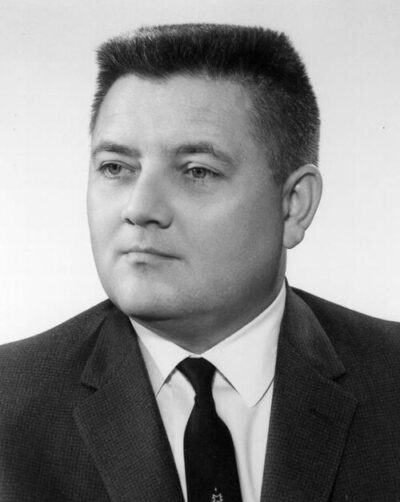
Edwin Thompson Jaynes
Edwin Thompson Jaynes was an American physicist. Born July 5, 1922, in Waterloo. Died April 30, 1998, in St. Louis. Educated at Princeton University.
Facts
14 facts · 2 confirmed by two sources · 1 cited · 11 from one source
Where this comes from
Papalocal keeps its own record. It started from these sources; what each one said is kept here as it was copied, so a change on their side never changes this page by itself. Tap one to read its version.
What Wikidata says · copied November 16, 2026 · revision 2520562295
- Described as
- American physicist (1922-1998)
- Other names
- Edwin Jaynes
- Born
- July 5, 1922 · 3 references
- Died
- April 30, 1998 · 2 references
- Born in
- Waterloo
- Died in
- St. Louis
- Citizen of
- United States
- Occupation
- physicist; statistician; mathematician; statistical physicist
- Worked for
- Washington University in St. Louis
- Education
- Princeton University
- Field
- statistical physics; quantum physics; probability theory · 1 reference
- Wikipedias with a page
- 20
Wikidata item Q711210 (wikidata.org/wiki/Q711210), public domain (CC0). Copied November 16, 2026.
What Wikipedia says · copied November 16, 2026 · revision 1371989799
Edwin Thompson Jaynes (July 5, 1922 – April 30, 1998) was the Wayman Crow Distinguished Professor of Physics at Washington University in St. Louis. He wrote extensively on statistical mechanics and on foundations of probability and statistical inference, initiating in 1957 the maximum entropy interpretation of thermodynamics as being a particular application of more general Bayesian/information theory techniques (although he argued this was already implicit in the works of Josiah Willard Gibbs). Jaynes strongly promoted the interpretation of probability theory as an extension of logic.
In 1963, together with his doctoral student Fred Cummings, he modeled the evolution of a two-level atom in an electromagnetic field, in a fully quantized way. This model is known as the Jaynes–Cummings model.
A particular focus of his work was the construction of logical principles for assigning prior probability distributions; see the principle of maximum entropy, the principle of maximum caliber, the principle of transformation groups and Laplace's principle of indifference. Other contributions include the mind projection fallacy.
Jaynes' book, Probability Theory: The Logic of Science (2003) gathers various threads of modern thinking about Bayesian probability and statistical inference, develops the notion of probability theory as extended logic, and contrasts the advantages of Bayesian techniques with the results of other approaches. This book, which he dedicated to Harold Jeffreys, was published posthumously in 2003 (from an incomplete manuscript that was edited by Larry Bretthorst).
Jaynes coined the term 'mind projection fallacy' to describe the error of confusing subjective states of knowledge with objective properties of physical systems. This idea became influential in debates over the interpretation of probability and quantum mechanics.
Other of his doctoral students included Joseph H. Eberly and Douglas James Scalapino.
- Born, in its opening lines
- July 5, 1922
- Died, in its opening lines
- April 30, 1998
From the Wikipedia article “Edwin Thompson Jaynes” (en.wikipedia.org/wiki/Edwin_Thompson_Jaynes), by its contributors, under CC BY-SA 4.0 (creativecommons.org/licenses/by-sa/4.0/). Copied November 16, 2026; not changed.
Confirmed Two sources agree. Cited One source, and it names where it got it. One source One source, without a reference of its own. Sources disagree The sources disagree. We show the best-supported value and keep theirs below.
