
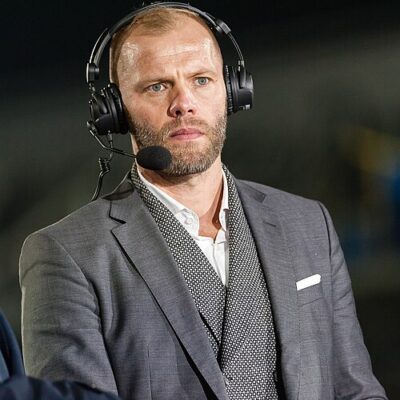
Eiður Guðjohnsen
Eiður Guðjohnsen is an Icelandic footballer. Born September 15, 1978, in Reykjavík. Teams include AS Monaco FC (2009–2010), KR Reykjavík (1997–1998) and Bolton Wanderers F.C. (2 times) (1998–2015).
Facts
26 facts · 1 confirmed by two sources · 1 cited · 24 from one source
Where this comes from
Papalocal keeps its own record. It started from these sources; what each one said is kept here as it was copied, so a change on their side never changes this page by itself. Tap one to read its version.
What Wikidata says · copied November 16, 2026 · revision 2561059714
- Described as
- Icelandic footballer
- Other names
- Eidur Gudjohnsen
- Born
- September 15, 1978 · 4 references
- Born in
- Reykjavík
- Citizen of
- Iceland
- Occupation
- association football player; association football coach
- Teams
- AS Monaco FC (2009–2010); KR Reykjavík (1997–1998); Bolton Wanderers F.C. (2 times) (1998–2015); AEK Athens F.C. (2011–2012); PSV Eindhoven (1995–1997); FC Barcelona (2006–2009); Tottenham Hotspur F.C. (2010); Chelsea F.C. (2000–2006); Stoke City F.C. (2010–2011); Fulham F.C. (2011); Cangzhou Mighty Lions F.C. (2015); Pune FC (2016); Iceland national under-17 football team (1992–1994); Iceland national under-19 football team (1994–1996); Iceland national under-21 football team (1994–1998)
- Sport
- association football · 1 reference
- Children
- Sveinn Aron Guðjohnsen · 1 reference; Andri Guðjohnsen; Daníel Guðjohnsen
- Father
- Arnór Guðjohnsen
- Height
- 1.87 m (6 ft 2 in)
- Wikipedias with a page
- 54
Wikidata item Q187396 (wikidata.org/wiki/Q187396), public domain (CC0). Copied November 16, 2026.
What Wikipedia says · copied November 16, 2026 · revision 1384904370
Eiður Smári Guðjohnsen (transliterated as Eidur Smari Gudjohnsen; born 15 September 1978) is an Icelandic professional football coach and former player who played as a forward. Eiður saw his greatest success in England and Spain with Chelsea and Barcelona respectively, where he won the UEFA Champions League and La Liga with the latter and the League Cup and Premiership twice with the former. Along with two spells at Bolton Wanderers fourteen years apart, he also played in Iceland, the Netherlands, France, Greece, Belgium, China, Norway and India in a club career lasting 23 years. He is regarded as the greatest Icelandic footballer of all time.
Eiður is the son of Arnór Guðjohnsen, who was also an Icelandic international footballer. He made his full international debut for Iceland as a substitute for his father in 1996, scoring 26 international goals in 88 caps between 1996 and 2016. He was the captain of the Iceland national team until Ólafur Jóhannesson took over the role of manager. He was part of their squad that reached the quarter-finals of UEFA Euro 2016, their first major tournament.
- Born, in its opening lines
- September 15, 1978
From the Wikipedia article “Eiður Guðjohnsen” (en.wikipedia.org/wiki/Eiður_Guðjohnsen), by its contributors, under CC BY-SA 4.0 (creativecommons.org/licenses/by-sa/4.0/). Copied November 16, 2026; not changed.
Confirmed Two sources agree. Cited One source, and it names where it got it. One source One source, without a reference of its own. Sources disagree The sources disagree. We show the best-supported value and keep theirs below.
