
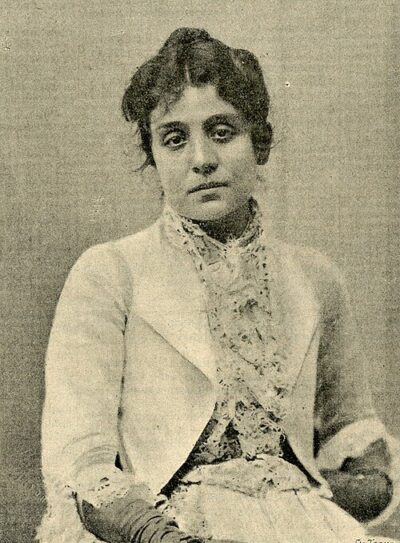
Eleonora Duse
Eleonora Duse was an Italian stage actress. Born October 3, 1858, in Vigevano. Died April 21, 1924, in Pittsburgh.
Facts
14 facts · 2 confirmed by two sources · 4 cited · 8 from one source
Where this comes from
Papalocal keeps its own record. It started from these sources; what each one said is kept here as it was copied, so a change on their side never changes this page by itself. Tap one to read its version.
What Wikidata says · copied November 16, 2026 · revision 2568749100
- Described as
- Italian stage actress (1858-1924)
- Other names
- Eleonora Giulia Amalia Duse
- Born
- October 3, 1858 · 14 references
- Died
- April 21, 1924 · 13 references
- Born in
- Vigevano · 4 references
- Died in
- Pittsburgh · 3 references
- Buried in
- cemetery of Sant'Anna · 1 reference
- Cause of death
- pneumonia
- Name at birth
- Eleonora Giulia Amalia Duse · 1 reference
- Citizen of
- Kingdom of Italy (1861–); Kingdom of Sardinia (–1861)
- Occupation
- actor · 2 references; screenwriter; stage actor; film actor
- Lived in
- Asolo
- Wikipedias with a page
- 53
Wikidata item Q275970 (wikidata.org/wiki/Q275970), public domain (CC0). Copied November 16, 2026.
What Wikipedia says · copied November 16, 2026 · revision 1385181989
Eleonora Giulia Amalia Duse ( DEW-zay, Italian: [eleoˈnɔːra ˈduːze]; 3 October 1858 – 21 April 1924), often known simply as Duse, was an Italian actress, rated by many as the greatest of her time.
She performed in many countries, notably in the plays of Gabriele D'Annunzio and Henrik Ibsen. Duse achieved a unique power of conviction and verity on the stage through intense absorption in the character, "eliminating the self" as she put it, and letting the qualities emerge from within, not imposed through artifice.
- Born, in its opening lines
- October 3, 1858
- Died, in its opening lines
- April 21, 1924
From the Wikipedia article “Eleonora Duse” (en.wikipedia.org/wiki/Eleonora_Duse), by its contributors, under CC BY-SA 4.0 (creativecommons.org/licenses/by-sa/4.0/). Copied November 16, 2026; not changed.
Confirmed Two sources agree. Cited One source, and it names where it got it. One source One source, without a reference of its own. Sources disagree The sources disagree. We show the best-supported value and keep theirs below.
