
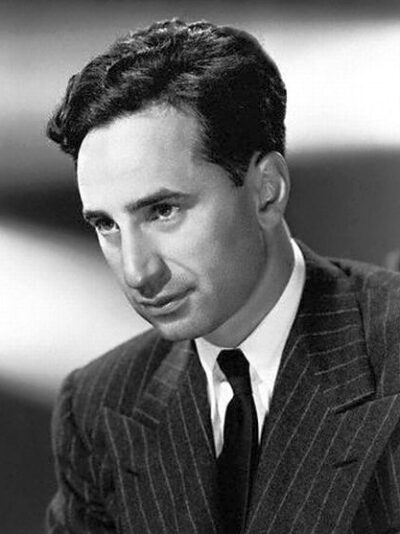
Elia Kazan
Elia Kazan was an American director and actor. Born September 7, 1909, in Constantinople. Died September 28, 2003, in New York City. Educated at Williams College and Yale School of Drama. Awards include Directors Guild of America Award, Academy Award for Best Director (2 times) and Golden Globe Award for Best Motion Picture – Drama.
Facts
35 facts · 2 confirmed by two sources · 6 cited · 27 from one source
Where this comes from
Papalocal keeps its own record. It started from these sources; what each one said is kept here as it was copied, so a change on their side never changes this page by itself. Tap one to read its version.
What Wikidata says · copied November 13, 2026 · revision 2568619860
- Described as
- American director and actor (1909–2003)
- Other names
- Ηλίας Καζαντζόγλου, Elias Kazantzoglou, Elia Kazanjoglou
- Born
- September 7, 1909 · 10 references
- Died
- September 28, 2003 · 10 references
- Born in
- Constantinople · 1 reference
- Died in
- New York City · 1 reference
- Buried in
- Greenwood Union Cemetery · 1 reference
- Citizen of
- United States; Greece
- Occupation
- film director · 2 references; screenwriter; film producer; writer · 2 references; theatre director; film actor; actor · 1 reference; film screenwriter
- Worked for
- The New School
- Education
- Williams College; Yale School of Drama; Juilliard School · 1 reference; New Rochelle High School · 1 reference
- Awards
- Directors Guild of America Award; Academy Award for Best Director (2 times) (1948, 1955) · 1 reference; Golden Globe Award for Best Motion Picture – Drama (1955); Tony Award for Best Director (3 times) (1947, 1949, 1959); Kennedy Center Honors; National Board of Review Award for Best Film; star on Hollywood Walk of Fame · 1 reference; Academy Honorary Award (1999) · 1 reference; Donaldson Awards
- Spouse
- Barbara Loden (1967–1980); Frances Kazan (1982–2003); Molly Kazan (1932–1963)
- Children
- Nicholas Kazan; Chris Kazan
- Height
- 1.73 m (5 ft 8 in)
- Wikipedias with a page
- 82
Wikidata item Q72717 (wikidata.org/wiki/Q72717), public domain (CC0). Copied November 13, 2026.
What Wikipedia says · copied November 13, 2026 · revision 1384328927
Elias Kazantzoglou (Greek: Ηλίας Καζαντζόγλου, IPA: [iˈli.as kazanˈdzoɣlu]; September 7, 1909 – September 28, 2003), known as Elia Kazan ( EE-lee-ə kə-ZAN), was a Greek-American film and theatre director, producer, screenwriter and actor, described by The New York Times as "one of the most honored and influential directors in Broadway and Hollywood history".
Born in Constantinople (now Istanbul) to Cappadocian Greek parents, his family went to the United States in 1913. After attending Williams College and then the Yale School of Drama, he acted professionally for eight years, later joining the Group Theatre in 1932, and co-founded the Actors Studio in 1947. With Robert Lewis and Cheryl Crawford, his actors' studio introduced "Method Acting" under the direction of Lee Strasberg. Kazan acted in a few films, including City for Conquest.
His films focused on personal or social issues that particularly concerned him. Kazan writes, "I don't move unless I have some empathy with the basic theme." His first such "issue" film was Gentleman's Agreement, with Gregory Peck, which dealt with antisemitism in the United States. It received eight Oscar nominations and three wins, including Kazan's first for Best Director. It was followed by Pinky, one of the first films in mainstream Hollywood to address racial prejudice against African Americans. A Streetcar Named Desire, an adaptation of the stage play which he had also directed, received twelve Oscar nominations, winning four, and was Marlon Brando's breakthrough role. Three years later, he directed Brando again in On the Waterfront, a film about union corruption on New York's waterfront. It also received twelve Oscar nominations, winning eight. In 1955, he directed John Steinbeck's East of Eden, starring James Dean.
A turning point in Kazan's career came with his testimony as a "friendly witness" before the House Un-American Activities Committee (HUAC) in 1952 at the height of the Hollywood blacklist. His decision to cooperate and name names brought him strong negative reactions from many friends and associates. His harshly anti-communist testimony "damaged if not shattered the careers of his former colleagues, Morris Carnovsky and Art Smith, both actors, and the playwright Clifford Odets". In his memoirs, Kazan writes that he and Odets had made a pact at the time to name each other in front of the committee. Kazan later justified his actions by saying he took "only the more tolerable of two alternatives that were either way painful and wrong". Nearly a half-century later, his 1952 HUAC testimony continued to cause controversy. When Kazan was awarded an honorary Oscar in 1999, dozens of actors chose not to applaud as 250 demonstrators picketed the event.
Kazan influenced the films of the 1950s and 1960s with his provocative, issue-driven subjects. Director Stanley Kubrick called him "without question, the best director we have in America, [and] capable of performing miracles with the actors he uses". Film author Ian Freer concludes that even "if his achievements are tainted by political controversy, the debt Hollywood—and actors everywhere—owes him is enormous". Orson Welles said "Kazan is a traitor ... [but] he is a very good director". In 2010, Martin Scorsese co-directed the documentary film A Letter to Elia as a personal tribute to Kazan.
- Born, in its opening lines
- September 7, 1909
- Died, in its opening lines
- September 28, 2003
From the Wikipedia article “Elia Kazan” (en.wikipedia.org/wiki/Elia_Kazan), by its contributors, under CC BY-SA 4.0 (creativecommons.org/licenses/by-sa/4.0/). Copied November 13, 2026; not changed.
Confirmed Two sources agree. Cited One source, and it names where it got it. One source One source, without a reference of its own. Sources disagree The sources disagree. We show the best-supported value and keep theirs below.
