
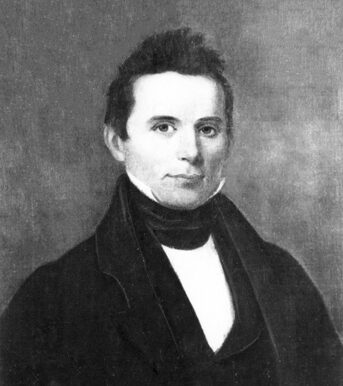
Elias Boudinot was a Cherokee Indian leader. Born 1802, in Calhoun. Died June 22, 1839, in Park Hill. Educated at Foreign Mission School.
Facts
17 facts · 2 confirmed by two sources · 4 cited · 11 from one source
Where this comes from
Papalocal keeps its own record. It started from these sources; what each one said is kept here as it was copied, so a change on their side never changes this page by itself. Tap one to read its version.
What Wikidata says · copied November 19, 2026 · revision 2569056589
- Described as
- Cherokee Indian leader (1802–1839)
- Other names
- Gallegina Uwati, Watie, Buck Watie, Galegina, ᎦᎴᎩᎾ ᎤᏩᏘ, Galagina
- Born
- 1802 · 3 references
- Died
- June 22, 1839 · 5 references
- Born in
- Calhoun
- Died in
- Park Hill · 1 reference
- Buried in
- Park Hill · 1 reference
- Citizen of
- United States
- Occupation
- entrepreneur; translator; Bible translator; journalist; newspaper editor; missionary · 1 reference; writer · 1 reference
- Education
- Foreign Mission School
- Spouse
- Harriet R. Gold Boudinot
- Children
- Elias Cornelius Boudinot · 1 reference
- Siblings
- Stand Watie
- Wikipedias with a page
- 10
Wikidata item Q51754 (wikidata.org/wiki/Q51754), public domain (CC0). Copied November 19, 2026.
What Wikipedia says · copied November 19, 2026 · revision 1369220921
Elias Boudinot (Cherokee: ᎦᎴᎩᎾ ᎤᏩᏘ, romanized: Gallegina Uwati; 1802 – June 22, 1839; also known as Buck Watie) was a writer, newspaper editor, and leader of the Cherokee Nation. He was a member of a prominent family, and was born and grew up in Cherokee territory, now part of present-day Georgia. Born to parents of mixed Cherokee and European ancestry and educated at the Foreign Mission School in Connecticut, he became one of several leaders who thought that acculturation was critical to Cherokee survival. He was influential in the period of removal to Indian Territory.
In 1826, Boudinot married Harriet R. Gold, the daughter of a prominent New England family in Cornwall, Connecticut. He met her while a student at the FMS in town. Following his cousin John Ridge's marriage to a local woman there in 1825, Boudinot's marriage was controversial and opposed by many townspeople. But to protect their future children, the Cherokee National Council had passed a law in 1825 enabling the descendants of Cherokee fathers and white mothers to be full citizens of the Cherokee. (Formerly, they had no official place in the matrilineal tribe, as children belong to their mother's clan and people, and the white women were outsiders.) The Boudinots returned to Cherokee homelands (now in Georgia) to live at New Echota. They reared their six children as Cherokee.
Boudinot, with numerous other leading Cherokee, particularly those who had been educated outside the tribe, thought that removal was inevitable in the face of the numbers of United States settlers encroaching on their lands. He and several allies signed the Treaty of New Echota in 1835, seeking to gain the best conditions for their people. Cession of communal lands was adamantly opposed by John Ross, the Principal Chief, and the full-blood members of tribe, who comprised the majority. The following year, the tribe was forced to cede most of its lands in the Southeast, and remove to west of the Mississippi River in Indian Territory in the late 1830s.
After Harriet died in 1836, Boudinot moved with his children to Indian Territory. After Removal, in June 1839 he and three other Treaty Party leaders were assassinated there by members of the Ross faction, known as the National Party. The orphaned Boudinot children were sent to be raised by his parents-in-law in Cornwall, Connecticut, which was believed more safe. They attended school there. After Boudinot's son E. C. was educated, he returned west, settling in Fayetteville, Arkansas. He became an attorney and active in tribal and Democratic Party politics. He represented the Cherokee Nation in the Confederate Congress as a non-voting delegate.
Boudinot appears as a character in Unto These Hills, an outdoor drama that has been performed in Cherokee, NC since 1950.
- Born, in its opening lines
- 1802
- Died, in its opening lines
- June 22, 1839
From the Wikipedia article “Elias Boudinot (Cherokee)” (en.wikipedia.org/wiki/Elias_Boudinot_(Cherokee)), by its contributors, under CC BY-SA 4.0 (creativecommons.org/licenses/by-sa/4.0/). Copied November 19, 2026; not changed.
Confirmed Two sources agree. Cited One source, and it names where it got it. One source One source, without a reference of its own. Sources disagree The sources disagree. We show the best-supported value and keep theirs below.
