
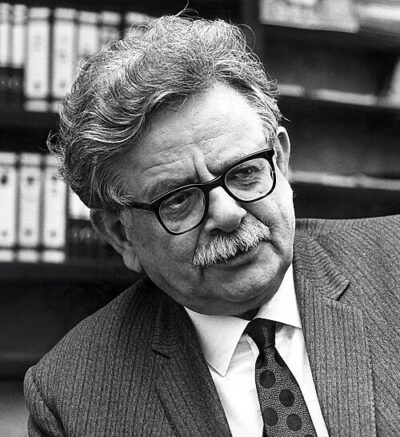
Elias Canetti
Elias Canetti was a Bulgarian-born Swiss and British Jewish modernist novelist, playwright, memoirist, and non-fiction writer. Born July 25, 1905, in Ruse. Died August 14, 1994, in Zurich. Known for Auto-da-Fé, Tongue Set Free and Crowds and Power. Educated at University of Vienna. Awards include Pour le Mérite for Sciences and Arts order, Nobel Prize in Literature and Grand Austrian State Prize for Literature.
Facts
44 facts · 2 confirmed by two sources · 17 cited · 25 from one source
Where this comes from
Papalocal keeps its own record. It started from these sources; what each one said is kept here as it was copied, so a change on their side never changes this page by itself. Tap one to read its version.
What Wikidata says · copied November 16, 2026 · revision 2568732254
- Described as
- Bulgarian-born Swiss and British Jewish modernist novelist, playwright, memoirist, and non-fiction writer (1905–1994)
- Other names
- Elías Canetti, Canetti
- Born
- July 25, 1905 · 16 references
- Died
- August 14, 1994 · 16 references
- Born in
- Ruse · 2 references
- Died in
- Zurich · 3 references
- Buried in
- Fluntern Cemetery · 2 references
- Citizen of
- United Kingdom (1952–) · 1 reference; Bulgaria
- Occupation
- writer · 2 references; aphorist; playwright · 1 reference; chemist · 2 references; essayist · 1 reference; novelist; psychologist · 1 reference; philosopher · 1 reference
- Education
- University of Vienna
- Member of
- German Academy for Language and Literature; Bavarian Academy of Fine Arts
- Known for
- Auto-da-Fé; Tongue Set Free; Crowds and Power; Their Days are Numbered
- Awards
- Pour le Mérite for Sciences and Arts order (1979); Nobel Prize in Literature (1981) · 2 references; Grand Austrian State Prize for Literature (1967); Literature Award of the Bavarian Academy of the Fine Arts (1969) · 1 reference; Nelly Sachs Prize (1975); Gottfried-Keller-Preis (1977); Johann-Peter-Hebel-Preis (1980); Franz Kafka Prize (1981) · 1 reference; Georg Büchner Prize (1972); Commander's Cross of the Order of Merit of the Federal Republic of Germany; Franz-Kafka-Preis (1981); Franz Nabl Prize (1975) · 1 reference; City of Vienna Literature Prize (1966) · 1 reference; honorary doctorate of the University of Graz; honorary doctor of the University of Manchester
- Field
- novel · 1 reference; essay · 1 reference
- Spouse
- Veza Canetti (1933–1963) · 1 reference; Hera Buschor (1971–1988) · 1 reference
- Children
- Johanna Canetti · 1 reference
- Siblings
- Georges Canetti · 1 reference; Jacques Canetti
- Wikipedias with a page
- 112
Wikidata item Q80064 (wikidata.org/wiki/Q80064), public domain (CC0). Copied November 16, 2026.
What Wikipedia says · copied November 16, 2026 · revision 1380281718
Elias Canetti (; German: [eˈliːas kaˈnɛti]; 25 July 1905 – 14 August 1994) was a German-language writer, known as a modernist novelist, playwright, memoirist, and nonfiction writer.
Born in Ruse, Bulgaria, to a Sephardic Jewish family, he later lived in England, Austria, Germany, and Switzerland. He won the 1981 Nobel Prize in Literature, "for writings marked by a broad outlook, a wealth of ideas and artistic power".
He is noted for his nonfiction book Crowds and Power, among other works.
- Born, in its opening lines
- July 25, 1905
- Died, in its opening lines
- August 14, 1994
From the Wikipedia article “Elias Canetti” (en.wikipedia.org/wiki/Elias_Canetti), by its contributors, under CC BY-SA 4.0 (creativecommons.org/licenses/by-sa/4.0/). Copied November 16, 2026; not changed.
Confirmed Two sources agree. Cited One source, and it names where it got it. One source One source, without a reference of its own. Sources disagree The sources disagree. We show the best-supported value and keep theirs below.
