
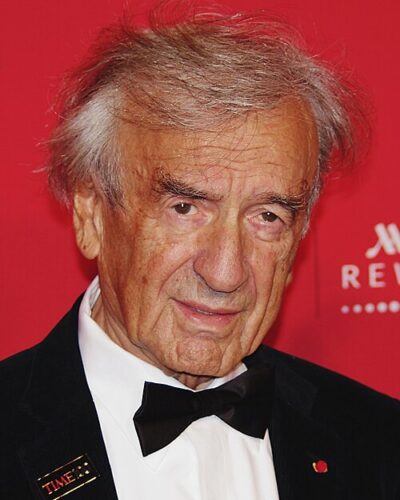
Elie Wiesel
Elie Wiesel was a Romanian-born American writer, professor, political activist, Nobel laureate, and Holocaust survivor. Born September 30, 1928, in Sighetu Marmației. Died July 2, 2016, in New York City. Known for Night. Educated at Faculty of Arts of Paris. Awards include Prix Médicis, Bordin Prize and Prix du Livre Inter.
Facts
47 facts · 2 confirmed by two sources · 19 cited · 25 from one source · 1 where the sources disagree
What’s different
- Buried in: we show Sharon Gardens Cemetery (Sources disagree). Wikidata also lists Kensico Cemetery
Where this comes from
Papalocal keeps its own record. It started from these sources; what each one said is kept here as it was copied, so a change on their side never changes this page by itself. Tap one to read its version.
What Wikidata says · copied November 13, 2026 · revision 2563200751
- Described as
- Romanian-born American writer, professor, political activist, Nobel laureate, and Holocaust survivor (1928–2016)
- Other names
- Élie Wiesel, A-7713, Eliezer Wiesel
- Born
- September 30, 1928 · 13 references
- Died
- July 2, 2016 · 12 references
- Born in
- Sighetu Marmației · 1 reference
- Died in
- New York City · 1 reference
- Buried in
- Kensico Cemetery; Sharon Gardens Cemetery · 1 reference
- Name at birth
- Eliezer Wiesel
- Citizen of
- United States (1963–) · 1 reference; Kingdom of Romania (–1940) · 1 reference; Kingdom of Hungary (1940–1944); Israel
- Occupation
- writer · 3 references; political activist; Judaic scholar; novelist; autobiographer; university teacher · 1 reference; translator; humanist
- Worked for
- Yedioth Ahronoth; Boston University; City University of New York · 1 reference
- Education
- Faculty of Arts of Paris
- Member of
- American Academy of Arts and Letters; American Academy of Arts and Sciences; Romanian Academy
- Sport
- association football
- Known for
- Night · 1 reference
- Awards
- Prix Médicis (1968) · 1 reference; Bordin Prize (1972); Prix du Livre Inter (1980); Grand Prix littéraire de la Ville de Paris (1983) · 1 reference; Lucien Barrière Literary Award (1984) · 1 reference; Nobel Peace Prize (1986) · 2 references; Four Freedoms Award – Freedom of Worship (1985) · 1 reference; honorary doctor of the University of Paris 1 Pantheon-Sorbonne (1987) · 1 reference; honorary doctor of the University of Miami (1988) · 1 reference; Presidential Medal of Freedom (1992) · 1 reference; honorary doctorate of the Bordeaux Montaigne University (1993) · 2 references; honorary degree from Spelman College (1995) · 1 reference; honorary doctor of the University of Picardie Jules Verne (1995) · 1 reference; honorary doctor of the Florida Atlantic University (1997) · 1 reference; Grand Cross of the Legion of Honour (2001)
- Spouse
- Marion Wiesel
- Children
- Elisha Wiesel
- Father
- Shlomo Wiesel · 1 reference
- Mother
- Sarah Feig · 1 reference
- Religion
- Judaism
- Wikipedias with a page
- 106
Wikidata item Q18391 (wikidata.org/wiki/Q18391), public domain (CC0). Copied November 13, 2026.
What Wikipedia says · copied November 13, 2026 · revision 1384328998
Eliezer "Elie" Wiesel (September 30, 1928 – July 2, 2016) was a Romanian-born American writer, professor, political activist, Nobel laureate, and Holocaust survivor. He authored 57 books, written mostly in French and English, including Night, which is based on his experiences as a Jewish prisoner at Auschwitz and Buchenwald during the Holocaust.
As a political activist, Wiesel became a regular speaker on the subject of the Holocaust and advocated for justice in numerous causes around the globe, including that of Soviet Jews and Ethiopian Jews, South African apartheid, the Rwandan genocide, the Bosnian genocide, the War in Darfur, the Kurdish independence movement, the Armenian genocide, Argentina's Desaparecidos, Nicaragua's Miskito people, the Sri Lankan Tamils, and the Cambodian genocide. He was also an outspoken advocate for Israel and frequently weighed in to support the country during escalations of the Arab–Israeli conflict and throughout the Iran–Israel proxy conflict. He backed Netanyahu publicly, including his controversial 2015 Congress speech on Iran, and signed ads praising Jewish settlers. He said Jerusalem "belongs to the Jewish people" and opposed territorial compromise there. He also hosted direct talks to facilitate the Israeli–Palestinian peace process.
Wiesel was a professor of the humanities at Boston University, which created the Elie Wiesel Center for Jewish Studies in his honor. He received a number of awards, including the Nobel Peace Prize in 1986. He was a founding board member of the Human Rights Foundation and remained active in it throughout his life. Wiesel was one of the main figures who spearheaded the establishment of the United States Holocaust Memorial Museum in 1993.
- Born, in its opening lines
- September 30, 1928
- Died, in its opening lines
- July 2, 2016
From the Wikipedia article “Elie Wiesel” (en.wikipedia.org/wiki/Elie_Wiesel), by its contributors, under CC BY-SA 4.0 (creativecommons.org/licenses/by-sa/4.0/). Copied November 13, 2026; not changed.
Confirmed Two sources agree. Cited One source, and it names where it got it. One source One source, without a reference of its own. Sources disagree The sources disagree. We show the best-supported value and keep theirs below.
