
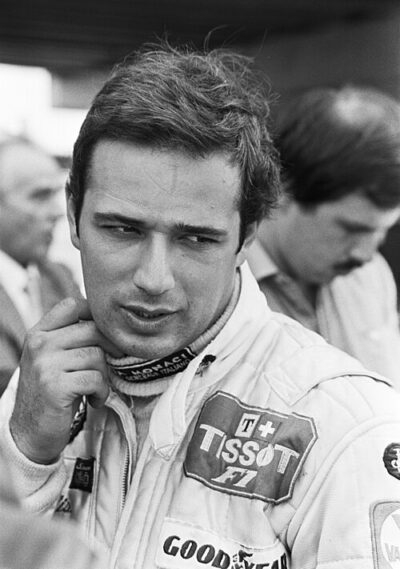
Elio de Angelis
Elio de Angelis was an Italian racing driver. Born March 26, 1958, in Rome. Died May 15, 1986, in Marseille.
Facts
14 facts · 2 confirmed by two sources · 3 cited · 9 from one source
Where this comes from
Papalocal keeps its own record. It started from these sources; what each one said is kept here as it was copied, so a change on their side never changes this page by itself. Tap one to read its version.
What Wikidata says · copied November 16, 2026 · revision 2547353209
- Described as
- Italian racing driver (1958-1986)
- Born
- March 26, 1958 · 1 reference
- Died
- May 15, 1986 · 1 reference
- Born in
- Rome · 1 reference
- Died in
- Marseille · 1 reference
- Buried in
- Campo Verano
- Cause of death
- smoke inhalation injury
- Citizen of
- Italy
- Occupation
- motorcycle racer; racing automobile driver · 2 references; Formula One driver; pianist
- Sport
- motorcycle sport
- Instrument
- piano
- Spouse
- Ute Kittelberger
- Wikipedias with a page
- 34
Wikidata item Q173115 (wikidata.org/wiki/Q173115), public domain (CC0). Copied November 16, 2026.
What Wikipedia says · copied November 16, 2026 · revision 1385778854
Elio de Angelis (26 March 1958 – 15 May 1986) was an Italian racing driver, who competed in Formula One from 1979 to 1986.
In Formula One, De Angelis drove for Shadow, Lotus and Brabham, winning two Grands Prix across eight seasons. He finished third in the 1984 World Drivers' Championship with Lotus. De Angelis was a competitive and highly popular presence in Formula One during the 1980s, and is sometimes referred to as Formula One's "last gentleman player".
In May 1986, de Angelis was killed in an accident whilst testing the Brabham BT55 at Paul Ricard.
- Born, in its opening lines
- March 26, 1958
- Died, in its opening lines
- May 15, 1986
From the Wikipedia article “Elio de Angelis” (en.wikipedia.org/wiki/Elio_de_Angelis), by its contributors, under CC BY-SA 4.0 (creativecommons.org/licenses/by-sa/4.0/). Copied November 16, 2026; not changed.
Confirmed Two sources agree. Cited One source, and it names where it got it. One source One source, without a reference of its own. Sources disagree The sources disagree. We show the best-supported value and keep theirs below.
