
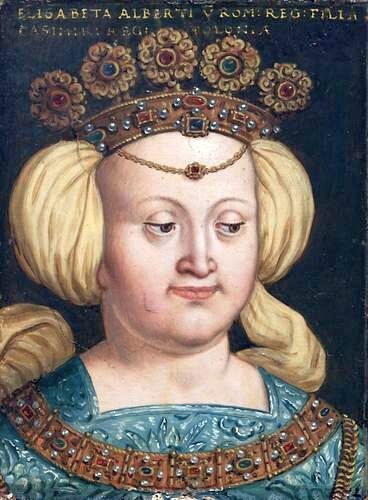
Elisabeth of Habsburg
Elisabeth of Habsburg was a Queen of Poland and Grand Duchess of Lithuania. Born 1436, in Vienna. Died August 30, 1505, in Kraków. Positions held include Queen Consort of Poland (1454–1492).
Facts
26 facts · 2 confirmed by two sources · 5 cited · 19 from one source
Where this comes from
Papalocal keeps its own record. It started from these sources; what each one said is kept here as it was copied, so a change on their side never changes this page by itself. Tap one to read its version.
What Wikidata says · copied November 16, 2026 · revision 2569204873
- Described as
- Queen of Poland and Grand Duchess of Lithuania
- Born
- 1436
- Died
- August 30, 1505 · 2 references
- Born in
- Vienna · 2 references
- Died in
- Kraków · 1 reference
- Buried in
- Wawel Cathedral
- Citizen of
- Archduchy of Austria
- Occupation
- consort
- Positions held
- Queen Consort of Poland (1454–1492)
- Spouse
- Casimir IV Jagiellon (1454–) · 1 reference
- Children
- Vladislaus II of Bohemia and Hungary; Hedwig Jagiellon, Duchess of Bavaria; Saint Casimir · 1 reference; John I Albert · 1 reference; Alexander Jagiellon; Sigismund I the Old; Barbara Jagiellon; Sophia Jagiellon, Margravine of Brandenburg-Ansbach; Anna Jagiellon; Elizabeth Jagellon · 1 reference; Elizabeth Jagiellon · 2 references; Elisabeth Jagiellon · 1 reference
- Father
- Albert II of Germany
- Mother
- Elizabeth of Luxembourg
- Siblings
- Duchess Anna I, Duchess of Luxembourg; Ladislaus the Posthumous; George of Habsburg, Heir of Austria
- Wikipedias with a page
- 32
Wikidata item Q93408 (wikidata.org/wiki/Q93408), public domain (CC0). Copied November 16, 2026.
What Wikipedia says · copied November 16, 2026 · revision 1382147100
Elizabeth of Austria (German: Elisabeth von Habsburg; Polish: Elżbieta Rakuszanka; Lithuanian: Elžbieta Habsburgaitė; c. 1436 – 30 August 1505) was Queen of Poland and Grand Duchess of Lithuania as the wife of King Casimir IV of Poland. Orphaned at an early age, she spent her childhood in the court of Holy Roman Emperor Frederick III. As one of the three surviving grandchildren of Emperor Sigismund, she had a strong claim to the kingdoms of Hungary and Bohemia. That made her an attractive bride for a Polish prince. The Polish nobility, seeking to increase Polish influence in Hungary and Bohemia, pursued marriage with Elizabeth since she was born and finally succeeded in 1454. Her marriage to Casimir was one of the most successful royal marriages in Poland. She gave birth to thirteen children, eleven of whom survived to adulthood. Four of her sons were crowned as kings.
- Born, in its opening lines
- c. 1436
- Died, in its opening lines
- August 30, 1505
From the Wikipedia article “Elizabeth of Austria (1436–1505)” (en.wikipedia.org/wiki/Elizabeth_of_Austria_(1436–1505)), by its contributors, under CC BY-SA 4.0 (creativecommons.org/licenses/by-sa/4.0/). Copied November 16, 2026; not changed.
Confirmed Two sources agree. Cited One source, and it names where it got it. One source One source, without a reference of its own. Sources disagree The sources disagree. We show the best-supported value and keep theirs below.
