
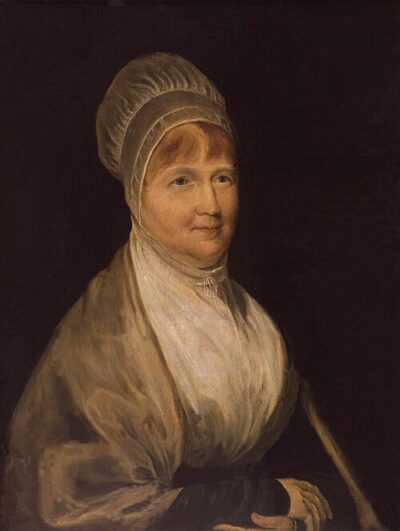
Elizabeth Fry
Elizabeth Fry was a social reformer from England. Born May 21, 1780, in Norwich. Died October 12, 1845, in Ramsgate.
Facts
36 facts · 2 confirmed by two sources · 27 cited · 7 from one source
Where this comes from
Papalocal keeps its own record. It started from these sources; what each one said is kept here as it was copied, so a change on their side never changes this page by itself. Tap one to read its version.
What Wikidata says · copied November 16, 2026 · revision 2553638540
- Described as
- social reformer from England (1780-1845)
- Other names
- Betsy Gurney, Elizabeth Gurney, Mrs. Elizabeth Fry, Elizabeth Gurney Fry
- Born
- May 21, 1780 · 12 references
- Died
- October 12, 1845 · 10 references
- Born in
- Norwich · 1 reference
- Died in
- Ramsgate · 1 reference
- Buried in
- Quaker Burial Ground
- Cause of death
- stroke · 1 reference
- Citizen of
- United Kingdom of Great Britain and Ireland
- Occupation
- nurse · 1 reference; philanthropist · 1 reference; diarist; politician; suffragist · 1 reference; writer; pedagogue · 1 reference; social reformer · 1 reference
- Spouse
- Joseph Fry (1800–1845) · 3 references
- Children
- Katharine Fry · 2 references; Louisa Fry · 2 references; John Gurney Fry · 2 references; William Storrs Fry · 2 references; Joseph Fry · 2 references; Samuel Gurney Fry · 2 references; Daniel Henry Fry · 2 references; Rachel Elizabeth Fry · 2 references; Elizabeth Fry · 2 references; Richenda Fry · 2 references; Hannah Fry · 2 references
- Father
- John Gurney · 2 references
- Mother
- Catherine Bell · 3 references
- Siblings
- Joseph John Gurney · 1 reference; Samuel Gurney · 1 reference; Daniel Gurney · 1 reference; Louisa Gurney Hoare · 1 reference; Priscilla Gurney · 1 reference; Richenda Gurney · 1 reference; Hannah Gurney · 1 reference
- Wikipedias with a page
- 32
Wikidata item Q271477 (wikidata.org/wiki/Q271477), public domain (CC0). Copied November 16, 2026.
What Wikipedia says · copied November 16, 2026 · revision 1381097631
Elizabeth Fry (née Gurney; 21 May 1780 – 12 October 1845), sometimes referred to as Betsy Fry, was an English prison reformer, social reformer, philanthropist and Quaker. Fry was a major driving force behind new legislation to improve the treatment of prisoners, especially female inmates, and as such has been called the "Angel of Prisons". She was instrumental in the Gaols Act 1823 which mandated sex-segregation of prisons and female warders for female inmates to protect them from sexual exploitation. Fry kept extensive diaries, in which she wrote explicitly of the need to protect female prisoners from rape and sexual abuse.
She was supported in her efforts by Queen Victoria and by Emperors Alexander I and Nicholas I of Russia; she was in correspondence with both Alexander and Nicholas, their wives, and the Empress Mother. In commemoration of her achievements, she was depicted on the Bank of England £5 note that was in circulation from 2002 until May 2017.
- Born, in its opening lines
- May 21, 1780
- Died, in its opening lines
- October 12, 1845
From the Wikipedia article “Elizabeth Fry” (en.wikipedia.org/wiki/Elizabeth_Fry), by its contributors, under CC BY-SA 4.0 (creativecommons.org/licenses/by-sa/4.0/). Copied November 16, 2026; not changed.
Confirmed Two sources agree. Cited One source, and it names where it got it. One source One source, without a reference of its own. Sources disagree The sources disagree. We show the best-supported value and keep theirs below.
