
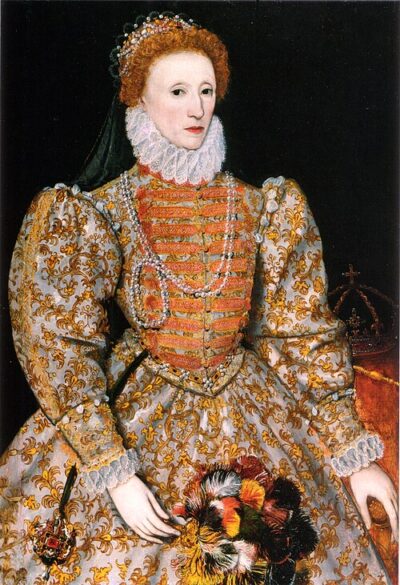
Elizabeth I of England
Elizabeth I of England was a Queen of England and Ireland from 1558 to 1603. Born September 7, 1533, in Palace of Placentia. Died March 24, 1603, in Richmond Palace. Positions held include Monarch of England (1558–1603) and King of Ireland (1558–1603). Awards include Knight of the Garter.
Facts
26 facts · 2 confirmed by two sources · 5 cited · 19 from one source
Where this comes from
Papalocal keeps its own record. It started from these sources; what each one said is kept here as it was copied, so a change on their side never changes this page by itself. Tap one to read its version.
What Wikidata says · copied November 16, 2026 · revision 2567537260
- Described as
- Queen of England and Ireland from 1558 to 1603 (1533–1603)
- Other names
- Princess Elizabeth of England, Queen Bess, Good Queen Bess, Elizabeth Tudor, Gloriana, Queen Elizabeth I, Lady Elizabeth, Virgin Queen, Elisabetta I, Queen Elizabeth, The Virgin Queen, Elizabeth I, Queen of England
- Born
- September 7, 1533 · 5 references
- Died
- March 24, 1603 · 5 references
- Born in
- Palace of Placentia
- Died in
- Richmond Palace
- Buried in
- Westminster Abbey · 1 reference
- Cause of death
- sepsis · 1 reference
- Citizen of
- Kingdom of England
- Occupation
- queen · 1 reference
- Positions held
- Monarch of England (1558–1603); King of Ireland (1558–1603)
- Awards
- Knight of the Garter (1558)
- Father
- Henry VIII of England · 3 references
- Mother
- Anne Boleyn · 3 references
- Siblings
- miscarried son Tudor; Henry, Duke of Cornwall; Mary I; Henry FitzRoy, 1st Duke of Richmond and Somerset; Edward VI of England · 1 reference; Henry, Duke of Cornwall; Catherine Carey · 1 reference; Richard Edwardes · 1 reference; Mary Seymour · 1 reference; Henry Carey, 1st Baron Hunsdon · 1 reference
- Religion
- Anglicanism
- Nickname
- Good Queen Bess; Gloriana
- Wikipedias with a page
- 191
Wikidata item Q7207 (wikidata.org/wiki/Q7207), public domain (CC0). Copied November 16, 2026.
What Wikipedia says · copied November 16, 2026 · revision 1385661529
Elizabeth I (7 September 1533 – 24 March 1603) was Queen of England and Ireland from 17 November 1558 until her death in 1603. She was the last and longest reigning monarch of the House of Tudor. Her eventful reign, and its effect on history and culture, gave name to the Elizabethan era.
Elizabeth was the only surviving child of Henry VIII and his second wife, Anne Boleyn. When Elizabeth was two years old, her parents' marriage was annulled, her mother was executed, and Elizabeth was declared illegitimate. Henry restored her to the line of succession when she was 10. After Henry's death in 1547, Elizabeth's younger half-brother Edward VI ruled until his own death in 1553, bequeathing the crown to a Protestant cousin, Lady Jane Grey, and ignoring the claims of his two half-sisters, Mary and Elizabeth, despite statutes to the contrary. Edward's will was quickly set aside and the Catholic Mary became queen, deposing Jane. During Mary's reign, Elizabeth was imprisoned for nearly a year on suspicion of supporting Protestant rebels.
Upon Mary's death in 1558, Elizabeth succeeded to the throne and set out to rule by good counsel. She depended heavily on a group of trusted advisers led by William Cecil, whom she created Baron Burghley. One of her first actions as queen was the establishment of an English church, of which she became the supreme governor. This arrangement, later named the Elizabethan Religious Settlement, would evolve into the Church of England. It was expected that Elizabeth would marry and produce an heir; however, despite numerous courtships, she never did. Because of this she is sometimes referred to as the "Virgin Queen". She was succeeded by her first cousin twice removed, James VI of Scotland.
In government, Elizabeth was more moderate than her father and siblings had been. One of her mottoes was video et taceo ('I see and keep silent'). In religion, she was relatively tolerant and avoided systematic persecution. After the pope declared her illegitimate in 1570, which in theory released English Catholics from allegiance to her, several conspiracies threatened her life, all of which were defeated with the help of her ministers' secret service, run by Francis Walsingham. Elizabeth was cautious in foreign affairs, manoeuvring between the major powers of France and Spain. She half-heartedly supported a number of ineffective, poorly resourced military campaigns in the Netherlands, France, and Ireland. By the mid-1580s, England could no longer avoid war with Spain.
As she grew older, Elizabeth became celebrated for her virginity. A cult of personality grew around her which was celebrated in the portraits, pageants, and literature of the day. The Elizabethan era is famous for the flourishing of English drama, led by playwrights such as William Shakespeare and Christopher Marlowe, the prowess of English maritime adventurers, such as Francis Drake and Walter Raleigh, and for the defeat of the Spanish Armada. Some historians depict Elizabeth as a short-tempered, sometimes indecisive ruler who enjoyed more than her fair share of luck. Towards the end of her reign, a series of economic and military problems weakened her popularity. Elizabeth is acknowledged as a charismatic performer and a dogged survivor in an era when government was ramshackle and limited, and when monarchs in neighbouring countries faced internal problems and religious civil wars that jeopardised their thrones. After the short, disastrous reigns of her half-siblings, her 44 years on the throne provided welcome stability for the kingdom and helped to forge a sense of national identity.
- Born, in its opening lines
- September 7, 1533
- Died, in its opening lines
- March 24, 1603
From the Wikipedia article “Elizabeth I” (en.wikipedia.org/wiki/Elizabeth_I), by its contributors, under CC BY-SA 4.0 (creativecommons.org/licenses/by-sa/4.0/). Copied November 16, 2026; not changed.
Confirmed Two sources agree. Cited One source, and it names where it got it. One source One source, without a reference of its own. Sources disagree The sources disagree. We show the best-supported value and keep theirs below.
