
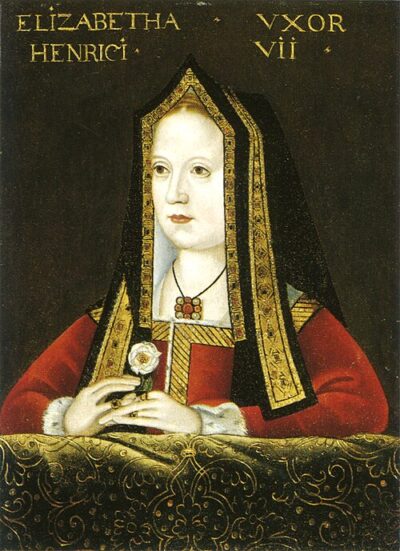
Elizabeth of York
Elizabeth of York was a Queen of England. Born February 11, 1466, in Palace of Westminster. Died February 11, 1503, in Tower of London.
Facts
30 facts · 2 confirmed by two sources · 14 cited · 13 from one source · 1 where the sources disagree
What’s different
- Cause of death: we show death in childbirth (Sources disagree). Wikidata also lists infectious disease
Where this comes from
Papalocal keeps its own record. It started from these sources; what each one said is kept here as it was copied, so a change on their side never changes this page by itself. Tap one to read its version.
What Wikidata says · copied November 16, 2026 · revision 2538729182
- Described as
- Queen of England
- Other names
- Elizabeth Plantagenet
- Born
- February 11, 1466
- Died
- February 11, 1503
- Born in
- Palace of Westminster
- Died in
- Tower of London · 1 reference
- Buried in
- Westminster Abbey · 1 reference
- Cause of death
- infectious disease; death in childbirth · 1 reference
- Citizen of
- Kingdom of England
- Occupation
- royalty
- Spouse
- Henry VII of England (1486–1503) · 2 references
- Children
- Arthur, Prince of Wales · 1 reference; Margaret Tudor · 1 reference; Henry VIII of England · 1 reference; Elizabeth Tudor; Mary Tudor · 1 reference; Edmund Tudor, Duke of Somerset; Edward Tudor · 1 reference; Katherine Tudor · 1 reference
- Father
- Edward IV of England · 1 reference
- Mother
- Elizabeth Woodville · 1 reference
- Siblings
- Margaret of York; Catherine of York; Cecily of York; Mary of York; Anne of York · 1 reference; Bridget of York; George Plantagenet, 1st Duke of Bedford; Edward V of England · 1 reference; Richard of Shrewsbury, 1st Duke of York · 1 reference; Thomas Grey, 1st Marquess of Dorset
- Religion
- Catholicism
- Wikipedias with a page
- 56
Wikidata item Q207953 (wikidata.org/wiki/Q207953), public domain (CC0). Copied November 16, 2026.
What Wikipedia says · copied November 16, 2026 · revision 1383702795
Elizabeth of York (11 February 1466 – 11 February 1503) was Queen of England from her marriage to King Henry VII on 18 January 1486 until she died in 1503. She was the daughter of King Edward IV and Elizabeth Woodville, and her marriage to Henry VII followed his victory at the Battle of Bosworth Field, the penultimate battle of the Wars of the Roses.
Elizabeth's younger brothers, the "Princes in the Tower", mysteriously disappeared from the Tower of London shortly after their uncle Richard III seized the throne in 1483. Although the 1484 Act of Parliament Titulus Regius declared the marriage of her parents as invalid, Elizabeth and her sisters returned to court under Richard III, after spending ten months in sanctuary in Westminster Abbey. It was rumoured that Richard was plotting to marry his niece Elizabeth. The final victory of the Lancastrian faction in the Wars of the Roses may have seemed a further disaster for the Yorkist princess. However, Henry Tudor knew the importance of Yorkist support for his invasion and promised to marry Elizabeth before he arrived in England. This may well have contributed to the haemorrhaging of Yorkist support for Richard, and her future husband had Titulus Regius repealed when he took the throne.
Elizabeth seems to have played little part in politics after coming to the throne. Her marriage appears to have been a successful and happy one, although her eldest son, Arthur, Prince of Wales, died aged 15 in 1502, and three other children died young. Her second and only surviving son became king of England as Henry VIII, while her daughters Margaret and Mary became the queens consort of Scotland and France respectively.
- Born, in its opening lines
- February 11, 1466
- Died, in its opening lines
- February 11, 1503
From the Wikipedia article “Elizabeth of York” (en.wikipedia.org/wiki/Elizabeth_of_York), by its contributors, under CC BY-SA 4.0 (creativecommons.org/licenses/by-sa/4.0/). Copied November 16, 2026; not changed.
Confirmed Two sources agree. Cited One source, and it names where it got it. One source One source, without a reference of its own. Sources disagree The sources disagree. We show the best-supported value and keep theirs below.
