
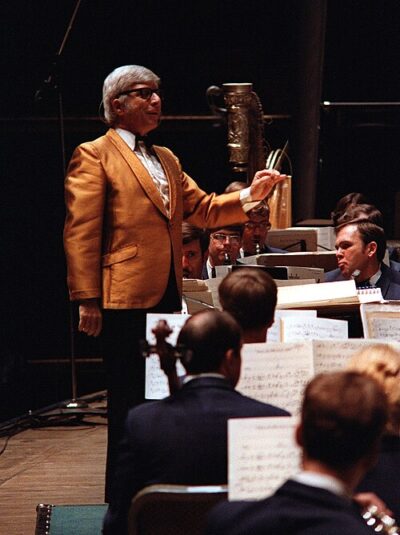
Elmer Bernstein
Elmer Bernstein was an American composer and conductor. Born April 4, 1922, in New York City. Died August 18, 2004, in Ojai. Educated at Juilliard School and New York University. Awards include Golden Globe Award for Best Original Score (2 times), Academy Award for Best Original Score and Golden Raspberry Award for Worst Musical Score.
Facts
28 facts · 2 confirmed by two sources · 8 cited · 18 from one source
What’s different
- Died: we show August 18, 2004 (Confirmed). Wikidata also lists August 19, 2004
Where this comes from
Papalocal keeps its own record. It started from these sources; what each one said is kept here as it was copied, so a change on their side never changes this page by itself. Tap one to read its version.
What Wikidata says · copied November 13, 2026 · revision 2568933743
- Described as
- American composer and conductor (1922-2004)
- Born
- April 4, 1922 · 10 references
- Died
- August 18, 2004 · 6 references; August 19, 2004 · 1 reference
- Born in
- New York City · 2 references
- Died in
- Ojai · 1 reference
- Cause of death
- cancer
- Citizen of
- United States
- Occupation
- composer · 1 reference; conductor · 1 reference; music educator; painter; actor · 1 reference; teacher; pianist; dancer
- Worked for
- University of Southern California
- Education
- Juilliard School; New York University; Steinhardt School of Culture, Education, and Human Development
- Instrument
- keyboard instrument · 1 reference
- Record label
- Imperial
- Awards
- Golden Globe Award for Best Original Score (2 times) (1962, 1966); Academy Award for Best Original Score (1968) · 1 reference; Golden Raspberry Award for Worst Musical Score (1985) · 1 reference; star on Hollywood Walk of Fame · 1 reference
- Children
- Peter Bernstein · 1 reference; Gregory Bernstein
- Lived in
- New York City
- Website
- https://elmerbernstein.com/
- Wikipedias with a page
- 41
Wikidata item Q111436 (wikidata.org/wiki/Q111436), public domain (CC0). Copied November 13, 2026.
What Wikipedia says · copied November 13, 2026 · revision 1379199172
Elmer Bernstein ( BURN-steen; April 4, 1922 – August 18, 2004) was an American composer and conductor. In a career that spanned over five decades, he composed "some of the most recognizable and memorable themes in Hollywood history", including over 150 original film scores, as well as scores for nearly 80 television productions. For his work, he received an Academy Award for Thoroughly Modern Millie (1967) and a Primetime Emmy Award. He also received seven Golden Globe Awards, five Grammy Awards, and two Tony Award nominations.
Bernstein composed and arranged over 100 film scores, including Sudden Fear (1952), The Man with the Golden Arm (1955), The Ten Commandments (1956), Sweet Smell of Success (1957), The Magnificent Seven (1960), To Kill a Mockingbird (1962), The World of Henry Orient (1964), The Great Escape (1963), Hud (1963), Thoroughly Modern Millie (1967), True Grit (1969), My Left Foot (1989), The Grifters (1990), Cape Fear (1991), Twilight (1998), and Far from Heaven (2002). He is known for his work on the comedic films Animal House (1978), Meatballs (1979), Airplane! (1980), The Blues Brothers (1980), Stripes (1981), Heavy Metal (1981), Trading Places (1983), Ghostbusters (1984), Spies Like Us (1985), The Black Cauldron (1985) and Three Amigos (1986).
He also worked on frequent collaborations with directors Martin Scorsese, Robert Mulligan, John Landis, Ivan Reitman, John Sturges, Bill Duke, George Roy Hill, Richard Fleischer, John Frankenheimer, and Henry Hathaway.
In 1985, Bernstein composed the dark, orchestral score for Disney's animated feature The Black Cauldron. Utilizing the eerie electronic tones of the ondes Martenot, with no songs, his work marked a distinct musical shift for Disney animation, though a significant amount of his music was cut out due to last-minute revisions.
- Born, in its opening lines
- April 4, 1922
- Died, in its opening lines
- August 18, 2004
From the Wikipedia article “Elmer Bernstein” (en.wikipedia.org/wiki/Elmer_Bernstein), by its contributors, under CC BY-SA 4.0 (creativecommons.org/licenses/by-sa/4.0/). Copied November 13, 2026; not changed.
Confirmed Two sources agree. Cited One source, and it names where it got it. One source One source, without a reference of its own. Sources disagree The sources disagree. We show the best-supported value and keep theirs below.
