
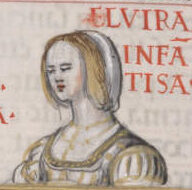
Elvira of Leon was a Queen of Sicily. Born 1100, in Toledo. Died February 6, 1135, in Palermo.
Facts
21 facts · 2 confirmed by two sources · 6 cited · 13 from one source
What’s different
- Born: we show 1100 (Confirmed). Wikidata also lists September 1103
Where this comes from
Papalocal keeps its own record. It started from these sources; what each one said is kept here as it was copied, so a change on their side never changes this page by itself. Tap one to read its version.
What Wikidata says · copied November 18, 2026 · revision 2564294336
- Described as
- Queen of Sicily
- Other names
- Elvira de Castilla
- Born
- September 1103 · 1 reference; 1100
- Died
- February 6, 1135 · 1 reference
- Born in
- Toledo
- Died in
- Palermo
- Buried in
- Palermo Cathedral
- Cause of death
- infectious disease
- Name at birth
- Elvira Alfónsez de León
- Citizen of
- Kingdom of Leon
- Occupation
- aristocrat
- Spouse
- Roger II of Sicily (1117–) · 1 reference
- Children
- Roger III, Duke of Apulia · 1 reference; Tancred, Prince of Bari · 1 reference; Alfonso of Hauteville · 1 reference; William I of Sicily · 1 reference; Adelicia of Sicilia · 1 reference
- Father
- Alfonso VI of León and Castile · 1 reference
- Mother
- Zaida of Seville
- Siblings
- Sancho Alfónsez; Urraca of León; Theresa of León; Elvira of Castile
- Wikipedias with a page
- 24
Wikidata item Q272111 (wikidata.org/wiki/Q272111), public domain (CC0). Copied November 18, 2026.
What Wikipedia says · copied November 18, 2026 · revision 1363285305
Elvira of Castile (c. 1100 – 6 February 1135) was a member of the House of Jiménez and the first Queen of Sicily as the wife of Roger II of Sicily.
Elvira was a legitimate daughter of Alfonso VI, king of León and Castile. Her mother was King Alfonso VI's fourth wife, Isabella. This Isabella is likely identical to Zaida of Seville, the Arab princess from the Abbadid dynasty who was Alfonso's mistress before marrying him. Other historians have argued that she was a French princess. Growing up at her father's court in the multiconfessional city of Toledo, Elvira must have been accustomed to a significant level of convivencia, which was present in Sicily as well.
In 1117 or 1118, Elvira married Roger II, then count of Sicily and king from 1130. Sicily too had a sizeable Muslim population, and the marriage was part of Roger's plan to emulate the religious policy of Elvira's father. Elvira's likely descent from the Muslim rulers of Al-Andalus exemplifies a "pattern of cultural association" between the queens of Sicily and the Islamic world. She may have even influenced the extensive cultivation of Islamic art during her husband's reign.
There is exceptionally little information about Queen Elvira. She does not appear to have been active in politics or as a church patron, and is chiefly remembered for giving birth to Roger's six children. Elvira and Roger had six children:Roger III (1118 – 12 May 1148), heir, Duke of Apulia (from 1135), possibly also Count of Lecce.
Tancred (1120–1138), Prince of Bari (from 1135).
William I (1120/1121 – 7 May 1166), his successor, Duke of Apulia (from 1148).
Alfonso (1122 – 10 October 1144), Prince of Capua (from 1135) and Duke of Naples.
Adelisia (1126 - post 1184), regnant duchess of Florence. She married firstly Jocelyn, Count of Loreto, and secondly Robert III, Count of Loritello.
Henry (1130 - 1143), prince of Taranto.
In 1135, both Roger and Elvira fell ill. The illness was grave and infectious. The king survived, but the queen died on 6 February. Roger was devastated by her death; he withdrew to his room and refused to see anyone except his closest servants. Eventually rumors spread that he too had died. Roger remained a widower for fourteen years and remarried only in 1149, as he had outlived four out of the five sons he had had with Elvira.
- Born, in its opening lines
- c. 1100
- Died, in its opening lines
- February 6, 1135
From the Wikipedia article “Elvira of Castile, Queen of Sicily” (en.wikipedia.org/wiki/Elvira_of_Castile,_Queen_of_Sicily), by its contributors, under CC BY-SA 4.0 (creativecommons.org/licenses/by-sa/4.0/). Copied November 18, 2026; not changed.
Confirmed Two sources agree. Cited One source, and it names where it got it. One source One source, without a reference of its own. Sources disagree The sources disagree. We show the best-supported value and keep theirs below.
