
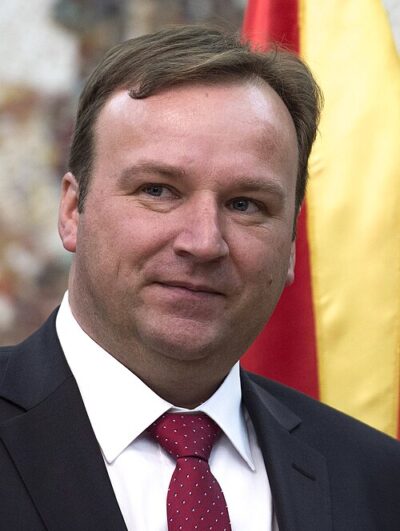
Emil Dimitriev
Emil Dimitriev is a politician from North Macedonia. Born March 19, 1979, in Probištip. Positions held include Prime Minister of North Macedonia (2016–2017) and member of the Assembly of the Republic of North Macedonia (2016–2020). Educated at Ss. Cyril and Methodius University of Skopje and University of Belgrade.
Facts
10 facts · 1 confirmed by two sources · 2 cited · 7 from one source
Where this comes from
Papalocal keeps its own record. It started from these sources; what each one said is kept here as it was copied, so a change on their side never changes this page by itself. Tap one to read its version.
What Wikidata says · copied November 16, 2026 · revision 2562782657
- Described as
- politician from North Macedonia
- Born
- March 19, 1979
- Born in
- Probištip
- Citizen of
- North Macedonia
- Occupation
- politician · 1 reference; head of government · 1 reference
- Positions held
- Prime Minister of North Macedonia (2016–2017); member of the Assembly of the Republic of North Macedonia (2016–2020)
- Political party
- Internal Macedonian Revolutionary Organization – Democratic Party for Macedonian National Unity
- Education
- Ss. Cyril and Methodius University of Skopje; University of Belgrade · 1 reference
- Wikipedias with a page
- 29
Wikidata item Q22077723 (wikidata.org/wiki/Q22077723), public domain (CC0). Copied November 16, 2026.
What Wikipedia says · copied November 16, 2026 · revision 1366601544
Emil Dimitriev (Macedonian: Емил Димитриев, pronounced ['emil dimit'riɛf]; born 19 March 1979) is a Macedonian conservative politician, sociologist, and general secretary of the VMRO-DPMNE. He served as Prime Minister of Macedonia, following the resignation of Nikola Gruevski, from January 2016 to May 2017.
- Born, in its opening lines
- March 19, 1979
From the Wikipedia article “Emil Dimitriev” (en.wikipedia.org/wiki/Emil_Dimitriev), by its contributors, under CC BY-SA 4.0 (creativecommons.org/licenses/by-sa/4.0/). Copied November 16, 2026; not changed.
Confirmed Two sources agree. Cited One source, and it names where it got it. One source One source, without a reference of its own. Sources disagree The sources disagree. We show the best-supported value and keep theirs below.
