
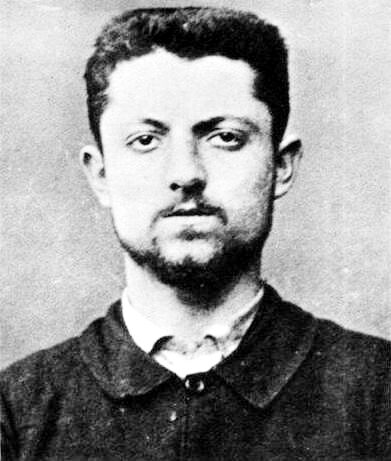
Émile Henry
Émile Henry was a sentenced to death in France. Born September 26, 1872, in Barcelona. Died May 21, 1894, in Paris. Educated at Lycée Jean-Baptiste-Say.
Facts
14 facts · 2 confirmed by two sources · 4 cited · 8 from one source
Where this comes from
Papalocal keeps its own record. It started from these sources; what each one said is kept here as it was copied, so a change on their side never changes this page by itself. Tap one to read its version.
What Wikidata says · copied November 18, 2026 · revision 2545358061
- Described as
- sentenced to death in France
- Other names
- Emile Henry, Saint-Just of Anarchy
- Born
- September 26, 1872 · 2 references
- Died
- May 21, 1894 · 3 references
- Born in
- Barcelona
- Died in
- Paris · 2 references
- Buried in
- Cemetery of Limeil-Brévannes · 1 reference
- Cause of death
- decapitation by guillotine · 2 references
- Citizen of
- France
- Occupation
- writer · 1 reference; anarchist · 1 reference; anarchist terrorist · 1 reference
- Education
- Lycée Jean-Baptiste-Say · 1 reference
- Father
- Fortuné Henry · 1 reference
- Mother
- Rose Caubet · 1 reference
- Siblings
- Jean-Charles Fortuné Henry · 1 reference
- Wikipedias with a page
- 20
Wikidata item Q285998 (wikidata.org/wiki/Q285998), public domain (CC0). Copied November 18, 2026.
What Wikipedia says · copied November 18, 2026 · revision 1360747510
Émile Henry (26 September 1872 – 21 May 1894), nicknamed 'the Saint-Just of Anarchy', was an individualist and illegalist anarchist militant and terrorist. He is best known for his terrorist actions and is considered one of the main founders of modern terrorism.
Born into a family of exiled Communards, he moved to France in 1880, where he pursued studies that promised him a prestigious career. However, after witnessing the misery and social inequalities of his society, he abandoned his studies to join Parisian anarchist circles, particularly under the influence of his older brother, Jean-Charles Fortuné Henry. Associating with various anarchists of the time, especially Charles Malato, who became his friend, he closely followed the beginning of the Ère des attentats, literally "Era of Attacks" (1892–1894) and the first attacks of Ravachol. As he became increasingly isolated, Henry paid close attention to the Carmaux strike and considered the agreement signed by the employers and socialists a betrayal of the proletariat. He then organized the Carmaux-Bons-Enfants bombing (8 November 1892), possibly with his brother and Adrienne Chailliey, targeting the headquarters of the Carmaux Mining Company by planting a parcel bomb. This bomb, retrieved by the police and an employee, exploded at the Bons-Enfants police station, killing four policemen and the employee. This was the deadliest attack of the Ère des attentats.
Although Henry managed to avoid strong suspicion, he fled France and took refuge in the United Kingdom. From this base and Belgium, in 1893, he participated in a series of robberies with the Ortiz gang, notably with Paolo Chiericotti and Léon Ortiz, following the emerging anarchist ideology of illegalism. His robberies and movements during this period are difficult to reconstruct, but he took part in the 1893 general strike in Belgium, where the army fired on the population. Henry himself fired at the police on this occasion. At the beginning of 1894, he returned to Paris, where the authorities were increasingly searching for him. The news of Auguste Vaillant's execution (5 February 1894) pushed him to act, seeking to assassinate the French president, Sadi Carnot. Failing to approach the Élysée Palace with a bomb, he went instead to the Café Terminus, where he threw his bomb into the crowd—killing one person and injuring about twenty others. Pursued by the police, at whom he fired, he was finally arrested.
The Café Terminus bombing and Henry's trial were central events in the emergence of modern terrorism. By targeting an adversary identified with society as a whole, he ushered terrorism into the era of mass terrorism, a phenomenon that continues into the 21st century. Unlike Ravachol or Vaillant, his predecessors, he did not present himself as an avenger but rather as a fighter who must destroy "bourgeois society" or die. He was sentenced to death, which did not seem to trouble him; he refused to appeal—declaring that he did not recognize "bourgeois justice"—and was executed on 21 May 1894 in Paris. The motivations behind this attack are debated, but they could range from a thought-out radicalization to romantic reasons aimed at impressing Élisa Gauthey, the anarchist with whom Henry was in love.
His action was rejected by some anarchists in France, who began to question the use of terrorism to achieve their goals after this event. Thus, he foreshadowed the end of the Ère des attentats and the evolution of anarchism from propaganda by the deed to other forms of struggle, such as anarcho-syndicalism. However, some, especially within individualist anarchism, used him as a symbol and hero of their struggle. Even though he did not influence later anarchist terrorism, the directions he gave to modern terrorism continued into the 21st century within very different movements.
- Born, in its opening lines
- September 26, 1872
- Died, in its opening lines
- May 21, 1894
From the Wikipedia article “Émile Henry (anarchist)” (en.wikipedia.org/wiki/Émile_Henry_(anarchist)), by its contributors, under CC BY-SA 4.0 (creativecommons.org/licenses/by-sa/4.0/). Copied November 18, 2026; not changed.
Confirmed Two sources agree. Cited One source, and it names where it got it. One source One source, without a reference of its own. Sources disagree The sources disagree. We show the best-supported value and keep theirs below.
