
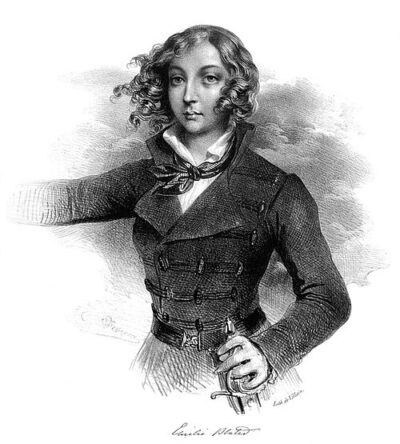
Emilia Plater
Emilia Plater was a Polish noblewoman. Born November 13, 1806, in Vilnius. Died December 23, 1831, in Vainežeris.
Facts
13 facts · 2 confirmed by two sources · 3 cited · 8 from one source
Where this comes from
Papalocal keeps its own record. It started from these sources; what each one said is kept here as it was copied, so a change on their side never changes this page by itself. Tap one to read its version.
What Wikidata says · copied November 16, 2026 · revision 2569254494
- Described as
- Polish noblewoman (1806-1831)
- Other names
- Emilia Plater-Broel, Countess Emilia Plater, Countess Emilia Broel-Plater
- Born
- November 13, 1806 · 2 references
- Died
- December 23, 1831 · 2 references
- Born in
- Vilnius · 2 references
- Died in
- Vainežeris
- Buried in
- Kapčiamiestis
- Cause of death
- disease
- Citizen of
- Russian Empire
- Occupation
- military personnel; freedom fighter · 1 reference; soldier · 1 reference
- Father
- Franciszek Ksawery Plater
- Mother
- Anna Mohl
- Military rank
- captain · 1 reference
- Wikipedias with a page
- 68
Wikidata item Q294136 (wikidata.org/wiki/Q294136), public domain (CC0). Copied November 16, 2026.
What Wikipedia says · copied November 16, 2026 · revision 1385901606
Emilia Plater (Lithuanian: Emilija Pliaterytė; 13 November 1806 – 23 December 1831) was a Polish-Lithuanian noblewoman and participant in the November Uprising of 1830–1831 against the Russian Empire. Born in Vilnius and raised in Polish Livonia, she joined the uprising in the former Grand Duchy of Lithuania in March 1831. She became one of the best-known female participants in the insurrection and was granted the rank of captain by General Dezydery Chłapowski, although the extent of her actual military command remains uncertain.
Plater participated in the insurgent campaign in Lithuania and refused to follow the withdrawing Polish forces into Prussia in July 1831. Instead, she attempted to reach the insurgent army in Congress Poland, but fell ill during the journey. She died in December 1831 at the age of 25 and was buried in Kapčiamiestis, in present-day Lithuania.
Her military exploits, some of which were embellished in later accounts, made her an enduring symbol of the struggle for Polish independence. Immortalised in Adam Mickiewicz's 1832 poem The Death of a Colonel, she became celebrated as the "Polish Joan of Arc" and has also been commemorated in Lithuania and Belarus.
- Born, in its opening lines
- November 13, 1806
- Died, in its opening lines
- December 23, 1831
From the Wikipedia article “Emilia Plater” (en.wikipedia.org/wiki/Emilia_Plater), by its contributors, under CC BY-SA 4.0 (creativecommons.org/licenses/by-sa/4.0/). Copied November 16, 2026; not changed.
Confirmed Two sources agree. Cited One source, and it names where it got it. One source One source, without a reference of its own. Sources disagree The sources disagree. We show the best-supported value and keep theirs below.
