
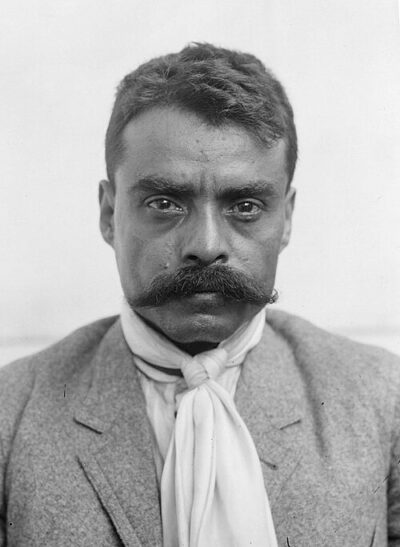
Emiliano Zapata
Emiliano Zapata was a Mexican revolutionary. Born August 8, 1879, in Anenecuilco. Died April 10, 1919, in Morelos.
Facts
17 facts · 2 confirmed by two sources · 2 cited · 13 from one source
Where this comes from
Papalocal keeps its own record. It started from these sources; what each one said is kept here as it was copied, so a change on their side never changes this page by itself. Tap one to read its version.
What Wikidata says · copied November 16, 2026 · revision 2566090575
- Described as
- Mexican revolutionary (1879–1919)
- Other names
- Emiliano Zapata Salazar
- Born
- August 8, 1879 · 5 references
- Died
- April 10, 1919 · 6 references
- Born in
- Anenecuilco · 1 reference
- Died in
- Morelos
- Buried in
- Plaza Revolución del Sur
- Cause of death
- gunshot wound
- Citizen of
- Mexico
- Occupation
- partisan; revolutionary · 1 reference; farmer
- Spouse
- Josefa Espejo Sánchez
- Children
- Paulina Ana María Zapata Portillo
- Siblings
- Eufemio Zapata
- Military branch
- Liberation Army of the South · 1 reference; cavalry · 1 reference
- Military rank
- general
- Height
- 1.75 m (5 ft 9 in)
- Wikipedias with a page
- 97
Wikidata item Q41718 (wikidata.org/wiki/Q41718), public domain (CC0). Copied November 16, 2026.
What Wikipedia says · copied November 16, 2026 · revision 1385311160
Emiliano Zapata Salazar (Latin American Spanish: [emiˈljano saˈpata]; 8 August 1879 – 10 April 1919) was a Mexican revolutionary and guerrilla leader. He was a leading figure in the Mexican Revolution of 1910–1920, the main leader of the people's revolution in the Mexican state of Morelos, and the inspiration of the agrarian movement called Zapatismo.
Zapata was born in the rural village of Anenecuilco, Morelos in an era when peasant communities came under increasing repression from the small-landowning class who monopolized land and water resources for sugarcane production with the support of dictator Porfirio Díaz (President from 1877 to 1880 and 1884 to 1911). Zapata early on participated in political movements against the Porfiriato and the landowning hacendados, and when the Revolution broke out in 1910 he became a leader of the peasant revolt in Morelos. Cooperating with a number of other peasant leaders, he formed the Liberation Army of the South, of which he soon became the undisputed leader. Zapata's forces contributed to the fall of Díaz, defeating the Federal Army in the Battle of Cuautla in May 1911, but when the revolutionary leader Francisco I. Madero became president he disavowed the role of the Zapatistas, denouncing them as mere bandits.
In November 1911, Zapata promulgated the Plan of Ayala, which called for substantial land reforms, redistributing lands to the peasants. Madero sent the Federal Army to root out the Zapatistas in Morelos. Madero's generals employed a scorched-earth policy, burning villages and forcibly removing their inhabitants, and drafting many men into the Army or sending them to forced-labor camps in southern Mexico. Such actions strengthened Zapata's standing among the peasants, and succeeded in driving the forces of Madero, led by Victoriano Huerta, out of Morelos. In a coup against Madero in February 1913, Huerta took power in Mexico, but a coalition of Constitutionalist forces in northern Mexico, led by Venustiano Carranza, Álvaro Obregón and Francisco "Pancho" Villa, ousted him in July 1914 with the support of Zapata's troops. Zapata did not recognize the authority that Carranza asserted as leader of the revolutionary movement, continuing his adherence to the Plan of Ayala.
In the aftermath of the revolutionaries' victory over Huerta, they attempted to sort out power relations in the Convention of Aguascalientes (October to November 1914). Zapata and Villa broke with Carranza, and Mexico descended into a civil war among the winners. Dismayed with the alliance with Villa, Zapata focused his energies on rebuilding society in Morelos (which he now controlled), instituting the land reforms of the Plan of Ayala. As Carranza consolidated his power and defeated Villa in 1915, Zapata initiated guerrilla warfare against the Carrancistas, who in turn invaded Morelos, employing once again scorched-earth tactics to oust the Zapatista rebels. Zapata re-took Morelos in 1917 and held most of the state against Carranza's troops until he was killed in an ambush in April 1919. After his death, Zapatista generals aligned with Obregón against Carranza and helped drive Carranza from power. In 1920, Zapatistas obtained important positions in the government of Morelos after Carranza's fall, instituting many of the land reforms envisioned by Zapata.
Zapata remains an iconic figure in Mexico, used both as a nationalist symbol as well as a symbol of the neo-Zapatista movement. Article 27 of the 1917 Mexican Constitution was drafted in response to Zapata's agrarian demands.
- Born, in its opening lines
- August 8, 1879
- Died, in its opening lines
- April 10, 1919
From the Wikipedia article “Emiliano Zapata” (en.wikipedia.org/wiki/Emiliano_Zapata), by its contributors, under CC BY-SA 4.0 (creativecommons.org/licenses/by-sa/4.0/). Copied November 16, 2026; not changed.
Confirmed Two sources agree. Cited One source, and it names where it got it. One source One source, without a reference of its own. Sources disagree The sources disagree. We show the best-supported value and keep theirs below.
