
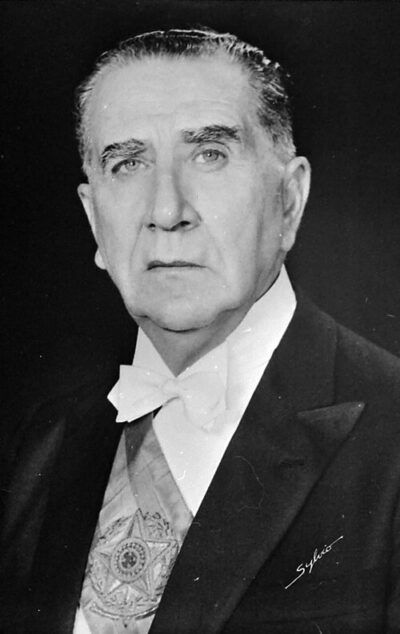
Emílio Garrastazu Médici
Emílio Garrastazu Médici was a Brazilian politician (1905–1985), president of Brazil. Born December 4, 1905, in Bagé. Died October 9, 1985, in Rio de Janeiro. Positions held include President of Brazil (1969–1974). Educated at Academia Militar das Agulhas Negras. Awards include Grand Cross of the Order of the Southern Cross, Order of Rio Branco and Order of Naval Merit.
Facts
26 facts · 2 confirmed by two sources · 2 cited · 22 from one source
Where this comes from
Papalocal keeps its own record. It started from these sources; what each one said is kept here as it was copied, so a change on their side never changes this page by itself. Tap one to read its version.
What Wikidata says · copied November 16, 2026 · revision 2559447256
- Described as
- Brazilian politician (1905–1985), president of Brazil (1969–1974)
- Other names
- Emilio Garrastazu Medici
- Born
- December 4, 1905 · 1 reference
- Died
- October 9, 1985 · 1 reference
- Born in
- Bagé
- Died in
- Rio de Janeiro
- Buried in
- Cemitério de São João Batista · 1 reference
- Cause of death
- stroke
- Citizen of
- Brazil
- Occupation
- politician; military personnel · 1 reference
- Positions held
- President of Brazil (1969–1974)
- Political party
- National Renewal Alliance Party
- Education
- Academia Militar das Agulhas Negras
- Awards
- Grand Cross of the Order of the Southern Cross; Order of Rio Branco; Order of Naval Merit; Grand Collar of the Military Order of the Tower and Sword (1973) · 2 references; Grand Collar of the Military Order of Saint James of the Sword (1972) · 2 references; Order of the Southern Cross · 1 reference; Order of Military Merit · 1 reference; Order of Aeronautical Merit · 1 reference; Military Order of the Tower and Sword · 1 reference; Military Order of Saint James of the Sword · 1 reference; anniversary medal at the occasion of the 2500th anniversary of the founding of the Iranian Empire · 1 reference
- Spouse
- Scylla Médici
- Military branch
- Brazilian Army · 1 reference
- Military rank
- general of the army · 1 reference
- Wikipedias with a page
- 40
Wikidata item Q299165 (wikidata.org/wiki/Q299165), public domain (CC0). Copied November 16, 2026.
What Wikipedia says · copied November 16, 2026 · revision 1380468727
Emílio Garrastazu Médici (Portuguese pronunciation: [eˈmilju ɡɐʁastaˈzu ˈmɛd(ʒi)si]; 4 December 1905 – 9 October 1985) was a Brazilian military leader and dictator who was the 28th president of Brazil from 1969 to 1974. His authoritarian rule marked the apex of the Brazilian military regime.
During his administration, the country experienced the so-called "Economic Miracle", characterized by a 55.84% growth in GDP (an average of 11.16% per year) and a 42.15% increase in per capita income (an average of 8.43% per year). However, this period also saw a threefold rise in external debt and a growing income disparity. Médici took office with inflation at 19.31% and left it at 15.54%. However, the economic growth of the period was driven by a significant increase in foreign investment and a broad state-led investment program funded through international credit institutions. The latter caused a drastic rise in external debt, which grew from $3.9 billion in 1968 to over $12.5 billion in 1973.
His presidency also saw the completion of development projects such as the National Integration Plan (PIN), which enabled the construction of the Trans-Amazonian Highway and the Rio-Niterói Bridge, among other initiatives. There were also significant tax incentives for industry and agriculture, and an agreement with Paraguay for the construction of the Itaipu Hydroelectric Plant — still the most productive hydroelectric facility in the world.
During Médici's presidency, the military dictatorship reached its peak, with strict control over the limited political activities allowed. Repression and censorship of civil institutions were intensified, and any expression of dissent against the regime was prohibited. This period was marked by the systematic use of violent repression, including torture and assassination. Historically, his presidency has been referred to as the "Years of Lead." As a result of this legacy, in 2015 and 2024, respectively, the Federal University of Rio de Janeiro (UFRJ) and the Federal University of Pelotas (UFPel) revoked the honorary Doctorate degrees they had awarded him in the 1970s.
- Born, in its opening lines
- December 4, 1905
- Died, in its opening lines
- October 9, 1985
From the Wikipedia article “Emílio Garrastazu Médici” (en.wikipedia.org/wiki/Emílio_Garrastazu_Médici), by its contributors, under CC BY-SA 4.0 (creativecommons.org/licenses/by-sa/4.0/). Copied November 16, 2026; not changed.
Confirmed Two sources agree. Cited One source, and it names where it got it. One source One source, without a reference of its own. Sources disagree The sources disagree. We show the best-supported value and keep theirs below.
