
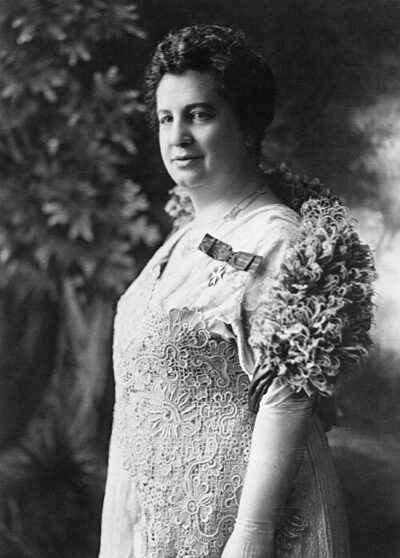
Emily Murphy
Emily Murphy was a Canadian judge. Born March 14, 1868, in London. Died October 27, 1933, in Edmonton. Educated at The Bishop Strachan School.
Facts
11 facts · 2 confirmed by two sources · 0 cited · 9 from one source
Where this comes from
Papalocal keeps its own record. It started from these sources; what each one said is kept here as it was copied, so a change on their side never changes this page by itself. Tap one to read its version.
What Wikidata says · copied November 16, 2026 · revision 2553699716
- Described as
- Canadian judge (1868–1933)
- Other names
- Emily Gowan Ferguson
- Born
- March 14, 1868 · 1 reference
- Died
- October 27, 1933 · 1 reference
- Born in
- London
- Died in
- Edmonton · 1 reference
- Citizen of
- Canada
- Occupation
- judge; human rights defender; writer; women's rights activist
- Education
- The Bishop Strachan School
- Siblings
- William Nassau Ferguson
- Wikipedias with a page
- 23
Wikidata item Q439355 (wikidata.org/wiki/Q439355), public domain (CC0). Copied November 16, 2026.
What Wikipedia says · copied November 16, 2026 · revision 1364640300
Emily Murphy (born Emily Gowan Ferguson; 14 March 1868 – 27 October 1933) was a Canadian women's rights activist and author. In June 1916, she became the first female magistrate in the British Empire. She is best known for her contributions to Canadian feminism, specifically to the question of whether women were "qualified persons" to serve in the Senate under Canadian law.
Murphy is known as one of "The Famous Five" (also called "The Valiant Five")—a group of Canadian women's rights activists that also included Henrietta Muir Edwards, Nellie McClung, Louise McKinney and Irene Parlby. In 1927, the women launched the "Persons Case," contending that women could be "qualified persons" eligible to sit in the Senate. The Supreme Court of Canada ruled that they were not. However, upon appeal to the Judicial Committee of the British Privy Council, the court of last resort for Canada at that time, the women won their case.
However, there has been some criticism of her later work, mainly for her role in the Sexual Sterilization Act of Alberta and her allegations that a ring of immigrants from other countries, particularly China, would corrupt the white race by getting Canadians hooked on drugs. In her book The Black Candle, she wrote: "It is hardly credible that the average Chinese peddler has any definite idea in his mind of bringing about the downfall of the white race, his swaying motive being probably that of greed, but in the hands of his superiors, he may become a powerful instrument to that end."
- Born, in its opening lines
- March 14, 1868
- Died, in its opening lines
- October 27, 1933
From the Wikipedia article “Emily Murphy” (en.wikipedia.org/wiki/Emily_Murphy), by its contributors, under CC BY-SA 4.0 (creativecommons.org/licenses/by-sa/4.0/). Copied November 16, 2026; not changed.
Confirmed Two sources agree. Cited One source, and it names where it got it. One source One source, without a reference of its own. Sources disagree The sources disagree. We show the best-supported value and keep theirs below.
