
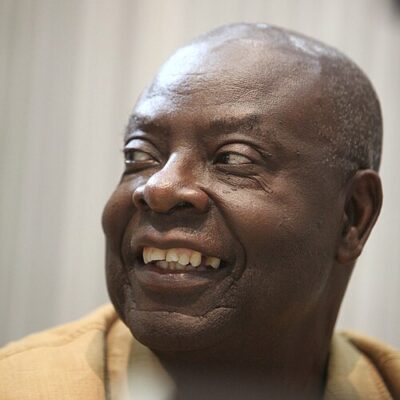
Emmanuel Dongala is a Congolese chemist and novelist. Born July 14, 1941, in Brazzaville. Educated at Rutgers University and Oberlin College. Awards include Guggenheim Fellowship, Grand prix littéraire en poésie d'Afrique noire and prix Virilo.
Facts
13 facts · 0 confirmed by two sources · 8 cited · 5 from one source
Where this comes from
Papalocal keeps its own record. It started from these sources; what each one said is kept here as it was copied, so a change on their side never changes this page by itself. Tap one to read its version.
What Wikidata says · copied November 18, 2026 · revision 2570013792
- Described as
- Congolese chemist and novelist
- Other names
- Emmanuel Boundzéki Dongala
- Born
- July 14, 1941 · 1 reference
- Born in
- Brazzaville · 1 reference
- Citizen of
- Central African Republic; Republic of the Congo; United States · 1 reference
- Occupation
- writer · 1 reference
- Worked for
- Bard College
- Education
- Rutgers University; Oberlin College
- Awards
- Guggenheim Fellowship (1999) · 1 reference; Grand prix littéraire en poésie d'Afrique noire (1988) · 1 reference; prix Virilo (2010) · 1 reference; prix Nessim Habif (2024) · 1 reference
- Wikipedias with a page
- 15
Wikidata item Q2707390 (wikidata.org/wiki/Q2707390), public domain (CC0). Copied November 18, 2026.
What Wikipedia says · copied November 18, 2026 · revision 1384330109
Emmanuel Boundzéki Dongala (born 1941) is a Congolese chemist and novelist. He was born in Brazzaville, Republic of Congo, in 1941. He was Richard B. Fisher Chair in Natural Sciences at Bard College at Simon's Rock until 2014.
Dongala's specialty as a chemist is stereochemistry and asymmetric synthesis, as well as environmental toxicology.
He is the author of a number of award-winning novels including Johnny Mad Dog (French: Johnny chien méchant) and Little Boys Come from the Stars.
From the Wikipedia article “Emmanuel Dongala” (en.wikipedia.org/wiki/Emmanuel_Dongala), by its contributors, under CC BY-SA 4.0 (creativecommons.org/licenses/by-sa/4.0/). Copied November 18, 2026; not changed.
Confirmed Two sources agree. Cited One source, and it names where it got it. One source One source, without a reference of its own. Sources disagree The sources disagree. We show the best-supported value and keep theirs below.
