
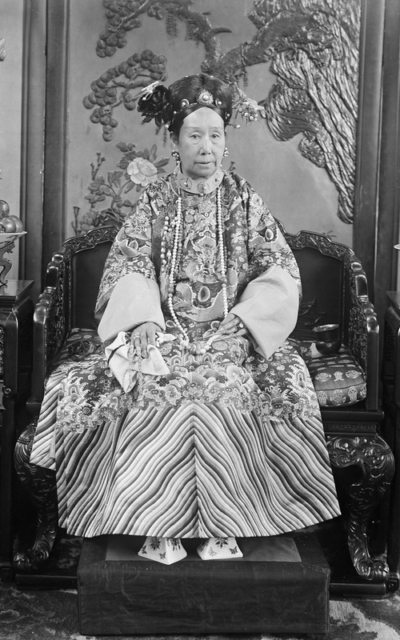
Empress Dowager Cixi
Empress Dowager Cixi was a Chinese empress. Born November 29, 1835, in Beijing. Died November 15, 1908, in Imperial City. Positions held include list of consorts of rulers of China (1861–1908). Awards include Order of Saint Catherine and Order of the Precious Crown.
Facts
22 facts · 2 confirmed by two sources · 4 cited · 16 from one source
Where this comes from
Papalocal keeps its own record. It started from these sources; what each one said is kept here as it was copied, so a change on their side never changes this page by itself. Tap one to read its version.
What Wikidata says · copied November 16, 2026 · revision 2568936028
- Described as
- Chinese empress (1835–1908)
- Other names
- Cixi, Tzu Hsi, Empress Cixi, Cixi Taihou, Tzu-hsi, Empress Tzu-hsi, Dowager Empress Tzu-hsi
- Born
- November 29, 1835 · 3 references
- Died
- November 15, 1908 · 3 references
- Born in
- Beijing · 1 reference
- Died in
- Imperial City
- Buried in
- Eastern Qing tombs
- Citizen of
- Qing dynasty
- Occupation
- politician; queen regnant; painter · 2 references; monarch; photographer · 1 reference
- Positions held
- list of consorts of rulers of China (1861–1908)
- Awards
- Order of Saint Catherine; Order of the Precious Crown
- Spouse
- Xianfeng Emperor
- Children
- Tongzhi Emperor · 1 reference; Guangxu Emperor · 1 reference
- Father
- Yehenara Huizheng
- Mother
- Fuca · 1 reference
- Siblings
- Yehenara Wanzhen; Guixiang; Fuxiang
- Wikipedias with a page
- 101
Wikidata item Q47842 (wikidata.org/wiki/Q47842), public domain (CC0). Copied November 16, 2026.
What Wikipedia says · copied November 16, 2026 · revision 1385624517
Empress Dowager Cixi (Mandarin pronunciation: [tsʰɹ̩̌.ɕì]; 29 November 1835 – 15 November 1908), also known at times as Xingzhen, Lady Yehe Nara, and Consort Yi, was a Manchu noblewoman of the Yehe Nara clan who periodically controlled the government of the late Qing dynasty as empress dowager and regent from 1861 until her death in 1908.
Cixi was selected as a concubine of the Xianfeng Emperor in her adolescence and gave birth to his son, Zaichun, in 1856. After the Xianfeng Emperor's death in 1861, their son became the Tongzhi Emperor, and Cixi assumed the role of co-empress dowager alongside Xianfeng's widow, Empress Dowager Ci'an. She and Ci'an ousted a group of regents appointed by the late emperor and assumed the regency together. Cixi then consolidated control over the dynasty when she installed her nephew as the Guangxu Emperor at the death of the Tongzhi Emperor in 1875. Ci'an continued to be co-regent with Cixi until her death in 1881.
Cixi oversaw the Tongzhi Restoration, during which she rejected Western political institutions but supported technological and military modernization. In 1898, she suppressed the Hundred Days' Reform initiated by the Guangxu Emperor and placed him under house arrest for the remainder of his life, likely eventually having him murdered by arsenic poisoning. (Though it is also speculated that Yuan Shikai may have been the one to have him murdered, due to potential reprisals against him due to his role in supporting Empress Dowager Cixi's coup; there are no reliable sources to prove who murdered the Guangxu Emperor.)
During the Boxer Rebellion, Cixi initially supported the Boxers and declared war on the foreign powers: a decision that led to the occupation of Beijing by the Eight-Nation Alliance and her flight to Xi'an. After the humiliating Boxer Protocol pushed the Qing dynasty to the brink of collapse, she initiated reforms aimed at establishing a constitutional monarchy. Cixi died in November 1908, two days after the Guangxu Emperor, leaving power in the hands of conservative regents amid a deeply divided and unstable society.
Cixi's legacy remains contested. While widely portrayed as a ruthless reactionary, she has been reassessed by some revisionist historians who argue that she was scapegoated for structural problems beyond her control. These scholars credit her with pursuing pragmatic reform in contrast to the Guangxu Emperor's radicalism, maintaining political order under intense imperialist pressure, and supporting institutions such as the Beiyang Army and Peking University.
- Born, in its opening lines
- November 29, 1835
- Died, in its opening lines
- November 15, 1908
From the Wikipedia article “Empress Dowager Cixi” (en.wikipedia.org/wiki/Empress_Dowager_Cixi), by its contributors, under CC BY-SA 4.0 (creativecommons.org/licenses/by-sa/4.0/). Copied November 16, 2026; not changed.
Confirmed Two sources agree. Cited One source, and it names where it got it. One source One source, without a reference of its own. Sources disagree The sources disagree. We show the best-supported value and keep theirs below.
