
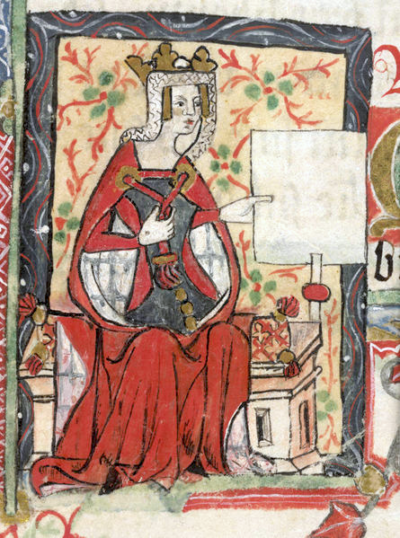
Empress Matilda
Empress Matilda was a Holy Roman Empress (1114–1125); claimant to the English throne. Born February 7, 1102, in Sutton Courtenay. Died September 10, 1167, in Notre-Dame des Prés. Positions held include queen consort and monarch (1141).
Facts
27 facts · 2 confirmed by two sources · 8 cited · 16 from one source · 1 where the sources disagree
What’s different
- Born in: we show Sutton Courtenay (Sources disagree). Wikidata also lists Winchester
Where this comes from
Papalocal keeps its own record. It started from these sources; what each one said is kept here as it was copied, so a change on their side never changes this page by itself. Tap one to read its version.
What Wikidata says · copied November 16, 2026 · revision 2564004726
- Described as
- Holy Roman Empress (1114–1125); claimant to the English throne
- Other names
- Empress Maude, Maud of England, Lady of England, Matilda, Maud, Matilde o Mahaut, Matilda of England, Matilda the Empress, Empress Matilda of Germany
- Born
- February 7, 1102 · 5 references
- Died
- September 10, 1167 · 9 references
- Born in
- Sutton Courtenay · 1 reference; Winchester · 1 reference
- Died in
- Notre-Dame des Prés · 1 reference
- Buried in
- Rouen Cathedral
- Citizen of
- Kingdom of England
- Occupation
- regent
- Positions held
- queen consort; monarch (1141)
- Spouse
- Henry V (1114–1125) · 2 references; Geoffrey Plantagenet, Count of Anjou (1128–1151) · 2 references
- Children
- Henry II of England · 1 reference; Geoffrey, Count of Nantes; William FitzEmpress · 3 references; Emma of Anjou · 1 reference
- Father
- Henry I of England · 1 reference
- Mother
- Matilda of Scotland · 1 reference
- Siblings
- Alice FitzRoy; Matilda FitzRoy, Countess of Perche; Matilda FitzRoy, Duchess of Brittany; Matilda FitzRoy, Abbess of Montvilliers; Sybilla of Normandy; William Adelin; Reginald de Dunstanville, 1st Earl of Cornwall; Henry FitzRoy; Robert, 1st Earl of Gloucester; Fulk FitzRoy
- Wikipedias with a page
- 66
Wikidata item Q150872 (wikidata.org/wiki/Q150872), public domain (CC0). Copied November 16, 2026.
What Wikipedia says · copied November 16, 2026 · revision 1381200325
Empress Matilda (c. 7 February 1102 – 10 September 1167), also known as Empress Maud or Athelicia, was Holy Roman Empress as the consort of Emperor Henry V from 1110 until 1125, and was subsequently a claimant to the English throne during the civil war known as the Anarchy (1138–1153). Following the death of her father, King Henry I of England, as his only surviving legitimate child and nominated heir, she asserted her right to the English throne. However, her cousin Stephen of Blois usurped the crown.
Matilda was the eldest child and only surviving daughter of Henry I of England and his first wife, Matilda of Scotland. As a child, she went to Germany where she was married to the future Henry V. She travelled with the emperor to Italy in 1116, was controversially crowned empress in St Peter's Basilica, and acted as the imperial regent in Italy. Matilda and Henry V had no children, and when he died in 1125, his rival Lothair of Supplinburg claimed the imperial crown.
Matilda's brother, William Adelin, died in the White Ship disaster of 1120, leaving Matilda's father and realm facing a potential succession crisis. Upon her widowhood in the Holy Roman Empire, Henry I recalled Matilda to his Duchy of Normandy and arranged for her to marry Geoffrey of Anjou to form an alliance to protect his southern borders in France. Henry had no further legitimate children and nominated Matilda as his heir, making his court swear an oath of loyalty to her and her successors, but the decision was not popular in his Anglo-Norman court. Henry died in 1135, but Matilda and Geoffrey faced opposition from the barons. Henry's nephew and successor, King Stephen, enjoyed the backing of the English Church. Stephen took steps to solidify his new regime but faced threats both from neighbouring powers and from opponents within his kingdom.
In 1139, Matilda crossed to England to take the kingdom by force, supported by her half-brother Robert, Earl of Gloucester, and her uncle David I of Scotland, while her husband, Geoffrey, focused on conquering Normandy. Matilda's forces captured Stephen at the Battle of Lincoln in 1141, but her attempt to be crowned at Westminster Abbey collapsed in the face of bitter opposition from the London crowds. As a result of this retreat, Matilda was never formally declared Queen of England, and was instead titled "Lady of the English" (Latin: domina Anglorum). Robert was captured following the Rout of Winchester in 1141, and Matilda agreed to exchange Stephen for him. Matilda was besieged at Oxford Castle by Stephen's forces that winter, but escaped at night across the frozen River Isis (Thames) to Abingdon. The war degenerated into a stalemate, with Matilda controlling much of the south-west of England, and Stephen the south-east and the Midlands. Large parts of the rest of the country were in the hands of local, independent barons.
Matilda returned to Normandy, now in the hands of her husband, in 1148, leaving their eldest son, Henry, to continue the campaign in England; he was eventually declared Stephen's heir after the signing of the Treaty of Wallingford and succeeded to the throne in 1154, forming the Angevin Empire. Matilda settled her court near Rouen and for the rest of her life concerned herself with the administration of Normandy, acting on her son's behalf when necessary. Particularly in the early years of her son's reign, she provided political advice and attempted to mediate during the Becket controversy. She worked extensively with the Church, founding Cistercian monasteries, and was known for her piety. She was buried under the high altar at Bec Abbey after her death in 1167, until much later when her tomb was moved to Rouen Cathedral.
- Born, in its opening lines
- February 7, 1102
- Died, in its opening lines
- September 10, 1167
From the Wikipedia article “Empress Matilda” (en.wikipedia.org/wiki/Empress_Matilda), by its contributors, under CC BY-SA 4.0 (creativecommons.org/licenses/by-sa/4.0/). Copied November 16, 2026; not changed.
Confirmed Two sources agree. Cited One source, and it names where it got it. One source One source, without a reference of its own. Sources disagree The sources disagree. We show the best-supported value and keep theirs below.
