
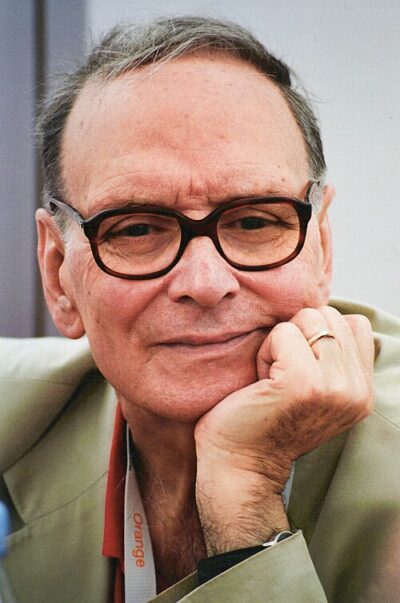
Ennio Morricone
Ennio Morricone was an Italian composer, orchestrator and conductor. Born November 10, 1928, in Rome. Died July 6, 2020, in Rome. Known for Il buono, il brutto, il cattivo and Once Upon a Time in the West. Educated at Accademia Nazionale di Santa Cecilia. Awards include Knight of the Legion of Honour, Gold Medal of the Italian Order of Merit for Culture and Art and Nastro d'Argento for Best Score.
Facts
50 facts · 2 confirmed by two sources · 19 cited · 29 from one source
Where this comes from
Papalocal keeps its own record. It started from these sources; what each one said is kept here as it was copied, so a change on their side never changes this page by itself. Tap one to read its version.
What Wikidata says · copied November 16, 2026 · revision 2569001590
- Described as
- Italian composer, orchestrator and conductor (1928–2020)
- Other names
- Dan Savio, Leo Nichols
- Born
- November 10, 1928 · 8 references
- Died
- July 6, 2020 · 5 references
- Born in
- Rome · 2 references
- Died in
- Rome · 2 references
- Buried in
- Cimitero Laurentino
- Cause of death
- femoral fracture · 1 reference
- Citizen of
- Italy · 1 reference
- Occupation
- conductor; pianist; film score composer · 1 reference; music arranger · 1 reference; composer · 2 references; trumpeter · 1 reference; record producer · 1 reference; musician · 2 references
- Worked for
- Accademia Nazionale di Santa Cecilia
- Education
- Accademia Nazionale di Santa Cecilia
- Member of
- The Ennio Morricone Orchestra · 1 reference
- Sport
- chess
- Genre
- film score · 1 reference
- Instrument
- piano; trumpet · 1 reference
- Record label
- Virgin Records
- Known for
- Il buono, il brutto, il cattivo; Once Upon a Time in the West
- Awards
- Knight of the Legion of Honour (2009); Gold Medal of the Italian Order of Merit for Culture and Art (2000) · 1 reference; Nastro d'Argento for Best Score (1965) · 1 reference; Grammy Trustees Award (2014); Academy Award for Best Original Score (2016) · 1 reference; Artis Bohemiae Amicis Medal (2015); Leopard of Honour (1989); Knight Grand Cross of the Order of Merit of the Italian Republic (2017); European Film Academy Lifetime Achievement Award (1999) · 1 reference; European Film Award for Best Composer (2013) · 1 reference; Grammy Awards · 1 reference; Princess of Asturias Award for the Arts (2020); Order of the Rising Sun, 4th class; star on Hollywood Walk of Fame · 1 reference; Cinearti La chioma di Berenice Prize
- Field
- film score · 1 reference; television score · 1 reference; jazz · 1 reference; music · 1 reference
- Spouse
- Maria Travia
- Children
- Andrea Morricone · 1 reference; Giovanni Morricone
- Father
- Mario Morricone
- Lived in
- Rome
- Website
- http://www.enniomorricone.org
- Wikipedias with a page
- 94
Wikidata item Q23848 (wikidata.org/wiki/Q23848), public domain (CC0). Copied November 16, 2026.
What Wikipedia says · copied November 16, 2026 · revision 1382863820
Ennio Morricone (10 November 1928 – 6 July 2020) was an Italian composer, orchestrator, conductor, trumpeter, and pianist who wrote music in a wide range of styles. With more than 400 scores for cinema and television, as well as more than 100 classical works, Morricone is widely considered one of the greatest and most prolific film composers of all time. He received numerous accolades throughout his career, including two Academy Awards, three Grammy Awards, three Golden Globes, six BAFTAs, ten David di Donatello, eleven Nastro d'Argento, two European Film Awards, the Golden Lion Honorary Award, and the Polar Music Prize.
His filmography includes more than 70 award-winning films, all of Sergio Leone's films from A Fistful of Dollars on, all of Giuseppe Tornatore's films since Cinema Paradiso, Dario Argento's Animal Trilogy, as well as The Battle of Algiers (1966), 1900 (1976), La Cage aux Folles (1978), Le Professionnel (1981), The Thing (1982), The Key (1983) by Tinto Brass and Tie Me Up! Tie Me Down! (1989). He received the Academy Award for Best Original Score nominations for Days of Heaven (1978), The Mission (1986), The Untouchables (1987), Bugsy (1991), Malèna (2000) and The Hateful Eight (2015), winning for the last. He won the Academy Honorary Award in 2007. His score to The Good, the Bad and the Ugly (1966) is regarded as one of the most influential soundtracks in history. It was inducted into the Grammy Hall of Fame in 2008.
After playing the trumpet in jazz bands in the 1940s, Morricone became a studio arranger for RCA Victor and in 1955 started ghost writing for film and theatre. Throughout his career, he composed music for artists such as Paul Anka, Mina, Milva, Zucchero, and Andrea Bocelli. From 1960 to 1975, he gained international fame for composing music for Westerns and—with an estimated 10 million copies sold—Once Upon a Time in the West is one of the best-selling scores worldwide. From 1966 to 1980, he was a main member of Il Gruppo, one of the first experimental composers collectives. In 1969, he co-founded Forum Music Village, a prestigious recording studio. He continued to compose music for European productions, such as Marco Polo, La piovra, Nostromo, Fateless, Karol, and En mai, fais ce qu'il te plait.
Morricone composed for Hollywood directors such as Don Siegel, Mike Nichols, Brian De Palma, Barry Levinson, William Friedkin, Oliver Stone, Warren Beatty, John Carpenter, and Quentin Tarantino. He has also worked with directors such as Bernardo Bertolucci, Mauro Bolognini, Tinto Brass, Giuliano Montaldo, Roland Joffé, Wolfgang Petersen, Roman Polanski, Henri Verneuil, Mario Bava, Lucio Fulci, Umberto Lenzi, Gillo Pontecorvo, and Pier Paolo Pasolini. His best-known compositions include "The Ecstasy of Gold", "Se telefonando", "Man with a Harmonica", "Here's to You", "Chi mai", "Gabriel's Oboe", and "E più ti penso". He has influenced many artists including Hans Zimmer, Danger Mouse, Dire Straits, Muse, Metallica, Fields of the Nephilim, and Radiohead.
On May 10, 2016, Mondadori Libri published his official autobiography, Ennio Morricone. Inseguendo quel suono. La mia musica, la mia vita. Written in conversation with Alessandro De Rosa, the book has been reprinted several times in Italy, translated into the world's major languages, transcribed and published in English under the title Ennio Morricone: In His Own Words by Oxford University Press in 2019, and described by Morricone himself in the preface as "the best book ever written about me, the most authentic, the most detailed and well curated. The truest."
- Born, in its opening lines
- November 10, 1928
- Died, in its opening lines
- July 6, 2020
From the Wikipedia article “Ennio Morricone” (en.wikipedia.org/wiki/Ennio_Morricone), by its contributors, under CC BY-SA 4.0 (creativecommons.org/licenses/by-sa/4.0/). Copied November 16, 2026; not changed.
Confirmed Two sources agree. Cited One source, and it names where it got it. One source One source, without a reference of its own. Sources disagree The sources disagree. We show the best-supported value and keep theirs below.
