
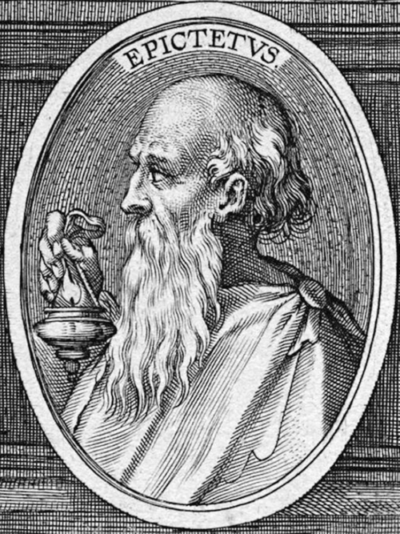
Epictetus
Epictetus was a Greek Stoic philosopher (c. 50–c. 138). Born 50, in Hierapolis. Died 138, in Nicopolis.
Facts
8 facts · 0 confirmed by two sources · 4 cited · 3 from one source · 1 where the sources disagree
What’s different
- Died: we show 138 (Sources disagree). Wikidata also lists 125
Where this comes from
Papalocal keeps its own record. It started from these sources; what each one said is kept here as it was copied, so a change on their side never changes this page by itself. Tap one to read its version.
What Wikidata says · copied November 16, 2026 · revision 2568258764
- Described as
- Greek Stoic philosopher (c. 50–c. 138)
- Other names
- Epiktetos, Epictetus of Hierapolis
- Born
- 50 · 4 references
- Died
- 138 · 2 references; 125 · 1 reference
- Born in
- Hierapolis · 1 reference
- Died in
- Nicopolis · 1 reference
- Citizen of
- Ancient Rome · 1 reference
- Occupation
- philosopher · 1 reference; writer · 1 reference
- Field
- philosophy · 1 reference
- Wikipedias with a page
- 118
Wikidata item Q183144 (wikidata.org/wiki/Q183144), public domain (CC0). Copied November 16, 2026.
What Wikipedia says · copied November 16, 2026 · revision 1364934656
Epictetus ( EH-pick-TEE-təss; Ancient Greek: Ἐπίκτητος, Epíktētos; c. 50 – c. 135 AD) was a Greek Stoic philosopher. He was born into slavery at Hierapolis, Phrygia (present-day Pamukkale, in western Turkey) and lived in Rome until his banishment, after which he spent the rest of his life in Nicopolis in northwestern Greece.
Epictetus studied Stoic philosophy under Musonius Rufus and after manumission, his formal emancipation from slavery, he began to teach philosophy. When philosophers were banished from Rome by Emperor Domitian toward the end of the first century, Epictetus founded a school of philosophy in Nicopolis. He taught that philosophy is a way of life and not simply a theoretical discipline. To Epictetus, all external events are beyond our control; he argues that we should accept whatever happens calmly and dispassionately. However, he held that individuals are responsible for their own actions, which they can examine and control through rigorous self-discipline. His teachings were written down and published by his pupil Arrian in his Discourses and Enchiridion. They influenced many later thinkers, including Marcus Aurelius, Rabelais, Pascal, Montesquieu, Diderot, and Samuel Johnson.
From the Wikipedia article “Epictetus” (en.wikipedia.org/wiki/Epictetus), by its contributors, under CC BY-SA 4.0 (creativecommons.org/licenses/by-sa/4.0/). Copied November 16, 2026; not changed.
Confirmed Two sources agree. Cited One source, and it names where it got it. One source One source, without a reference of its own. Sources disagree The sources disagree. We show the best-supported value and keep theirs below.
