
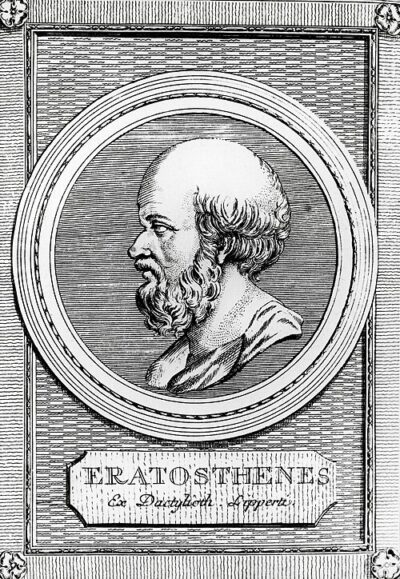
Eratosthenes
Eratosthenes was a Greek mathematician, geographer, poet, astronomer, librarian and music theorist. Born 276 BC, in Cyrene. Died 194 BC, in Alexandria. Positions held include head of the Library of Alexandria (-255–-200). Known for sieve of Eratosthenes and Catasterismi.
Facts
20 facts · 0 confirmed by two sources · 4 cited · 16 from one source
Where this comes from
Papalocal keeps its own record. It started from these sources; what each one said is kept here as it was copied, so a change on their side never changes this page by itself. Tap one to read its version.
What Wikidata says · copied November 16, 2026 · revision 2566560498
- Described as
- Greek mathematician, geographer, poet, astronomer, librarian and music theorist
- Other names
- Eratosthenes of Cyrene, Eρατοσθένης
- Born
- 276 BC · 3 references
- Died
- 194 BC · 4 references
- Born in
- Cyrene · 1 reference
- Died in
- Alexandria · 1 reference
- Name at birth
- Ἐρατοσθένης
- Occupation
- mathematician · 1 reference; astronomer · 1 reference; poet · 1 reference; librarian; historian; writer; musicologist; music theorist
- Positions held
- head of the Library of Alexandria (-255–-200) · 1 reference
- Worked for
- Library of Alexandria · 1 reference
- Known for
- sieve of Eratosthenes; Catasterismi
- Field
- geometry; number theory; geography
- Wikipedias with a page
- 111
Wikidata item Q43182 (wikidata.org/wiki/Q43182), public domain (CC0). Copied November 16, 2026.
What Wikipedia says · copied November 16, 2026 · revision 1385632656
Eratosthenes of Cyrene ( err-ə-TOSS-thə-neez; Ancient Greek: Ἐρατοσθένης [eratostʰénɛːs]; c. 276 BC – c. 195/194 BC) was an Ancient Greek polymath: a philosopher, scholar, mathematician, geographer, poet, astronomer, and music theorist. Eratosthenes eventually became the chief librarian at the Library of Alexandria. His work was the precursor to the modern discipline of geography, and he introduced some of its terminology, coining the terms geography and geographer.
He is best remembered as the first known person to calculate the Earth's circumference. He was also the first to calculate Earth's axial tilt, which similarly proved to have remarkable accuracy. He created the first global projection of the world incorporating parallels and meridians based on the geographic knowledge of his era. Eratosthenes was the founder of scientific chronology; he used Egyptian and Persian records to estimate the dates of the main events of the Trojan War, dating the sack of Troy to 1184 BC. In number theory, he introduced the sieve of Eratosthenes, an efficient method of identifying prime numbers and composite numbers.
His devotees nicknamed him Pentathlos after the Olympians who competed in that multi-event contest, for he had proven himself to be knowledgeable in every area of learning. Yet, according to an entry in the Suda (a 10th-century Byzantine encyclopedia), some critics scorned him, calling him Beta (Second, or Number 2) because he always came in second in all his endeavors.
From the Wikipedia article “Eratosthenes” (en.wikipedia.org/wiki/Eratosthenes), by its contributors, under CC BY-SA 4.0 (creativecommons.org/licenses/by-sa/4.0/). Copied November 16, 2026; not changed.
Confirmed Two sources agree. Cited One source, and it names where it got it. One source One source, without a reference of its own. Sources disagree The sources disagree. We show the best-supported value and keep theirs below.
