
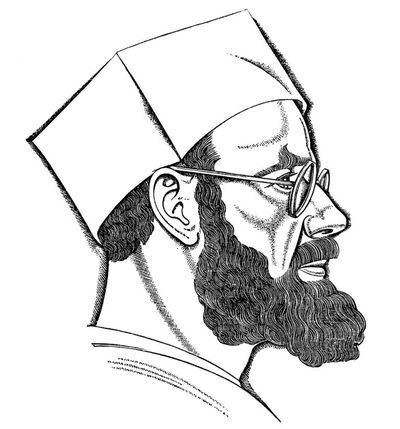
Eric Gill
Eric Gill was an English sculptor, typeface designer, and printmaker. Born February 22, 1882, in Brighton. Died November 17, 1940, in Uxbridge. Educated at Central School of Art and Design. Awards include Royal Designer for Industry.
Facts
31 facts · 2 confirmed by two sources · 14 cited · 15 from one source
Where this comes from
Papalocal keeps its own record. It started from these sources; what each one said is kept here as it was copied, so a change on their side never changes this page by itself. Tap one to read its version.
What Wikidata says · copied November 16, 2026 · revision 2557870544
- Described as
- English sculptor, typeface designer, and printmaker (1882–1940)
- Other names
- Arthur Eric Rowton Gill, A. E. R. G., Arthur Eric Rovton Peter Joseph Gill, Arthur Eric Rowton Peter Joseph Gill, E. P. J. G., Arthur Eric Rovton Peter Joseph
- Born
- February 22, 1882 · 11 references
- Died
- November 17, 1940 · 11 references
- Born in
- Brighton · 1 reference
- Died in
- Uxbridge · 1 reference
- Buried in
- Bisham Abbey
- Cause of death
- lung cancer
- Citizen of
- United Kingdom · 1 reference; United Kingdom of Great Britain and Ireland (–1927)
- Occupation
- type designer; sculptor · 3 references; graphic designer · 1 reference; illustrator; postage stamp designer; printer · 1 reference; artist · 1 reference; exlibrist · 1 reference
- Worked for
- Central School of Art and Design
- Education
- Central School of Art and Design
- Member of
- Royal Academy of Arts; Hague & Gill
- Awards
- Royal Designer for Industry (1936) · 1 reference
- Field
- art of sculpture; typography; erotic art · 1 reference
- Spouse
- Ethel Foster Moore (1904–) · 1 reference
- Children
- Elizabeth Moore Gill · 1 reference; Petra Tegetmeier · 1 reference; Joanna Moore Gill · 1 reference
- Father
- Arthur Tidman Gill · 1 reference
- Mother
- Cicely Rose King · 1 reference
- Siblings
- MacDonald Gill
- Wikipedias with a page
- 30
Wikidata item Q551426 (wikidata.org/wiki/Q551426), public domain (CC0). Copied November 16, 2026.
What Wikipedia says · copied November 16, 2026 · revision 1386017201
Arthur Eric Rowton Gill (22 February 1882 – 17 November 1940) was an English sculptor, letter cutter, typeface designer, and printmaker. Although the Oxford Dictionary of National Biography describes Gill as "the greatest artist-craftsman of the twentieth century: a letter-cutter and type designer of genius", he is also a figure of considerable controversy following the revelations of his sexual abuse of two of his daughters and of his pet dog.
Gill was born in Brighton and grew up in Chichester, where he attended the local college before moving to London. There he became an apprentice with a firm of ecclesiastical architects and took evening classes in stone masonry and calligraphy. Gill abandoned his architectural training and set up a business cutting memorial inscriptions for buildings and headstones. He also began designing chapter headings and title pages for books.
As a young man, Gill was a member of the Fabian Society, but later resigned. Initially identifying with the Arts and Crafts Movement, by 1907 he was lecturing and campaigning against the movement's perceived failings. He became a Roman Catholic in 1913 and remained so for the rest of his life. Gill established a succession of craft communities, each with a chapel at its centre and with an emphasis on manual labour as opposed to more modern industrial methods. The first of these communities was at Ditchling in Sussex, where Gill established The Guild of St Joseph and St Dominic for Catholic craftsmen. Many members of the Guild, including Gill, were also members of the Third Order of Saint Dominic, a lay division of the Dominican Order. At Ditchling, Gill and his assistants created several war memorials including those at Chirk in north Wales and at Trumpington near Cambridge, along with numerous works on religious subjects.
In 1924, the Gill family left Ditchling and moved to an isolated, disused monastery at Capel-y-ffin in the Black Mountains of Wales. The isolation of Capel-y-ffin suited Gill's wish to distance himself from what he regarded as an increasingly secular and industrialised society, and his time there proved to be among the most productive of his artistic career. At Capel, Gill made the sculptures The Sleeping Christ (1925), Deposition (1925), and Mankind (1927). He created engravings for a series of books published by the Golden Cockerel Press considered among the finest of their kind, and it was at Capel that he designed the typefaces Perpetua, Gill Sans, and Solus. After four years at Capel, Gill and his family moved into a quadrangle of properties at Speen in Buckinghamshire. From there, in the last decade of his life, Gill became an architectural sculptor of some fame, creating large, high-profile works for central London buildings, including both the headquarters of the BBC and the forerunner of London Underground. His mammoth frieze The Creation of Man was the British Government's gift to the new League of Nations building in Geneva. Despite failing health Gill was active as a sculptor until the last weeks of his life, leaving several works to be completed by his assistants after his death.
Gill was a prolific writer on religious and social matters, with some 300 printed works including books and pamphlets to his name. He frequently courted controversy with his opposition to industrialisation, modern commerce, and the use of machinery in both the home and the workplace. In the years preceding World War II, he embraced pacifism and left-wing causes.
- Born, in its opening lines
- February 22, 1882
- Died, in its opening lines
- November 17, 1940
From the Wikipedia article “Eric Gill” (en.wikipedia.org/wiki/Eric_Gill), by its contributors, under CC BY-SA 4.0 (creativecommons.org/licenses/by-sa/4.0/). Copied November 16, 2026; not changed.
Confirmed Two sources agree. Cited One source, and it names where it got it. One source One source, without a reference of its own. Sources disagree The sources disagree. We show the best-supported value and keep theirs below.
