
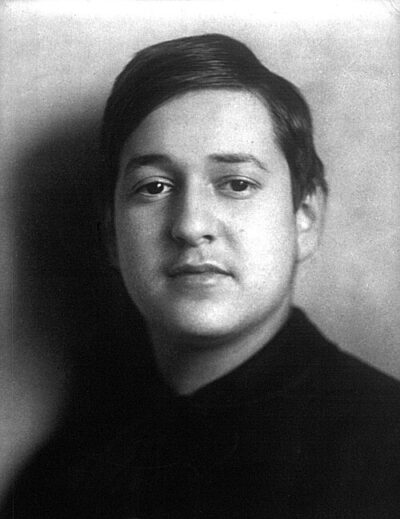
Erich Wolfgang Korngold
Erich Wolfgang Korngold was an Austrian-born American composer and conductor. Born May 29, 1897, in Brno. Died November 29, 1957, in Hollywood. Educated at University of Music and Performing Arts Vienna. Awards include Academy Award for Best Original Score.
Facts
27 facts · 2 confirmed by two sources · 12 cited · 13 from one source
Where this comes from
Papalocal keeps its own record. It started from these sources; what each one said is kept here as it was copied, so a change on their side never changes this page by itself. Tap one to read its version.
What Wikidata says · copied November 13, 2026 · revision 2565843693
- Described as
- Austrian-born American composer and conductor (1897–1957)
- Born
- May 29, 1897 · 16 references
- Died
- November 29, 1957 · 17 references
- Born in
- Brno · 5 references
- Died in
- Hollywood · 2 references
- Buried in
- Hollywood Forever Cemetery
- Citizen of
- Austria; United States (1943–) · 1 reference
- Occupation
- classical composer; pianist · 1 reference; conductor · 2 references; film score composer; librettist; composer · 3 references; music arranger · 1 reference; musician · 1 reference
- Worked for
- University of Music and Performing Arts Vienna
- Education
- University of Music and Performing Arts Vienna
- Member of
- Paul Schott
- Genre
- opera; film score
- Instrument
- piano
- Awards
- Academy Award for Best Original Score (1939) · 1 reference
- Field
- performing arts
- Spouse
- Luise Korngold (1924–) · 1 reference
- Children
- George Korngold · 1 reference
- Father
- Julius Korngold · 1 reference
- Website
- https://korngold-society.org/site/
- Wikipedias with a page
- 41
Wikidata item Q313371 (wikidata.org/wiki/Q313371), public domain (CC0). Copied November 13, 2026.
What Wikipedia says · copied November 13, 2026 · revision 1378380988
Erich Wolfgang Korngold (German: [ˈeːʁɪç ˈvɔlfɡaŋ ˈkɔʁnɡɔlt]; May 29, 1897 – November 29, 1957) was an Austrian composer and conductor, who left Europe in the mid-1930s and later adopted US nationality. A child prodigy, he became one of the most important and influential composers in Hollywood history. He was a noted pianist and composer of classical music, along with music for Hollywood films, and the first composer of international stature to write Hollywood scores.
When he was 11, his ballet Der Schneemann (The Snowman) became a sensation in Vienna; his Second Piano Sonata, which he wrote at age 13, was played throughout Europe by Artur Schnabel. His one-act operas Violanta and Der Ring des Polykrates were premiered in Munich in 1916, conducted by Bruno Walter. At 23, his opera Die tote Stadt (The Dead City) premiered in Hamburg and Cologne. In 1921 he conducted the Hamburg Opera. During the 1920s he re-orchestrated, re-arranged and nearly re-composed several operettas by Johann Strauss II. By 1931 he was a professor of music at the Vienna State Academy.
At the request of motion picture director Max Reinhardt, and due to the rise of the Nazi regime, Korngold moved to Hollywood in 1934 to write music for films. His first was Reinhardt's A Midsummer Night's Dream (1935). He subsequently wrote scores for such films as Captain Blood (1935), which helped boost the career of its starring newcomer, Errol Flynn. His score for Anthony Adverse (1936) won an Oscar; two years later he won another Oscar for The Adventures of Robin Hood (1938).
Korngold scored 16 Hollywood films in all, and received two more nominations for Oscars. Along with Max Steiner and Alfred Newman, he is one of the founders of American film music. Although his late-Romantic style of classical composition was no longer as popular when he died in 1957, his music underwent a resurgence of interest in the 1970s beginning with the release of the RCA Red Seal album The Sea Hawk: The Classic Film Scores of Erich Wolfgang Korngold (1972). This album, produced by his son George Korngold, was hugely popular and ignited interest in his other film music (and that of other classic film composers), as well as in his concert music, which often incorporates popular themes from his film scores (an example being the Violin Concerto in D, Op. 35, which incorporates themes from four of his motion picture scores and has become part of the standard repertoire).
- Born, in its opening lines
- May 29, 1897
- Died, in its opening lines
- November 29, 1957
From the Wikipedia article “Erich Wolfgang Korngold” (en.wikipedia.org/wiki/Erich_Wolfgang_Korngold), by its contributors, under CC BY-SA 4.0 (creativecommons.org/licenses/by-sa/4.0/). Copied November 13, 2026; not changed.
Confirmed Two sources agree. Cited One source, and it names where it got it. One source One source, without a reference of its own. Sources disagree The sources disagree. We show the best-supported value and keep theirs below.
