
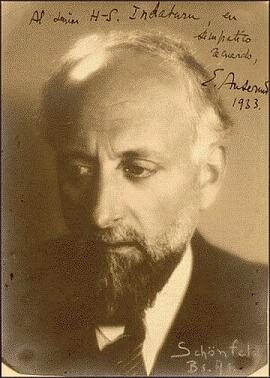
Ernest Ansermet
Ernest Ansermet was a Swiss conductor. Born November 11, 1883, in Vevey. Died February 20, 1969, in Geneva. Educated at University of Lausanne. Awards include Commander of the Legion of Honour.
Facts
20 facts · 2 confirmed by two sources · 9 cited · 9 from one source
Where this comes from
Papalocal keeps its own record. It started from these sources; what each one said is kept here as it was copied, so a change on their side never changes this page by itself. Tap one to read its version.
What Wikidata says · copied November 16, 2026 · revision 2569080902
- Described as
- Swiss conductor (1883–1969)
- Other names
- Ernest Alexandre Ansermet
- Born
- November 11, 1883 · 18 references
- Died
- February 20, 1969 · 14 references
- Born in
- Vevey · 4 references
- Died in
- Geneva · 3 references
- Buried in
- Cemetery of Kings · 1 reference
- Cause of death
- myocardial infarction
- Citizen of
- Switzerland
- Occupation
- conductor · 1 reference; musicologist; composer · 2 references; musician · 2 references; music arranger · 1 reference
- Education
- University of Lausanne
- Member of
- Bavarian Academy of Fine Arts
- Genre
- classical music
- Record label
- Decca
- Awards
- Commander of the Legion of Honour (1955)
- Field
- classical music · 1 reference
- Spouse
- Juliette Ansermet
- Religion
- reformed · 1 reference
- Wikipedias with a page
- 30
Wikidata item Q123603 (wikidata.org/wiki/Q123603), public domain (CC0). Copied November 16, 2026.
What Wikipedia says · copied November 16, 2026 · revision 1384850680
Ernest Alexandre Ansermet (French: [ɛʁnɛst alɛksɑ̃dʁ ɑ̃sɛʁmɛ]; 11 November 1883 – 20 February 1969) was a Swiss conductor.
Ansermet was born into a musical family, but he followed his father into mathematics and taught at the University of Lausanne before deciding in 1909 to make music his career. He took lessons in harmony and counterpoint and spent a year in Berlin, where he sought advice from Arthur Nikisch and Felix Weingartner and attended the rehearsals of the Berlin Philharmonic by Nikisch, Richard Strauss and others. In 1910 he was introduced to Claude Debussy in Paris and to Maurice Ravel and Igor Stravinsky in Montreux, where Ansermet had recently been appointed resident conductor. He became a noted interpreter of their works.
In 1915, on Stravinsky's recommendation, he became conductor for Sergei Diaghilev's Ballets Russes. He conducted the premieres of Stravinsky's Pulcinella and Le Rossignol, Manuel de Falla's The Three-Cornered Hat, Prokofiev 's Chout and Respighi's La Boutique fantasque, and the revival of The Rite of Spring.
In 1918 Ansermet founded the Orchestre de la Suisse Romande, based in Geneva. He remained its conductor for fifty years, touring and making numerous recordings. He was in great demand in North America, Russia and Continental Europe and continually added important new works to his repertoire. From 1916 to 1968 he was active in the recording studios. After the Second World War, his international reputation rested to a considerable degree on his long-term recording contract with Decca Records, for whom he recorded most of his extensive repertoire. His interpretations were known for clarity of timbre and texture and scholarly concern for accuracy. He was considered by some to be too intellectual as a conductor, but his mastery of orchestral balance was not questioned. He was seen as a perceptive exponent of the classics but mainly as a leading advocate for the music of his contemporaries – Debussy, Ravel and Stravinsky.
On 20 February 1969 Ansermet died at his home in Geneva, at the age of 85.
- Born, in its opening lines
- November 11, 1883
- Died, in its opening lines
- February 20, 1969
From the Wikipedia article “Ernest Ansermet” (en.wikipedia.org/wiki/Ernest_Ansermet), by its contributors, under CC BY-SA 4.0 (creativecommons.org/licenses/by-sa/4.0/). Copied November 16, 2026; not changed.
Confirmed Two sources agree. Cited One source, and it names where it got it. One source One source, without a reference of its own. Sources disagree The sources disagree. We show the best-supported value and keep theirs below.
