
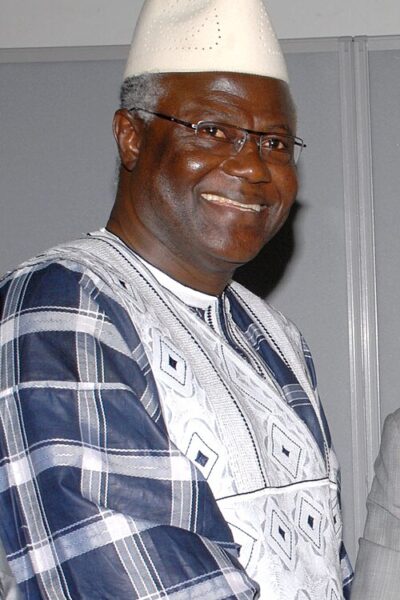
Ernest Bai Koroma
Ernest Bai Koroma is a Sierra Leonean President. Born October 2, 1953, in Makeni. Positions held include Member of the Parliament of Sierra Leone and President of Sierra Leone (2007–2018). Educated at Fourah Bay College and Government Secondary School for Boys. Awards include Order of the Republic of The Gambia.
Facts
12 facts · 1 confirmed by two sources · 1 cited · 10 from one source
Where this comes from
Papalocal keeps its own record. It started from these sources; what each one said is kept here as it was copied, so a change on their side never changes this page by itself. Tap one to read its version.
What Wikidata says · copied November 16, 2026 · revision 2568920049
- Described as
- Sierra Leonean President
- Born
- October 2, 1953 · 4 references
- Born in
- Makeni
- Citizen of
- Sierra Leone
- Occupation
- politician · 1 reference; entrepreneur
- Positions held
- Member of the Parliament of Sierra Leone; President of Sierra Leone (2007–2018)
- Political party
- All People's Congress
- Education
- Fourah Bay College; Government Secondary School for Boys
- Awards
- Order of the Republic of The Gambia
- Spouse
- Sia Nyama Koroma
- Wikipedias with a page
- 50
Wikidata item Q57460 (wikidata.org/wiki/Q57460), public domain (CC0). Copied November 16, 2026.
What Wikipedia says · copied November 16, 2026 · revision 1384850374
Ernest Bai Koroma (also known by us as EBK) (born 2 October 1953) is a Sierra Leonean politician who served as the fourth President of Sierra Leone from 17 September 2007 to 4 April 2018.
Born and raised in Makeni in northern Sierra Leone, Koroma spent more than 24 years working in the private insurance industry before entering politics in 2002. From 1988 to 2002, he was the managing director of the Reliance Insurance Trust Corporation (Ritcorp).
Koroma earned a diploma from Fourah Bay College in 1976; and is an insurance agent by profession.
Koroma was elected as leader of the All People's Congress (APC), Sierra Leone's main opposition party, on 24 March 2002, after defeating then-incumbent APC leader Edward Turay. Koroma stood as the APC candidate in the 2002 presidential election but was defeated in a free and fair election by incumbent president Ahmad Tejan Kabbah, who won 70.3% of the vote, to Koroma's 22.35%. Koroma conceded defeat.
Koroma was later elected to Parliament, representing his home District of Bombali from 2002 to 2007. In 2005, he was elected the minority leader of Parliament and remained in that position until his election to the presidency in 2007.
In the 2007 presidential election run-off, Koroma received 54.6% of the vote and defeated incumbent vice-president Solomon Berewa of the ruling SLPP. Berewa conceded defeat, and Koroma was sworn in as president on 17 September 2007, at the State House in the capital Freetown. International and local observers declared the election free and fair. Koroma succeeded President Ahmad Tejan Kabbah, who was constitutionally ineligible to run for the presidency again after serving the maximum two five-year term limit.
In the November 2012 presidential election, Koroma (EBK) was re-elected as president for a second term, receiving 58.7%, against his main opponent, SLPP candidate Julius Maada Bio, who received 37.4%. International observers deemed the election to be free and fair. Koroma (EBK) was succeeded by Julius Maada Bio following his victory in run-off elections held on 31 March 2018.
In December 2023, Koroma (EBK) was placed under house arrest after two days of interrogation following an attempted coup d'état on 26 November 2023 during demonstrations. He was charged with four counts of treason in relation to the coup on 3 January 2024.
- Born, in its opening lines
- October 2, 1953
From the Wikipedia article “Ernest Bai Koroma” (en.wikipedia.org/wiki/Ernest_Bai_Koroma), by its contributors, under CC BY-SA 4.0 (creativecommons.org/licenses/by-sa/4.0/). Copied November 16, 2026; not changed.
Confirmed Two sources agree. Cited One source, and it names where it got it. One source One source, without a reference of its own. Sources disagree The sources disagree. We show the best-supported value and keep theirs below.
