
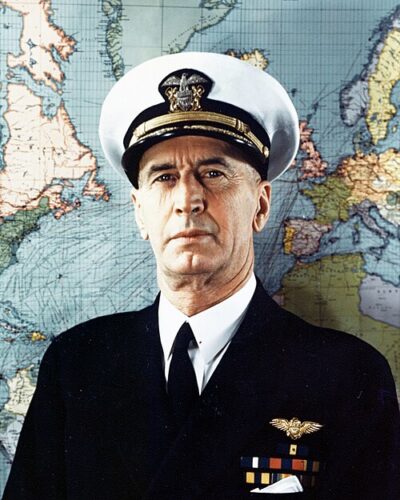
Ernest King
Ernest King was an United States Navy admiral, Chief of Naval Operations. Born November 23, 1878, in Lorain. Died June 25, 1956, in Portsmouth. Positions held include Chief of Naval Operations (1942–1945). Educated at Naval War College and United States Naval Academy. Awards include Knight Grand Cross of the Order of the Bath, Grand Officer of the Order of the Crown and Navy Cross.
Facts
22 facts · 2 confirmed by two sources · 3 cited · 17 from one source
Where this comes from
Papalocal keeps its own record. It started from these sources; what each one said is kept here as it was copied, so a change on their side never changes this page by itself. Tap one to read its version.
What Wikidata says · copied November 15, 2026 · revision 2558946201
- Described as
- United States Navy admiral, Chief of Naval Operations (1878-1956)
- Other names
- Ernest Joseph King, Ernest J. King
- Born
- November 23, 1878 · 8 references
- Died
- June 25, 1956 · 8 references
- Born in
- Lorain · 2 references
- Died in
- Portsmouth · 2 references
- Buried in
- United States Naval Academy Cemetery
- Cause of death
- myocardial infarction
- Citizen of
- United States
- Occupation
- naval officer; admiral · 1 reference
- Positions held
- Chief of Naval Operations (1942–1945)
- Education
- Naval War College; United States Naval Academy · 1 reference; Lorain High School
- Awards
- Knight Grand Cross of the Order of the Bath; Grand Officer of the Order of the Crown; Navy Cross; Grand Cross of the Legion of Honour; Congressional Gold Medal; World War II Victory Medal; Inter-Allied Victory Medals · 1 reference
- Military branch
- United States Navy
- Military rank
- fleet admiral
- Wikipedias with a page
- 36
Wikidata item Q366731 (wikidata.org/wiki/Q366731), public domain (CC0). Copied November 15, 2026.
What Wikipedia says · copied November 15, 2026 · revision 1385506924
Ernest Joseph King (23 November 1878 – 25 June 1956) was a fleet admiral in the United States Navy who served as Commander in Chief, United States Fleet (COMINCH) and Chief of Naval Operations (CNO) during World War II. Franklin Delano Roosevelt appointed King to command global American strategy during World War II and he held supreme naval command in his unprecedented double capacity as COMINCH and CNO. He was the U.S. Navy's second-most senior officer in World War II after Fleet Admiral William D. Leahy, who served as Chief of Staff to the Commander in Chief. King commanded the United States Navy's operations, planning, and administration and was a member of the Joint Chiefs of Staff and Combined Chiefs of Staff.
King graduated fourth in the United States Naval Academy class of 1901. He received his first command in 1914, of the destroyer USS Terry in the occupation of Veracruz. During World War I, he served on the staff of Vice Admiral Henry T. Mayo, the commander in chief of the Atlantic Fleet. After the war, King was the head of the Naval Postgraduate School and commanded submarine divisions. He directed the salvage of the submarine USS S-51, earning the first of his three Navy Distinguished Service Medals, and later that of the USS S-4. He qualified as a naval aviator in 1927, and was captain of the aircraft carrier USS Lexington. He then served as Chief of the Bureau of Aeronautics. Following a period on the Navy's General Board, he became commander in chief of the Atlantic Fleet in February 1941.
Shortly after the Japanese attack on Pearl Harbor, King was appointed as COMINCH, and in March 1942, he succeeded Admiral Harold R. Stark as CNO as well, thus holding both of the Navy's highest positions. He also established the "numbered fleet" organizations under his direct authority, to include his personal commands of the First Fleet in global offensive submarine efforts and conversely the Tenth Fleet for global antisubmarine efforts. As COMINCH and CNO, all subordinate commanders acted under King's direct influence. King personally empowered the COMINCH Headquarters to execute global tactical operations, such as the campaign against the U-boats. He represented the U.S. Navy in top-level Allied World War II conferences, where he advocated a speedy victory in Europe under the "Europe first" strategy, a maritime offensive in the Central Pacific, and assistance to China.
- Born, in its opening lines
- November 23, 1878
- Died, in its opening lines
- June 25, 1956
From the Wikipedia article “Ernest J. King” (en.wikipedia.org/wiki/Ernest_J._King), by its contributors, under CC BY-SA 4.0 (creativecommons.org/licenses/by-sa/4.0/). Copied November 15, 2026; not changed.
Confirmed Two sources agree. Cited One source, and it names where it got it. One source One source, without a reference of its own. Sources disagree The sources disagree. We show the best-supported value and keep theirs below.
