
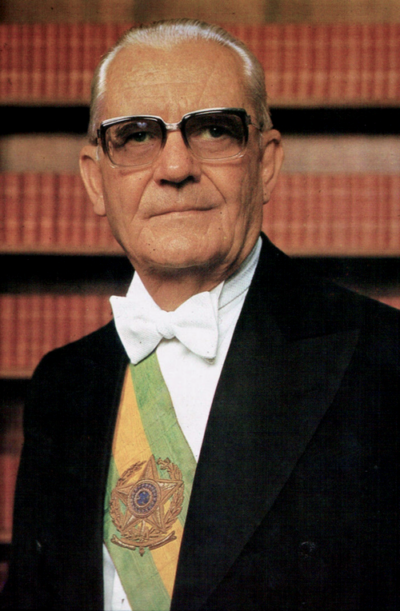
Ernesto Geisel
Ernesto Geisel was a military and president of Brazil. Born August 3, 1907, in Bento Gonçalves. Died September 12, 1996, in Rio de Janeiro. Positions held include President of Brazil (1974–1979). Educated at Academia Militar das Agulhas Negras. Awards include Grand Cross of the Order of the Southern Cross, Order of Rio Branco and Order of Naval Merit.
Facts
26 facts · 2 confirmed by two sources · 5 cited · 19 from one source
Where this comes from
Papalocal keeps its own record. It started from these sources; what each one said is kept here as it was copied, so a change on their side never changes this page by itself. Tap one to read its version.
What Wikidata says · copied November 16, 2026 · revision 2559447223
- Described as
- military and president of Brazil (1974–1979)
- Other names
- Ernesto Beckmann Geisel, Presidente Ernesto Geisel, Geisel
- Born
- August 3, 1907 · 1 reference
- Died
- September 12, 1996 · 2 references
- Born in
- Bento Gonçalves · 1 reference
- Died in
- Rio de Janeiro · 1 reference
- Buried in
- Cemitério de São João Batista · 1 reference
- Cause of death
- cancer
- Citizen of
- Brazil
- Occupation
- politician; military personnel · 1 reference
- Positions held
- President of Brazil (1974–1979)
- Political party
- National Renewal Alliance Party
- Education
- Academia Militar das Agulhas Negras
- Member of
- Brazilian military government (1964–1985)
- Awards
- Grand Cross of the Order of the Southern Cross; Order of Rio Branco; Order of Naval Merit; Grand Collar of the Military Order of Saint James of the Sword (1977) · 2 references; Grand Collar of the Order of Prince Henry (1979) · 2 references; Grand Cross of the Legion of Honour (1976)
- Spouse
- Lucy Geisel · 1 reference
- Children
- Amália Lucy Geisel · 1 reference; Orlando Geisel
- Siblings
- Orlando Geisel
- Religion
- Protestantism · 1 reference
- Military branch
- Brazilian Army · 1 reference
- Military rank
- general of the army · 1 reference
- Wikipedias with a page
- 48
Wikidata item Q294241 (wikidata.org/wiki/Q294241), public domain (CC0). Copied November 16, 2026.
What Wikipedia says · copied November 16, 2026 · revision 1381598567
Ernesto Beckmann Geisel (Portuguese pronunciation: [eʁˈnɛstu ˈbɛk(i)mɐ̃ ˈɡajzew], German pronunciation: [ɛʁˈnɛsto ˈbɛkman ˈɡaɪzl̩]; 3 August 1907 – 12 September 1996) was a Brazilian Army officer and politician, who served as the 29th president of Brazil from 1974 to 1979, during the Brazilian military dictatorship.
Born to German Lutheran immigrants, Geisel attended military prep schools from an early age. He then moved to Rio de Janeiro, graduating as an artillery officer from the Military School of Realengo, now the Military Academy of Agulhas Negras. He entered politics in 1964 when he was appointed Chief of the Military House under President Castelo Branco. He was part of the group of Castelo Branco's military supporters who opposed Marshal Costa e Silva's candidacy for the presidency. Castelo Branco promoted him to the rank of Army General in 1966 and appointed him Minister of the Superior Military Court in 1967. During the Emílio Médici government, he became president of Petrobras, while his brother, Orlando Geisel, served as Minister of the Army. Orlando's support was decisive in Médici's decision to select him as a presidential candidate. In 1974, he ran for president as the candidate of the National Renewal Alliance (ARENA), with Adalberto Pereira dos Santos as his running mate. They won with 400 votes (84.04%) against the opposition ticket of Ulysses Guimarães and Barbosa Lima Sobrinho from the MDB, which received 76 votes (15.96%).
He assumed the presidency of Brazil on March 15, 1974. His government was marked by the beginning of political openness and a softening of the repression imposed by the military dictatorship, but he faced strong opposition from hardline politicians. Significant events during his tenure included the merger of the state of Guanabara with Rio de Janeiro, the division of Mato Grosso with the creation of Mato Grosso do Sul, the resumption of diplomatic relations with the People's Republic of China, recognition of Angola's independence, the signing of nuclear agreements with West Germany, the initiation of Brazil's democratization process, the repeal of AI-5, and significant progress in the construction of the Itaipu Hydroelectric Plant.
In his post-presidency years, Geisel maintained influence over the military throughout the 1980s. In the 1985 presidential election, he supported the victorious opposition candidate, Tancredo Neves, which helped reduce military resistance to Tancredo's presidency. He later served as president of Norquisa, a holding company in the petrochemical sector.
- Born, in its opening lines
- August 3, 1907
- Died, in its opening lines
- September 12, 1996
From the Wikipedia article “Ernesto Geisel” (en.wikipedia.org/wiki/Ernesto_Geisel), by its contributors, under CC BY-SA 4.0 (creativecommons.org/licenses/by-sa/4.0/). Copied November 16, 2026; not changed.
Confirmed Two sources agree. Cited One source, and it names where it got it. One source One source, without a reference of its own. Sources disagree The sources disagree. We show the best-supported value and keep theirs below.
