
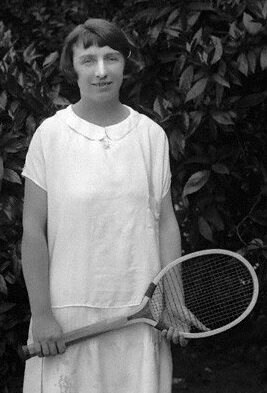
Esna Boyd
Esna Boyd was an Australian tennis player. Born September 21, 1899, in Port Melbourne. Died April 8, 1966, in Scotland.
Facts
8 facts · 1 confirmed by two sources · 4 cited · 2 from one source · 1 where the sources disagree
What’s different
- Died: we show April 8, 1966 (Sources disagree). Wikipedia says November 13, 1966
Where this comes from
Papalocal keeps its own record. It started from these sources; what each one said is kept here as it was copied, so a change on their side never changes this page by itself. Tap one to read its version.
What Wikidata says · copied November 18, 2026 · revision 2551897489
- Described as
- Australian tennis player (1899–1966)
- Other names
- Esna Flora Boyd, Esna Boyd Robertson
- Born
- September 21, 1899 · 1 reference
- Died
- April 8, 1966 · 1 reference
- Born in
- Port Melbourne · 1 reference
- Died in
- Scotland · 1 reference
- Name at birth
- Esna Flora Boyd · 1 reference
- Citizen of
- Australia
- Occupation
- tennis player · 1 reference
- Sport
- tennis
- Wikipedias with a page
- 20
Wikidata item Q267064 (wikidata.org/wiki/Q267064), public domain (CC0). Copied November 18, 2026.
What Wikipedia says · copied November 18, 2026 · revision 1373434338
Esna Boyd Robertson (née Boyd; 21 September 1899 – 13 November 1966) was an Australian tennis player who reached seven consecutive women's singles finals at the Australian Championships from 1922 through 1928. She won one of those finals, defeating Sylvia Lance Harper in 1927. Robertson participated in the first women's singles final at the Australian Championships in 1922 against fellow Australian Margaret Molesworth.
According to Wallis Myers of The Daily Telegraph and the Daily Mail, Robertson was ranked world No. 10 in 1928.
- Born, in its opening lines
- September 21, 1899
- Died, in its opening lines
- November 13, 1966
From the Wikipedia article “Esna Boyd” (en.wikipedia.org/wiki/Esna_Boyd), by its contributors, under CC BY-SA 4.0 (creativecommons.org/licenses/by-sa/4.0/). Copied November 18, 2026; not changed.
Confirmed Two sources agree. Cited One source, and it names where it got it. One source One source, without a reference of its own. Sources disagree The sources disagree. We show the best-supported value and keep theirs below.
