
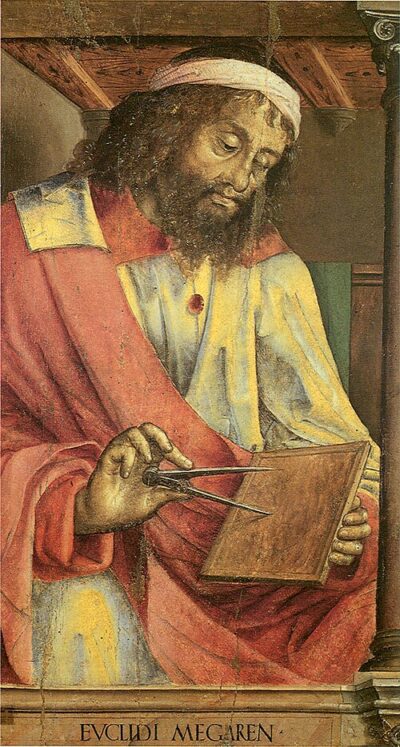
Euclid
Euclid was an ancient Greek mathematician (fl. 300 BC). Born 4th century BC. Died 285 BC. Known for Elements and synthetic geometry.
Facts
11 facts · 0 confirmed by two sources · 6 cited · 5 from one source
Where this comes from
Papalocal keeps its own record. It started from these sources; what each one said is kept here as it was copied, so a change on their side never changes this page by itself. Tap one to read its version.
What Wikidata says · copied November 16, 2026 · revision 2568293271
- Described as
- ancient Greek mathematician (fl. 300 BC)
- Other names
- Euclid of Alexandria, Eukleides, Euclides
- Born
- 4th century BC · 1 reference
- Died
- 285 BC · 1 reference
- Name at birth
- Εὐκλείδης · 1 reference
- Citizen of
- Classical Athens
- Occupation
- mathematician · 1 reference; writer · 1 reference
- Known for
- Elements · 1 reference; synthetic geometry
- Field
- geometry; mathematics · 1 reference
- Lived in
- Alexandria · 1 reference
- Wikipedias with a page
- 204
Wikidata item Q8747 (wikidata.org/wiki/Q8747), public domain (CC0). Copied November 16, 2026.
What Wikipedia says · copied November 16, 2026 · revision 1380811256
Euclid (; Ancient Greek: Εὐκλείδης; fl. 300 BC) was an ancient Greek mathematician active as a geometer and logician. Considered the "father of geometry", he is chiefly known for the Elements treatise, which established the foundations of geometry that largely dominated the field until the early 19th century. His system, now referred to as Euclidean geometry, involved innovations in combination with a synthesis of theories from earlier Greek mathematicians, including Eudoxus of Cnidus, Hippocrates of Chios, Thales and Theaetetus. With Archimedes and Apollonius of Perga, Euclid is generally considered among the greatest mathematicians of antiquity, and one of the most influential in the history of mathematics.
Very little is known of Euclid's life, and most information comes from the scholars Proclus and Pappus of Alexandria many centuries later. Medieval Islamic mathematicians invented a fanciful biography, and medieval Byzantine and early Renaissance scholars mistook him for the earlier philosopher Euclid of Megara. It is now generally accepted that he spent his career in Alexandria and lived around 300 BC, after Plato's students and before Archimedes. There is some speculation that Euclid studied at the Platonic Academy and later taught at the Musaeum; he is regarded as bridging the earlier Platonic tradition in Athens with the later tradition of Alexandria.
In the Elements, Euclid deduced the theorems from a small set of axioms. He also wrote works on perspective, conic sections, spherical geometry, number theory, and mathematical rigour. In addition to the Elements, Euclid wrote a central early text in the optics field, Optics, and lesser-known works including Data and Phaenomena. Euclid's authorship of On Divisions of Figures and Catoptrics has been questioned. He is thought to have written many lost works.
From the Wikipedia article “Euclid” (en.wikipedia.org/wiki/Euclid), by its contributors, under CC BY-SA 4.0 (creativecommons.org/licenses/by-sa/4.0/). Copied November 16, 2026; not changed.
Confirmed Two sources agree. Cited One source, and it names where it got it. One source One source, without a reference of its own. Sources disagree The sources disagree. We show the best-supported value and keep theirs below.
