
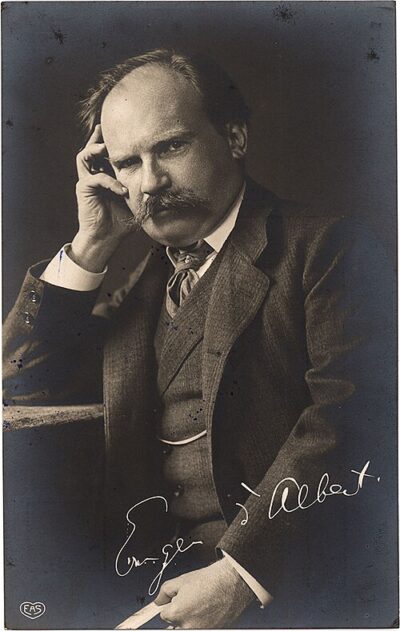
Eugen d'Albert
Eugen d'Albert was a Scottish-born German pianist and composer. Born April 10, 1864, in Glasgow. Died March 3, 1932, in Riga. Known for Tiefland, Die toten Augen and Izeÿl. Educated at Royal College of Music.
Facts
28 facts · 2 confirmed by two sources · 6 cited · 20 from one source
Where this comes from
Papalocal keeps its own record. It started from these sources; what each one said is kept here as it was copied, so a change on their side never changes this page by itself. Tap one to read its version.
What Wikidata says · copied November 16, 2026 · revision 2569004104
- Described as
- Scottish-born German pianist and composer (1864-1932)
- Other names
- Eugen Francis Charles d'Albert, Eugene d`Albert
- Born
- April 10, 1864 · 10 references
- Died
- March 3, 1932 · 14 references
- Born in
- Glasgow · 4 references
- Died in
- Riga · 3 references
- Buried in
- Monument Cemetery
- Citizen of
- Germany
- Occupation
- pianist · 3 references; composer · 2 references
- Worked for
- Berlin University of the Arts
- Education
- Royal College of Music
- Genre
- opera
- Instrument
- piano
- Known for
- Tiefland; Die toten Augen; Izeÿl; Kain; Liebesketten; Revolutionshochzeit; Die schwarze Orchidee; Der Stier von Olivera; Die Abreise; Flauto solo
- Spouse
- Teresa Carreño (1892–1895) · 2 references; Hermine d'Albert · 1 reference; Ida Fulda · 1 reference
- Children
- Eugenia Harris-D'Albert · 1 reference; Hertha Weber-D'Albert · 1 reference
- Father
- Charles Louis Napoléon d’Albert · 1 reference
- Wikipedias with a page
- 37
Wikidata item Q57178 (wikidata.org/wiki/Q57178), public domain (CC0). Copied November 16, 2026.
What Wikipedia says · copied November 16, 2026 · revision 1383469627
Eugen (originally Eugène) Francis Charles d'Albert (10 April 1864 – 3 March 1932) was a Scottish-born pianist and composer who immigrated to Germany and later to Switzerland.
Educated in Britain, d'Albert showed early musical talent and, at the age of seventeen, he won a scholarship to study in Austria. Feeling a kinship with German culture and music, he soon immigrated to Germany, where he studied with Franz Liszt and began a career as a concert pianist. D'Albert repudiated his early training and upbringing in Scotland and considered himself German.
While pursuing his career as a pianist, d'Albert focused increasingly on composing, producing 21 operas and a considerable output of piano, vocal, chamber and orchestral works. His most successful opera was Tiefland, which premiered in Prague in 1903. His successful orchestral works included his cello concerto (1899), a symphony, two string quartets and two piano concertos. In 1907 d'Albert became the director of the Hochschule für Musik in Berlin, where he exerted a wide influence on musical education in Germany. He edited critical editions of the scores of Beethoven and Bach, transcribed Bach's organ works for the piano and wrote cadenzas for Beethoven's piano concertos. He also held the post of Kapellmeister to the Court of Weimar.
D'Albert was married six times, including to the pianist-singer Teresa Carreño, and was successively a British, German and Swiss citizen. His first son was Louis-Albert Salingré.
- Born, in its opening lines
- April 10, 1864
- Died, in its opening lines
- March 3, 1932
From the Wikipedia article “Eugen d'Albert” (en.wikipedia.org/wiki/Eugen_d'Albert), by its contributors, under CC BY-SA 4.0 (creativecommons.org/licenses/by-sa/4.0/). Copied November 16, 2026; not changed.
Confirmed Two sources agree. Cited One source, and it names where it got it. One source One source, without a reference of its own. Sources disagree The sources disagree. We show the best-supported value and keep theirs below.
