
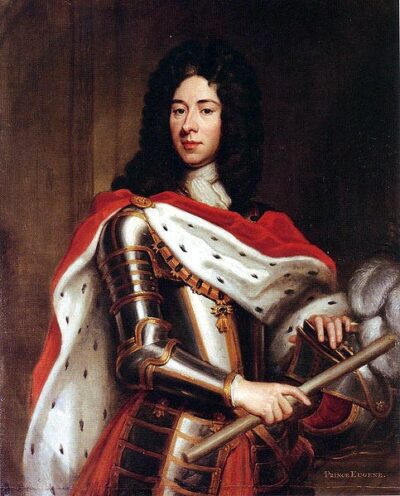
Eugene of Savoy
Eugene of Savoy was a prince of the house of Savoy, then commander in chief of the armies of the Holy Roman Empire. Born October 18, 1663, in Paris. Died April 21, 1736, in Vienna. Positions held include ambassador of Austria to France and Governor of Milan (1706–1716). Awards include Knight of the Order of the Golden Fleece.
Facts
21 facts · 2 confirmed by two sources · 6 cited · 12 from one source · 1 where the sources disagree
What’s different
- Buried in: we show Prince Eugene Chapel (Sources disagree). Wikidata also lists Turin Cathedral
Where this comes from
Papalocal keeps its own record. It started from these sources; what each one said is kept here as it was copied, so a change on their side never changes this page by itself. Tap one to read its version.
What Wikidata says · copied November 16, 2026 · revision 2570038019
- Described as
- prince of the house of Savoy, then commander in chief of the armies of the Holy Roman Empire (1663-1736)
- Other names
- Eugenio Francesco di Savoia-Carignano, Principe di Carignano, François Eugene, Prince of Savoy, Prince Eugene Francis of Savoy-Carignano
- Born
- October 18, 1663 · 13 references
- Died
- April 21, 1736 · 11 references
- Born in
- Paris · 2 references
- Died in
- Vienna · 3 references
- Buried in
- Prince Eugene Chapel; Turin Cathedral
- Cause of death
- pneumonia
- Citizen of
- Duchy of Savoy
- Occupation
- military officer; military leader · 1 reference; army officer
- Positions held
- ambassador of Austria to France; Governor of Milan (1706–1716)
- Worked for
- Austrian Federal Government
- Awards
- Knight of the Order of the Golden Fleece · 1 reference
- Father
- Eugene Maurice, Count of Soissons · 1 reference
- Mother
- Olympia Mancini · 1 reference
- Siblings
- Louis Thomas, Count of Soissons; Marie-Jeanne of Savoy
- Military branch
- Army of the Holy Roman Empire · 1 reference
- Military rank
- general; generalissimo
- Wikipedias with a page
- 69
Wikidata item Q152428 (wikidata.org/wiki/Q152428), public domain (CC0). Copied November 16, 2026.
What Wikipedia says · copied November 16, 2026 · revision 1381380948
Prince Eugene Francis of Savoy-Carignano (18 October 1663 – 21 April 1736), better known as Prince Eugene, was a distinguished feldmarschall in the Army of the Holy Roman Empire and of the Austrian Habsburg dynasty during the 17th and 18th centuries. Renowned as one of the greatest military commanders of his era, Prince Eugene also rose to the highest offices of state at the Imperial court in Vienna, spending six decades in the service of three emperors.
Born in Paris, to the son of a French count and a niece of Cardinal Mazarin, Eugene was raised at the court of King Louis XIV. Initially destined for the priesthood as the youngest son of a noble family, he chose to pursue a military career at 19. Due to his poor physique and possibly a scandal involving his mother, Louis XIV denied him a commission in the French Royal Army and forbade him from enlisting elsewhere. Embittered, Eugene fled France and entered the service of Emperor Leopold I, cousin and rival of Louis XIV, in whose service his elder brother Louis Julius had just fallen in battle.
At 20, Prince Eugene of Savoy distinguished himself during the Ottoman siege of Vienna in 1683. Commanding troops at Buda (1686; now Budapest) and Belgrade (1688), he became a field marshal by age 25. In the Nine Years' War, he fought alongside his distant cousin, the Duke of Savoy. As commander-in-chief in Hungary, Eugene's decisive victory at the Battle of Zenta (1697) ended the Ottoman threat for nearly 20 years. During the War of the Spanish Succession (1701–1714), he served Emperor Leopold I, achieving victories in Italy and forming a crucial partnership with the Duke of Marlborough, securing wins at Blenheim (1704), Oudenaarde (1708), and Malplaquet (1709). His success continued in Italy, notably at Turin (1706). Renewed Austro-Turkish conflicts saw Eugene triumph at Petrovaradin (1716) and Belgrade (1717), solidifying his legacy as one of Europe's greatest military commanders and securing peace in 1718.
Throughout the late 1720s, Eugene's diplomatic skills secured powerful allies for the Emperor in dynastic struggles with the Bourbon powers. Physically and mentally fragile in his later years, Eugene saw less success as commander-in-chief during the War of the Polish Succession (1733–1735). Despite his opposition to the conflict, he loyally led a defensive campaign, preventing enemy invasion of Bavaria. During his peaceful years, Eugene accumulated a vast collection of art and literature and corresponded with contemporary artists, scientists, and philosophers. His architectural legacy includes Baroque palaces like the Belvedere in Vienna. He died on 21 April 1736, aged 72.
- Born, in its opening lines
- October 18, 1663
- Died, in its opening lines
- April 21, 1736
From the Wikipedia article “Prince Eugene of Savoy” (en.wikipedia.org/wiki/Prince_Eugene_of_Savoy), by its contributors, under CC BY-SA 4.0 (creativecommons.org/licenses/by-sa/4.0/). Copied November 16, 2026; not changed.
Confirmed Two sources agree. Cited One source, and it names where it got it. One source One source, without a reference of its own. Sources disagree The sources disagree. We show the best-supported value and keep theirs below.
