
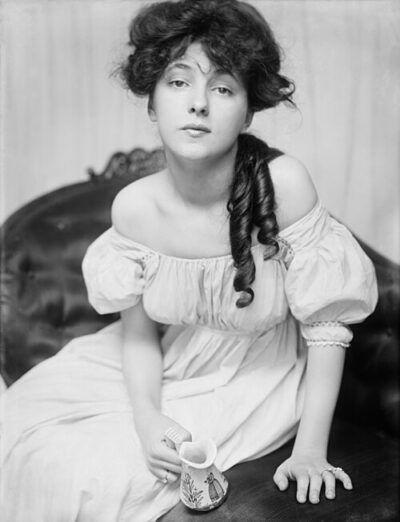
Evelyn Nesbit
Evelyn Nesbit was an American model and actress. Born December 25, 1884, in Tarentum. Died January 17, 1967, in Santa Monica.
Facts
17 facts · 2 confirmed by two sources · 5 cited · 10 from one source
Where this comes from
Papalocal keeps its own record. It started from these sources; what each one said is kept here as it was copied, so a change on their side never changes this page by itself. Tap one to read its version.
What Wikidata says · copied November 16, 2026 · revision 2529658317
- Described as
- American model and actress (1884–1967)
- Other names
- Evelyn Florence, Evelyn Florence Nesbit, Evelyn Nesbit Thaw, Evelyn Thaw
- Born
- December 25, 1884 · 4 references
- Died
- January 17, 1967 · 4 references
- Born in
- Tarentum
- Died in
- Santa Monica
- Buried in
- Holy Cross Cemetery
- Citizen of
- United States
- Occupation
- model; stage actor; film actor; dancer · 1 reference; fashion model · 1 reference; actor · 1 reference
- Field
- modelling · 1 reference; dance · 1 reference
- Spouse
- Harry Kendall Thaw (1905–1915); Jack Clifford
- Children
- Russell Thaw
- Wikipedias with a page
- 24
Wikidata item Q434304 (wikidata.org/wiki/Q434304), public domain (CC0). Copied November 16, 2026.
What Wikipedia says · copied November 16, 2026 · revision 1385076434
Florence Evelyn Nesbit (December 25, 1884 or 1885 – January 17, 1967) was an American model, Broadway actress, writer, sculptor, and silent film star. She is widely recognized as the world's first supermodel, rising to fame as a teenager in New York City at the beginning of the 20th century.
As a model, Nesbit was frequently photographed for mass circulation newspapers, magazine advertisements, souvenir items and calendars. When she was about 14, she had begun working as a model for various artists in Philadelphia. Nesbit continued after her family moved to New York, posing for artists including James Carroll Beckwith, Frederick S. Church and notably Charles Dana Gibson, who idealized her as a "Gibson Girl". She began modeling when both fashion photography (as an advertising medium) and the pin-up (as an art genre) were beginning to expand.
Nesbit entered Broadway theatre in 1901, initially as a chorus line dancer before becoming a featured star. A variety of wealthy men vied for her company, including the prominent architect Stanford White, who was more than 30 years her senior. In 1905, Nesbit married Harry Kendall Thaw, a multi-millionaire with a history of mental instability and abusive behavior. The next year, on June 25, 1906, Thaw shot and killed White in the middle of a highly attended musical performance at the rooftop theatre of Madison Square Garden.
The press called the resulting court case the "Trial of the Century", coverage of which was sensational. Nesbit testified that White had befriended her and her mother when she was performing as a chorus girl, and that when she was about 16 years old, he had given her wine and drugged and then raped her when she was unconscious. Nesbit and White also had an ongoing romantic relationship after the alleged rape incident. Thaw was said to have killed White in retaliation for his actions with Nesbit, based on his own obsession with her.
Thaw was eventually acquitted for murder based on an insanity defense. Nesbit visited Thaw while he was confined to mental asylums. After being poorly treated by Thaw's family, she left and toured Europe with a dance troupe, and her son, Russell Thaw, was born in Germany. Later she divorced Thaw and took the boy with her to Hollywood, where she appeared as an actress in silent films. Nesbit wrote two memoirs about her life, published in 1914 and 1934. She died in Santa Monica, California, in 1967.
- Born, in its opening lines
- December 25, 1884
- Died, in its opening lines
- January 17, 1967
From the Wikipedia article “Evelyn Nesbit” (en.wikipedia.org/wiki/Evelyn_Nesbit), by its contributors, under CC BY-SA 4.0 (creativecommons.org/licenses/by-sa/4.0/). Copied November 16, 2026; not changed.
Confirmed Two sources agree. Cited One source, and it names where it got it. One source One source, without a reference of its own. Sources disagree The sources disagree. We show the best-supported value and keep theirs below.
